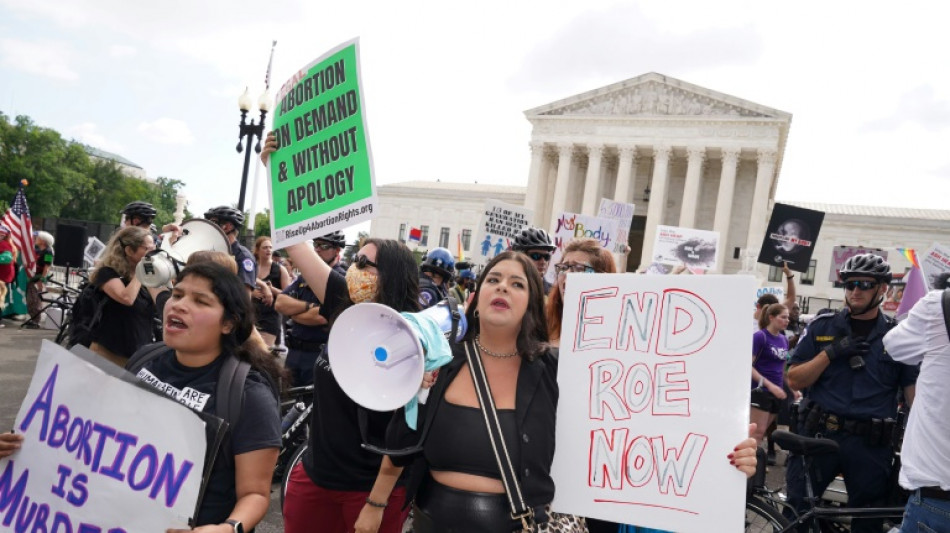
Abortion access threatened in half of US states / Photo: MANDEL NGAN - AFP

 Kroenke to buy baseball's Los Angeles Angels: statement

 US defends Trump's Venezuela oil deal

 OpenAI to launch new model with 'stronger safeguards' after hack

 Fans mourn 'bittersweet' final Ariana Grande gig in London

 Norway's King Haakon VIII swears allegiance to constitution

 Syria site infrastructure 'consistent with nuclear reactor': IAEA

 Juventus sign Woltemade, Sarr on loan from Premier League

 US strikes Iran in latest tit-for-tat attacks

 China's Xi arrives in Egypt as US sanctions threat looms over Iran links

 Car bomb at Colombian police station kills one, injures 11

 Rain delays start of play on US Open

 Man City agree blockbuster deal to sign Chelsea star Fernandez: reports

 Alkemya Metacore Secures $50M via Tokenised Equity to Scale Nickel Energy and Security Tech

 Man City chase Fernandez, Arsenal sell Jesus on deadline day

 EU says Russian 'hybrid attacks' won't halt aid to Ukraine

 Explosives used in sabotage attack on German power lines
 Nepali families hold symbolic funerals for missing after floods

 Newcastle sign Lille forward Fernandez-Pardo

 Even at Elysee, phones are handed in, Macron tells French pupils

 Chelsea agree to sign Atalanta's Ahanor, with Palace loan for this season

 Chelsea sign Atalanta's Ahanor and loan him to Palace

 UK chalks up hottest summer on record for second year running

 China's Xi visits Egypt as US sanctions threat looms over Iran links

 RISE Robotics Awarded $100,000 MassVentures Grant to Accelerate Commercialization of Beltdraulic Technology

 Global bond sell-off deepens on inflation concerns

The US Supreme Court's overturning of America's constitutional right to abortion gives all 50 states the freedom to ban the procedure, with nearly half expected to do so in some form.
- Automatic bans -
Thirteen states, mostly in the conservative and religious south of the country, have in recent years adopted so-called "trigger" laws to come into force virtually automatically after the decision was handed down.
They differ in how they ban abortions. Idaho provides exceptions for rape or incest but Kentucky only does so if the pregnant woman's life is in danger.
Laws in Louisiana could see health professionals jailed for up to ten years for carrying out abortions. In Missouri, it's 15 years.
In some states, such as South Dakota, the ban went into effect the day of the Supreme Court's ruling. South Dakota does allow for exceptions when the mother is at risk.
Missouri's attorney general Eric Schmitt tweeted a photo of himself signing an opinion banning abortion in the Midwestern state less than two hours after the Supreme Court's decision was announced. Arkansas and Oklahoma quickly followed with similar moves.
Other states, such as Mississippi, also require the attorney general to first confirm that the court has changed the legal framework.
Texas and Tennessee have set a period of 30 days between the release of the judgment and a new ban coming into force.
- Restrictions -
Iowa, Georgia, Ohio and South Carolina are among states that have passed laws restricting abortion after six weeks, before many people even know they are pregnant.
While currently blocked by the courts, those laws could take effect now that the Supreme Court has changed the legal landscape.
- Complex patchwork -
Ten states, including Arizona and Michigan, have pre-1973 laws banning abortion on the books that they could theoretically revive, though their path forward is uncertain.
In Wisconsin -- where the Democratic governor supports abortion rights, but the majority Republican lawmakers do not -- Planned Parenthood has said it does not plan to carry out abortions from the end of June, citing a legal risk.
In Michigan, Democratic Attorney General Dana Nessel has added to the confusion by promising not to prosecute people who violate its 1931 law banning abortion.
But local prosecutors will still be able to do so, and the state risks becoming a complex patchwork of laws.
In Arizona, Republican Governor Doug Ducey believes that a law passed this year to ban abortions after 15 weeks of pregnancy will override previous rules.
Senators in his party do not see it that way and Ducey is expected to go to court to get clarity.
- Others to watch -
According to the Guttmacher Institute, four states have signaled that they are unfavorable to abortion but do not currently have laws prohibiting them.
Lawmakers in Nebraska and Indiana have failed to pass abortion bans. Officials in Montana and Florida have reduced deadlines for terminating a pregnancy, but supreme courts in those states have protected the right to abortion.
- Liberal states -
Twenty-two states -- mostly in the northeast and on the West Coast -- will retain the right to abortion and are preparing for an influx of women seeking abortions.
Connecticut and Delaware, for example, have expanded the categories of professionals who are authorized to carry out abortions to include nurses and midwives.
Lawmakers in California have allocated $152 million to assist access to abortion and the governor of New York has pledged $35 million.
A.Williams--AT