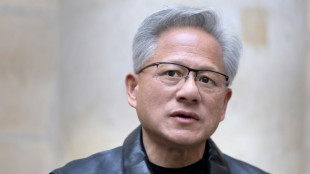
Nvidia unveils plan for Taiwan's first 'AI supercomputer' / Photo: I-Hwa Cheng
- AFP

 Nvidia's web of AI bets: smart strategy or bubble risk?

 Carrick fights for Man Utd job, Arsenal face Liverpool test

 Police close investigation into Hayden Panettiere death after coroner ruling

 Australian mushroom killer loses appeal, has sentence extended

 Lethbridge students learn how city transit and transportation systems work

 India highlights defence ties with Japan and Australia at Cebu meetings

 Horoscope for October 30, 2026: communication and patience shape the day

 Amazon cloud business accelerates but shares drop on profit miss

 Wesley Fofana under scrutiny after Chelsea penalty miss in Carabao Cup

 Russell admits absence of rivalry because he cannot match Antonelli

 DR Congo says Rwanda flouting pact, US sanctions justified

 Brazil's Flavio Bolsonaro isolated, ridiculed after self-exile
 Asian equities diverge after mixed technology earnings and Fed rate decision

 Zverev 'on top of the world' after securing No. 1 ranking

 Clash of styles as Vikings, Lions prepare for NFL showdown

 After a long slog to the top, Zverev leaps to No. 1 ranking

 GCC legislative officials review ways to deepen regional cooperation

 Canada buying stake in AI firm Cohere to bolster tech sovereignty

 Utah files criminal charges against prediction market Kalshi

 Grieving Spain demands answers for latest rail disaster

 Judges to rule on Australian mushroom killer's appeal

 Qatar prime minister tours Cityscape Qatar 2026

 Bugatti CEO to stop leaving keys inside cars after Chiron theft

 Starc, Lyon leave South Africa reeling

 Arsenal lose appeal against Dowman red card in shock Fleetwood defeat

Nvidia boss Jensen Huang announced plans for Taiwan's "first AI supercomputer", as he showcased on Monday the company's latest advances in artificial intelligence.
Global semiconductor chip giants have gathered in Taiwan for the island's top tech expo, Computex, as the sector grapples with the impact of US tariffs and disrupted supply chains.
Huang said Nvidia would work with Taiwanese tech giants Foxconn and TSMC as well as the government to build Taiwan's "first AI supercomputer .. for the AI infrastructure and AI ecosystem".
"Having a world-class AI infrastructure in Taiwan is really important," Huang said in a keynote addresss on the eve of Computex.
The four-day event will draw computer and chip companies from around the world to Taiwan, whose semiconductor industry is critical to the production of everything from iPhones to the servers that run ChatGPT.
Taiwan produces the bulk of the world's most advanced chips, including those needed for the most powerful AI applications and research.
Top executives from Qualcomm, MediaTek and Foxconn will also speak at Computex, where advances in moving AI from data centres into laptops, robots and cars will be in the spotlight.
"From Agentic AI driving smarter personal devices to Physical AI reshaping autonomy, the show maps out the next frontier," specialist research firm Counterpoint said in a note.
Tech expert Paul Yu told AFP the industry was at a "critical juncture" for AI hardware development.
"Over the past two and a half years, significant investment has driven rapid advances in AI technology," said Yu, of Witology Markettrend Research Institute.
"2025 to 2026 will be the crucial period for transitioning AI model training into profitable applications."
- 'Taiwan to continue to thrive' -
While US tariffs were the biggest issue facing the sector, most companies at Computex "will shy away from addressing tariffs directly as the situation is too uncertain," said Eric Smith of specialist platform TechInsights.
Last month, Washington announced a national security probe into imports of semiconductor technology, which could put the industry in the crosshairs of President Donald Trump's trade bazooka and inflict potentially devastating levies.
Since taking office in January, Trump has threatened hefty tariffs against many of America's biggest trade partners with the aim of forcing companies to move production to US soil.
Export-dependent Taiwan has pledged to increase investment in the United States as it seeks to avoid a 32 percent US tariff on its shipments.
But there are concerns the island could lose its dominance of the chip sector -- the so-called "silicon shield" protecting it from an invasion or blockade by China and an incentive for the United States to defend it.
TSMC, the Taiwanese contract chipmaking giant, has unveiled plans to inject an additional $100 billion into the United States, on top of the $65 billion already pledged.
TSMC-supplier GlobalWafers also announced plans last week to increase its US investment by $4 billion as the Taiwanese company opened a wafer facility in the US state Texas.
But Huang was optimistic on Friday when asked about the impact of tariffs on Taiwan, saying the island would "remain at the centre of the technology ecosystem".
"There are so many smart companies here, there are so many innovative and spirited companies," Huang said told reporters.
"I fully expect Taiwan to continue to thrive... before, after, throughout."
E.Hall--AT