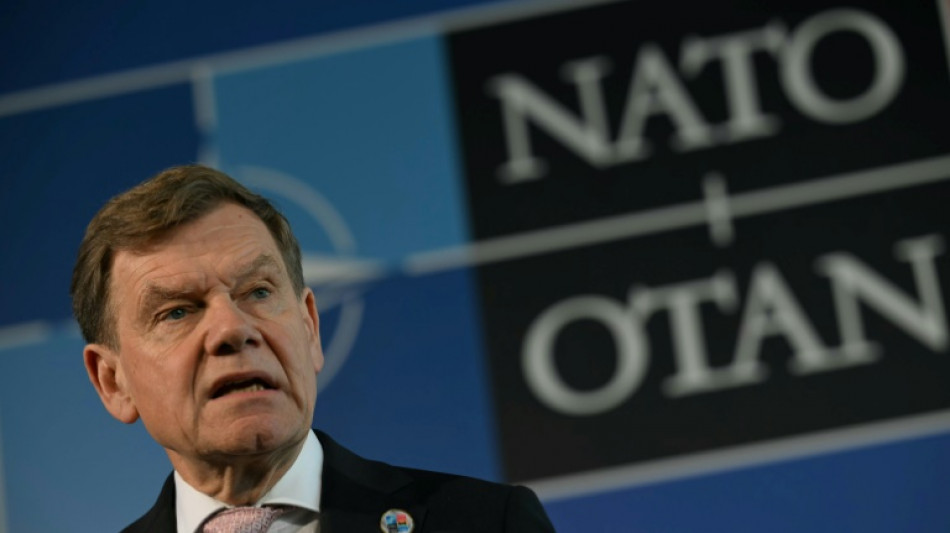
'Paradigm shift': Germany says to meet Trump's NATO spending target / Photo: OZAN KOSE - AFP

 Stocks sink, yields at multi-decade highs and oil spikes on Mideast flare-up
 US defends Trump Venezuela oil deal as energy secretary lands in Caracas
 Jubilant Monfils celebrates birthday with US Open win
 The Japanese idealist behind the last deradicalisation NGO in Somalia
 Rybakina, Gauff advance as Zverev launches US Open campaign
 Macron in Britain to help unveil tapestry, hold Burnham talks
 China's Xi to hold talks with Sisi in rare visit to Egypt
 Confident Gauff reaches US Open 2nd round with straight-set win

 US postal whistleblower warns ballot system could disrupt midterms

 John Ternus takes over as Apple enters era of AI, foldable phones

 Second-ranked Rybakina eases into US Open 2nd round

 Man City sign Fernandez, Ndiaye as Premier League clubs set new spending record

 Alcaraz aims to step it up in round two of US Open title defense

 Honduran judge drops corruption charges against ex-leader Hernandez

 Mudryk joins Spurs on loan from Chelsea after doping ban ends
 What's next after judge strikes down New York's landmark climate fund law

 Cobolli claws out five-set victory at rain-hit US Open
 Ndiaye seizes 'chance of a lifetime' in Man City move

 Global bond sell-off, surging oil prices send markets into the red

 Zuckerberg, Musk make plea at G20 for more AI data centers
 'Discomfort' at G20 finance talks as US hosts Russian minister
 Man City set to sign Fernandez for record fee, Ndiaye on deadline day
 Back-to-school in Cuba a grim day with shortages of everything
 Canadian minister says Russia's G20 presence sparked 'discomfort'

 IMF reaches agreement with Senegal on new $2.2 bn loan programme

Germany under new Chancellor Friedrich Merz surprised NATO allies on Thursday by signalling plans to massively boost defence spending to five percent of GDP as demanded by US President Donald Trump.
The pledge, made by the foreign minister at NATO talks in Turkey, came a day after conservative Merz, in office for just over a week, said his government planned to build up "the strongest conventional army in Europe".
Security expert Roderich Kiesewetter of Merz's conservative CDU party called the move a "paradigm shift", speaking to Bild daily, adding that "it won't happen overnight, but it has to happen".
For now those goals sound highly ambitious, given the dire state of the German armed forces which, defence experts warn, have been plagued by shortages of key weapons systems and faced trouble recruiting new troops.
Germany, with its dark World War II history, has long been reluctant to spend big on defence. Funding dropped off sharply after the Cold War as European countries relied on NATO heavyweight the United States for security.
Decades of lower military spending since the Berlin Wall fell, the so-called "peace dividend", has reduced Germany's number of battle tanks and howitzers from the thousands to the hundreds.
In recent years, Germany's Bundeswehr, as it deployed in Afghanistan and Mali, was often mocked for equipment failures, including helicopters that couldn't fly and rifles that did not shoot straight.
The army, hoping to boost its troop strength to 203,000 by 2031, has struggled to find new recruits despite a social media advertising blitz, falling short last year by over 20,000.
The military still has "too little of everything" -- from air defences and drones to satellites and AI capabilities -- the parliamentary commissioner for the armed forces, Eva Hoegl, warned in March.
- 'Epochal shift' -
Trump has long railed against NATO members not paying their fair share, and Germany only just hit the alliance target last year of spending two percent of GDP on defence.
Russia's full-scale invasion of Ukraine in 2022 led then chancellor Olaf Scholz to declare an "epochal shift" and announce 100 billion euros in extra defence spending.
Major orders have been placed, including for new German-built submarines and American-made F-35 fighter jets, but they will take years to build and deliver.
Now Merz has signalled an even bigger shift, warning against the strategic threat posed by a hostile Russia, while also seeking to repair Berlin's strained ties with the Trump administration.
Announcing his plans to strengthen the army, he said on Wednesday that "our friends and partners also expect this from us. Indeed, they practically demand it."
NATO chief Mark Rutte has floated a plan for alliance members to spend 3.5 percent of GDP on their militaries and another 1.5 percent on other security measures such as infrastructure and cyber defence.
On Thursday at NATO talks in Antalya, German Foreign Minister Johann Wadephul pointed to Rutte's proposal to reach "the five percent that President Trump demanded" and declared that "we follow him there".
- 'Collective madness' -
For Germany, this would equate to more than 200 billion euros per year -- a figure long deemed wildly unrealistic.
But Merz's coalition government has since secured major financial firepower -- an easing of debt rules and approval for hundreds of billions in extra funding for defence and infrastructure.
Merz told Die Zeit weekly that spending big on defence -- especially European-made systems -- should not be seen as a "burden" but instead as a stimulus for the recession-hit economy.
"If we want to strengthen our defence capabilities, we must gradually reduce our dependence on the US," he said.
The CEO of German defence giant Rheinmetall, Armin Papperger, said that, after it stepped up capacity in recent years, "we can deliver and stand by our responsibility".
Heated debate meanwhile quickly flared in Germany, where MP Peter Boehringer of the far-right and Moscow-friendly Alternative for Germany (AfD) called the move "completely absurd".
But criticism of Trump's five-percent demand also came from Ralf Stegner of the SPD, the junior coalition partner in the Merz government.
Stegner told the Handelsblatt daily that, in a conflict-torn world, "disarmament is the order of the day... not an arms race".
Spending "billions on weapons that reduce the world to rubble and ashes and then billions for the reconstruction of Gaza, Ukraine and Aleppo, that is collective madness", he said.
H.Romero--AT