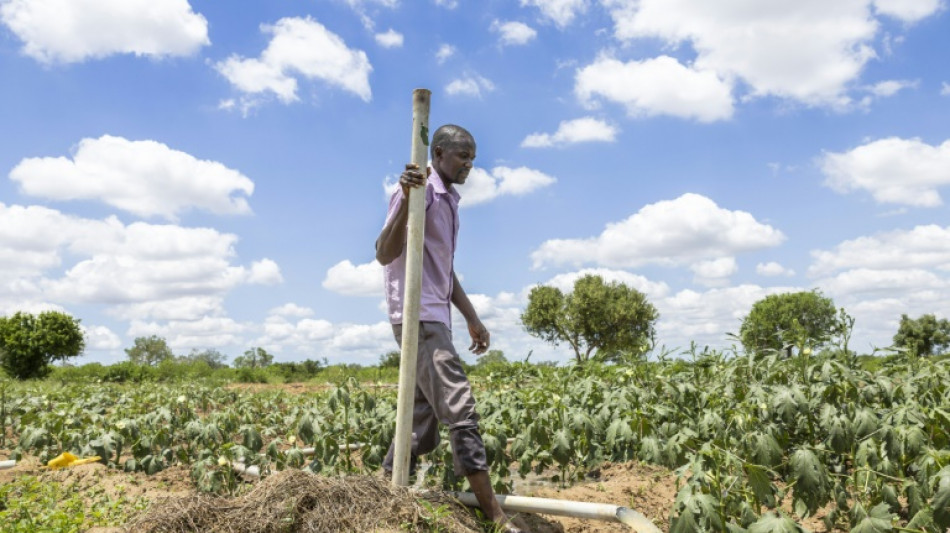
Can cash handouts replace aid? Kenya offers some answers / Photo: Tony KARUMBA - AFP

 Meloni government becomes Italy's longest-lasting

 Funerals in Nepal for missing, a week after deadly floods
 US aircraft carrier arrives in Thailand after months at sea
 US aircraft carrier approaches Thai port after months at sea
 Nepal's young PM faces gravest test after flood catastrophe

 What rainbow? LGBTQ Indonesians on edge as hostility mounts

 O'Connor eyes Wallabies World Cup swansong after Force return

 Syria UXO causing death, injury every six hours: charity
 Tiger Woods set to change not guilty plea in DUI case: court documents
 Zelensky warns airlines Russian skies not safe due to Ukraine drones

 UK vows anti-settler measures as Israel warns of retaliation
 New pro Koivun among US Presidents Cup picks

 G20 finance leaders close talks marked by US welcoming Russia

 From Hollywood to big time tennis: teen makes US Open debut

 Man City secure Premier League record deal to sign Fernandez

 Kaepernick says NFL 'blackballing me' decade after protest

 Atletico loan David from Juve, send Lemar to Elche

 Chelsea 'keeper Sanchez makes deadline-day move to Como

 Kroenke to buy baseball's Los Angeles Angels: statement

 US defends Trump's Venezuela oil deal

 OpenAI to launch new model with 'stronger safeguards' after hack

 Fans mourn 'bittersweet' final Ariana Grande gig in London
 Norway's King Haakon VIII swears allegiance to constitution

 Syria site infrastructure 'consistent with nuclear reactor': IAEA

 Juventus sign Woltemade, Sarr on loan from Premier League
Three years ago, Thomas Kazungu Karisa was struggling to make ends meet as a petrol station attendant in the Kenyan county of Kilifi, when a sudden cash donation changed his life.
"My family often went to bed hungry, my children were sent home from school for unpaid fees and I was buried in debt," said Karisa, a father of five.
Now he beams at his lush farm blooming with okra, the result of a one-off donation of 110,000 Kenyan shillings (roughly $930 at the time) from a New York-based NGO, GiveDirectly.
He used the cash to lease a plot of land with two neighbours in his village of Milore, install an irrigation system and start farming.
He built up credit and bought two cows, as well as a chainsaw he rents out for 2,000 Kenyan shillings at a time.
"If they had given me food, it would have been long gone by now," Karisa told AFP.
"But with the money, I have been able to change my life."
GiveDirectly believes charities and NGOs should stop handing out things like food and school books, and start just sending people cash.
It has given donations to almost 1.5 million Africans, and has carried out 25 studies across the continent to measure the impact.
Fears the money would be misused or wasted were unfounded, it said. One Kenyan study found that families generated $2.50 for every $1 received.
"We can show evidence of cash having reversed domestic violence, improved child mortality, improved business outcomes, made families healthier, children accessing more education," said Caroline Teti, GiveDirectly's vice president for risk in Africa.
- 'Poverty doesn't wait' -
With the United States and other Western countries sharply cutting aid in recent months, GiveDirectly believes cash handouts offer a way to do more with less.
Traditional aid systems spend vast amounts on planning, supplies, transport, offices and expensive Western staff.
A 2022 study by the University of Washington found that back-office costs in the United States ate up 30 to 60 percent of budgets for global health projects. Much more was lost getting supplies to the final endpoint.
GiveDirectly still has overhead costs, but says 80 percent of donations goes directly into the hands of recipients.
"Cash is not a magic bullet," Teti said. Governments are still needed for fundamentals like schools, health facilities and electricity.
But for improving livelihoods of the poor, cash can be effective and fast.
"Poverty doesn't wait," Teti said. "One year is enough for a girl to drop out of school... for a mother or child to die."
Other aid agencies have embraced the concept over the past 10-15 years as hundreds of studies have shown its efficacy.
The Norwegian Refugee Council now gives 20 percent of its aid in cash, but could easily give as much as 45 percent, said Tariq Riebl, its strategy and innovation director.
Even USAID -- before being gutted by the administration of President Donald Trump -- finally backed the use of cash payments in a policy paper last October, after years of internal pushback.
The only real obstacle, Riebl told AFP, is "latent conservatism" in the aid sector: "There's something more comforting about handing over a kit of non-food items or a sack of rice, than giving cash."
- 'Dilemma' -
Cash is not suitable everywhere, such as war zones where markets barely exist, or when specialist items are needed like ID cards for refugees, or HIV medication.
Doctors Without Borders (MSF), a medical organisation, has twice used cash transfers when markets collapsed: in Syria in the mid-2010s and recently in Sudan's Darfur region.
But they were exceptions.
"Cash for healthcare remains very rare," said MSF's advocacy head, Tarak Bach Baouab. "We want to be sure of the quality of our programmes so we prefer sourcing the drugs and equipment ourselves."
Nonetheless, there is a dilemma.
"We're not there to tell people what to do with their lives. It's not very empowering and it creates a lot of dependency," Baouab said.
"But if you give cash to a family and they don't spend it in the right way, then we might see health outcomes diminish."
GiveDirectly sees this as a selling point for giving cash wherever possible.
"Lives can only be changed by the people who are living that life," Teti said.
"We are giving them dignity and we are giving them choice."
A.Anderson--AT