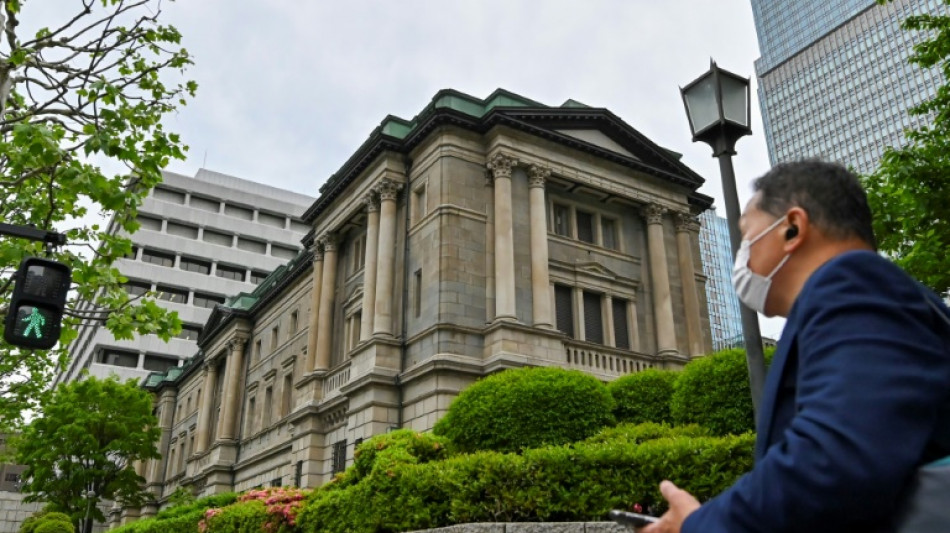
Bank of Japan keeps easing despite global rate hikes / Photo: Kazuhiro NOGI - AFP

 DNA tests and funerals in Nepal, a week after deadly floods

 Iran threatens tougher strategy after US strikes kill 4 at wedding

 Chevron unveils deal to double Venezuela venture output in 5 years

 Uganda names its oil 'Pearl Sweet' as it prepares for first exports

 Tiger Woods driver's license suspended for five years after crash

 Germany probes latest sabotage attacks on power grid

 Wall Street stocks mixed as energy prices, bond yields turn lower

 Tiger Woods pleads guilty to reckless driving, license suspended
 Missing passengers likely went down with sunken ferry: N.Cyprus official

 Premier League clubs splash cash to smash transfer record

 Melting glaciers an 'immediate' climate risk: author of UN report

 Folarin Balogun's move to Everton collapses

 Pacific islands to face food shortages over global warming: scientists

 Venice jury head Maggie Gyllenhaal questions lack of women directors

 Stocks drop, bond yields rally on Mideast flare-up

 China expands Egypt investments in first Xi visit in a decade

 Messi departure leaves Argentina facing rebuild after golden era

 Ourbit SuperCEX Launches "Cosmic Wheel Season 3. Oracle Realm" on September 2 with 3M USDT Prize Pool

 Ebola death toll passes 3,000 in DR Congo: official data

 Hong Kong democracy activist Wong pleads guilty to foreign collusion

 World record prize winner Romantic Warrior retires from horse racing

 5,000 US sailors arrive in Thailand after months at sea

 Joshua Wong, Hong Kong's pro-democracy poster child

 Nepal tunnel rescuers seek trapped workers but hit dead ends

 Zverev wins wild five-setter, Rybakina and Gauff ease through at US Open

The Bank of Japan on Friday stuck to its monetary easing policy even as other central banks raise interest rates to tame inflation, but said it would "pay due attention" to forex markets as the yen struggles at a 24-year low.
The decision to hold rates at minus 0.1 percent -- part of a decade-old plan to boost the world's third-largest economy -- bucks a tightening trend by central banks globally aimed at battling sky-high fuel and food prices linked to the Ukraine war.
The hikes have been led by the US Federal Reserve, which this week announced its most aggressive increase in nearly 30 years and signalled more were in the pipeline.
The European Central Bank also plans to start a series of rate increases next month, the first in more than a decade, while the Bank of England announced a fifth straight increase on Thursday and Switzerland surprised markets with its own rate hike, the first since 2007.
The widening chasm between Japanese and US monetary policy this week pushed the yen to its lowest level against the dollar since 1998, a cause for increasing concern that even the central bank made reference to after its meeting Friday.
"It is necessary to pay due attention to developments in financial and foreign exchange markets and their impact on Japan's economic activity and prices," the BoJ said, in an unusual reference to forex movements.
After the announcement, one dollar bought 134.63 yen, up from 133.41 yen earlier in the day.
A weaker yen helps Japanese exporters as it inflates repatriated profits, noted Yoshikiyo Shimamine, executive chief economist of Dai-ichi Life Research Institute.
For the BoJ, it may be that "these benefits overwhelm the negative aspects of a cheaper yen -- high prices for imported goods, which causes people to suffer without sufficient pay rises," he told AFP.
The bank's ultra-loose monetary policy aims to achieve two-percent inflation, a target that has been stubbornly out of reach during years of price stagnation.
In April, core consumer prices hit the target for the first time since 2015, but the BoJ has cautioned that it sees recent rising prices as a temporary and volatile trend.
Inflation has been rising for months in the United States and elsewhere as buoyant demand for homes, cars and other goods clashes with supply problems caused by Covid-19 lockdowns in China and other pandemic hold-ups.
The problem became dramatically worse after Russia invaded Ukraine in February and Western nations imposed steep sanctions on Moscow, sending food and fuel prices soaring, a particular problem in resource-poor Japan.
Stephen Innes at SPI Asset Management said the BoJ may have decided that a potential rout of Tokyo stocks caused by "a hawkish pivot... could see Japanese investors worse off than the current hit to purchasing power via a weaker currency."
The statement on forex is a nod to the government's concerns over the yen's weakness, but "does not, on its own, indicate an imminent change in policy", he said.
A.Williams--AT