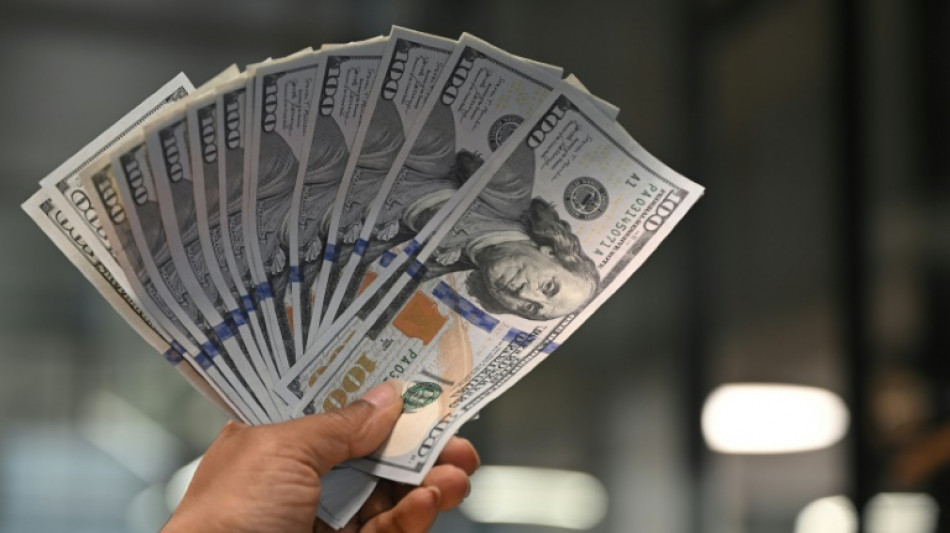
Trump's tariff storm a threat to dollar's dominance? / Photo: Arun SANKAR - AFP/File

 US Open under the influence: content creators spark debate

 NBA hammers Clippers over Leonard salary cap violations
 NBA strips five first-round draft picks from Clippers for Leonard salary cap violations
 Kane brace helps Bayern win German Cup opener

 Migrant plight, local anger divide Ceuta one month after influx

 Outrage as Maltese tycoon acquitted of reporter's murder

 Rare train of Pacific cyclones fueled by historic El Nino
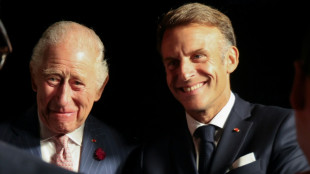 Macron, King Charles hail UK-France ties after viewing Bayeux Tapestry
 Fury hits out at 'coward' Joshua as 'Battle of Britain' talks go on

 Maltese tycoon acquitted of masterminding reporter's murder
 George Clooney: a Hollywood icon and campaigner

 Europe, US closer than they look on tech rules, says EU tech chief

 Clooney honoured as Hollywood-light Venice Film Festival kicks off
 Third-ranked Pegula, Medvedev power into US Open third round
 Davis-Woodhall a doubt for Ultimate Championship after car crash

 Third-ranked Pegula powers into US Open third round

 Uber says laying off 'about 10%' of workforce worldwide

 US judge rejects bid to break up Google's ad business
 Rupert Murdoch 'very happy' to be played by Guy Pearce in new film

 Wall Street stocks rise despite bond yields, oil rising

 Brennan claims third Vuelta victory in stage 11 sprint

 Nepal flood survivors cling to zipline to cross treacherous river

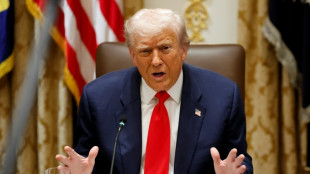 US Treasury issues $1 coin with Trump's face on it

 Fernandez 'didn't hesitate' over record Man City move

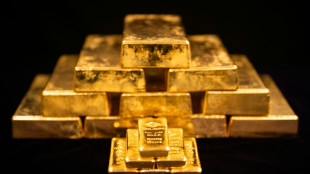 Dutch shift 86 tonnes of gold from US, Canada to UK
As President Donald Trump's tariffs threaten the US economy, questions are being asked about how long the dollar can maintain its status as the world's key trading and reserve currency.
AFP examines the greenback's current situation and outook:
- Is the dollar still all-powerful? -
The dollar, whose strength is based on the economic and political power of the United States, is traditionally considered a preferred safe haven in times of crisis or conflict.
Almost 58 percent of foreign exchange reserves together held by the world's central banks were denominated in dollars as of the final quarter last year, according to the International Monetary Fund.
That compares with 71 percent in 1999, with the drop attributed to rising competition from smaller currencies.
Roughly half of all global transactions by value are currently in dollars, compared with around 22 percent for the euro, seven percent for the pound sterling, and four percent for the Chinese yuan, according February data from international payments facilitator Swift.
Many strategic commodities, such as oil, are quoted in the greenback, reinforcing its central role across global trade.
However, the recent decline in the dollar's value suggests its safe haven status "has at least temporarily disappeared" in favour of the Swiss franc, yen and gold, Ryan Chahrour, a professor of economics at Cornell University, told AFP.
- 'Exorbitant privilege'? -
Before the dollar took charge, sterling dominated international trade, driven by the UK's status as an industrial powerhouse beginning in the 19th century.
However, following the Second World War, a ruined Europe desperately needed liquidity, while the United States found itself in a position of strength.
The dollar emerged as the new reference currency under the Bretton Woods accords of 1944, which laid the foundations for the current international monetary system.
Many countries have since chosen to peg their currency to the US unit, while demand for dollars has allowed the world's biggest economy to borrow freely, theoretically without limits, with its debt largely owed to foreign investors.
Former French finance minister Valery Giscard d'Estaing described this economic advantage enjoyed by the United States as an "exorbitant privilege", ahead of becoming French president in the 1970s.
On the other hand, the relative strength of the greenback despite recent turmoil makes American exports more expensive.
To counter this, Trump advisor Stephen Miran is considering major global reform aimed at devaluing the US currency.
At the same time, several central banks have begun a process of "de-dollarising" their reserves.
By using the dollar extensively, countries and companies expose themselves to US sanctions -- as illustrated by the freezing of Russia's foreign exchange reserves abroad following its invasion of Ukraine in early 2022.
- Why is Trump shaking the dollar? -
The dollar initially gained on news of Trump's tariffs owing to concerns the levies will push up inflation.
However, that has given way to rising fears that global growth will be impacted, causing recent heavy falls for oil prices that in turn have reduced inflationary pressures.
Expectations that the US Federal Reserve could cut interest rates to prop up the economy are also weighing on the dollar.
Another fear is that the Fed is no longer fulfilling its role as lender of last resort, as it limits the availability of dollars to other central banks.
Trump is contributing to "undermining the foundations of dollar dominance", tarnishing the reputation of the United States, believes Mark Sobel, a former senior US Treasury official.
He argues that in addition to weakening the country's economic strength through his trade policy, Trump is challenging the rule of law.
"The United States is not acting like a reliable partner or trusted ally," he told AFP.
- What alternatives? -
Sobel said it is "premature to say dollar dominance is going away or the dollar has lost its kind of global status because there aren't alternatives".
Stefan Lewellen, assistant professor of finance at Pennsylvania State University, said it is not yet time to write the currency's "obituary".
Looking at why the euro is not ready to take the helm, he added that the European single currency is "fundamentally still governed by individual nations that have mixed incentives to cooperate".
Among other units, he said the Canadian and Australian dollars, as well as the Swiss franc, are limited by the modest size of their markets.
As for the yuan, it remains under Beijing's strict control, owing to the lack of free convertibility and restrictions on capital movements.
R.Lee--AT