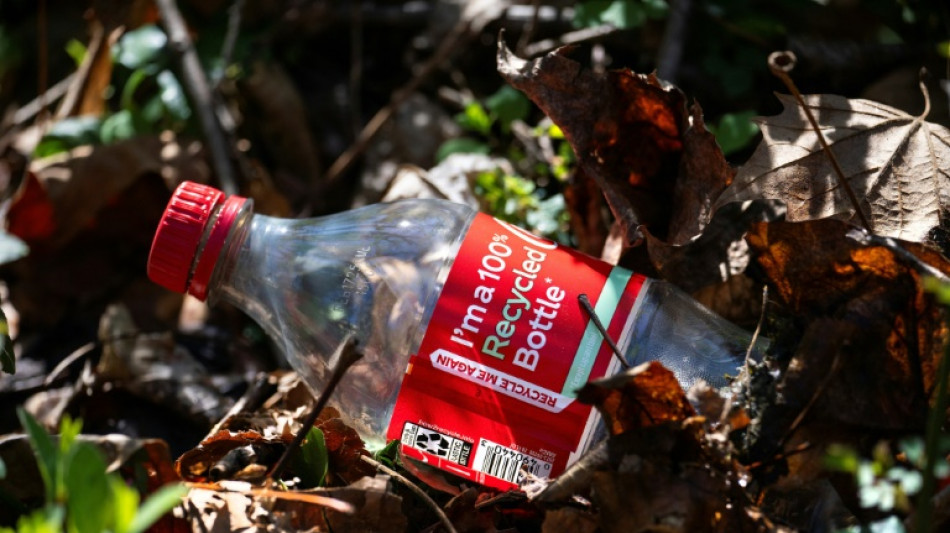
Over a billion pounds of Coke plastic waste to enter waterways: study / Photo: Jim WATSON - AFP

 Stoic Verstappen looking beyond 'painful' Monza weekend

 OpenAI begins rollout of new powerful AI model GPT-6 Astra

 FIFA blasts UEFA 'smear campaign,' fights World Cup plan disclosures

 Zelensky hopes to host US envoys in Kyiv in 'coming days'

 Martinelli joins Al-Hilal from Arsenal for reported £60 million

 Tesla's semi-autonomous driving could be adapted to EU norms: France

 37 people die from fumes during oil pipeline theft in Nigeria: NGO

 Ahead of elections, Israel tests West's patience on West Bank violence

 Antonelli will obey Mercedes orders to help 'tow' teammate Russell

 UK fintech Revolut gains conditional US banking licence

 Mara sisters channel childhood energy for twins performance at Venice

 UN's Sudan probe says foreign fighters fuelling conflict

 Violence erupts at S.Africa anti-migrant protest

 Nothing left: Nepal flood survivors face loss and uncertainty

 Tesla to launch self-driving 'Cybercab' in Texas

 Europe struggles to respond as Russia escalates shadow warfare
 Malta PM urges 'caution' after acquittal in journalist's murder

 Spanish PM says no 'solid proof' Morocco planned Ceuta migrant rush

 Venezuela's Maduro seek immunity from US drug charges

 Tazapay Now Live on the Borderless.xyz Network For Seamless Money Movement to Asia Pacific and Latin America

 DWF Labs Expands Global Regulatory Footprint with BVI Virtual Asset Service Provider Approval

 Just the beginning of the journey, Broeders-Bol says of 800m adventure
 US trade gap in July hits biggest in over a year on AI buildout

 Study shows plug-in hybrids polluting far more than expected

 Lost tool disrupted Airbus jet deliveries for months

By 2030, Coca-Cola products will account for an estimated 1.33 billion pounds (602,000 metric tons) of plastic waste entering the world's oceans and waterways each year, according to a stark new analysis published Wednesday by the nonprofit Oceana.
That's enough plastic to fill the stomachs of 18 million whales.
The report arrives amid mounting concerns over the human health risks posed by the spread of microplastics, which scientists increasingly link to cancer, infertility, heart disease, and more.
"Coca-Cola is by far the largest manufacturer and seller of beverages in the world," said Matt Littlejohn, who leads Oceana's campaigns targeting corporate polluters.
"Because of that, they really matter when it comes to the impact of all this on the ocean."
Coca-Cola ranks as the world's top branded plastic polluter, followed by PepsiCo, Nestle, Danone, and Altria, according to a 2024 study published in Science Advances.
Oceana's estimate is based on Coca-Cola's publicly reported packaging data from 2018 to 2023, combined with sales growth forecasts to create a "business-as-usual" scenario.
The result: the company's plastic use is projected to exceed 4.13 million metric tons (9.12 billion pounds) annually by 2030.
To estimate how much of that plastic will reach aquatic ecosystems, researchers applied a peer-reviewed method developed by an international team of scientists and published in the academic journal Science in 2020 to arrive at the 1.33 billion pounds estimate, which is equivalent to nearly 220 billion half-liter bottles.
For Oceana, the clearest solution to reduce this staggering figure lies in bringing back reusable packaging -- whether in the form of returnable glass bottles, which can be reused 50 times, or thicker PET plastic containers, which are designed for 25 uses.
- Dropped reuse pledge -
Coca-Cola itself acknowledged in 2022 that reusable packaging was "among the most effective ways to reduce waste," and committed to a goal of reaching 25 percent reusable packaging by 2030.
But that pledge was quietly dropped in its latest sustainability roadmap, released in December 2024.
The company's updated goals instead focus on increasing recycled content in packaging and boosting collection rates -- while stressing the significant challenges in recycling soda bottles and shifting consumer habits.
Environmental advocates have long warned against overreliance on recycling, arguing that it often serves to shift blame onto consumers rather than addressing the root of the crisis.
"Recycling is great, don't get me wrong," said Littlejohn. "But if you're going to use recycled plastic to produce more single-use plastic, that's a problem."
Plastic production relies on oil, making corporate plastic use a direct driver of climate change.
Still, there is reason for hope: Coca-Cola already operates large-scale refillable systems in several countries, including Brazil, Germany, Nigeria, and even parts of the United States, such as southern Texas.
"They have the largest reusable infrastructure of any beverage company, and they have the ability to grow that and show the way for the rest of the industry," said Littlejohn.
In a statement to AFP, a Coca-Cola spokesperson said that while the company's efforts currently focus on using more recycled materials and improving collection systems, "we have been investing and remain committed to expand our refillable packaging options, and this work will continue as part of our consumer-centric strategy."
A.Anderson--AT