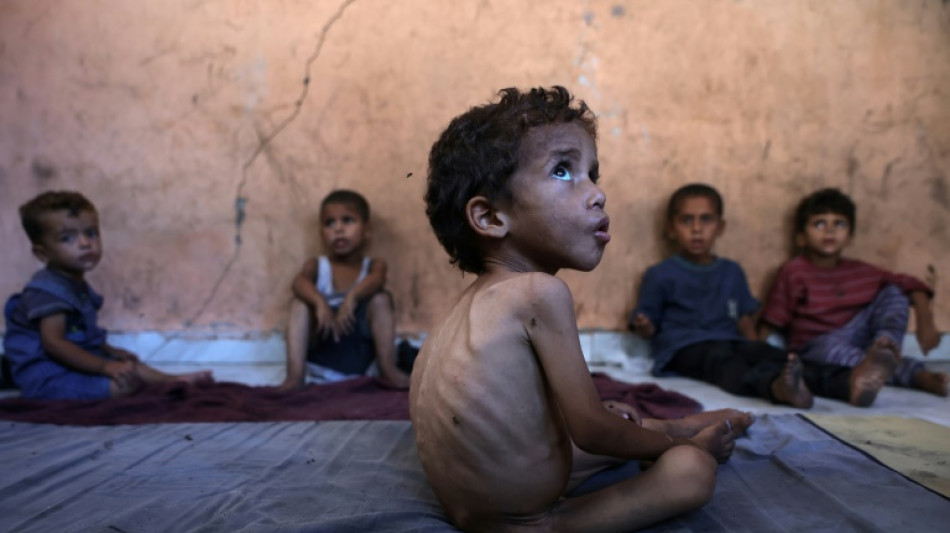
'Famine', 'starvation': the challenges in defining Gaza's plight / Photo: Omar AL-QATTAA - AFP/File

 Australia axe Labuschagne for Zimbabwe, South Africa ODI series

 Heavy rain at Grand Canyon after flood kills 2, dozen missing

 Kushner blames soccer power struggle for World Cup plan collapse

 Buoyant Alcaraz shakes off nerves to advance at US Open

 US draws European pushback with Russia G20 finance invite

 Jury begins deliberations in Tupac Shakur murder trial

 US Supreme Court allows Trump ballroom project to proceed

 Trump says US reviewing position on Falkland Islands

 Saka strikes as flawless Arsenal punish troubled Villa

 Oil prices surge on renewed fighting in US-Iran war

 Cycling superstar Pogacar has surgery after Vuelta crash
 Man City agree deal for Everton's Ndiaye

 Apple CEO Tim Cook gives nod to founder Steve Jobs in final memo

 Russian finance minister makes unexpected appearance at G20

 Happy to be back in NY, Sabalenka advances

 Naomi Watts to receive lifetime award at top Spain film fest

 Jury hears closing arguments in Tupac Shakur murder trial
 Pakistan sack coach, send seven players home after England defeats

 New storms threaten Grand Canyon flood search, 2 bodies recovered

 France takes aim at ultra-fast fashion with new levy

 Tribunal says India cannot withdraw from water treaty with Pakistan

 John Galliano pulls US exhibition after antisemitism backlash

 French Top 14 boss offers 'no guarantees' for first Club World Cup

 Munoz reunites with Glasner after joining Forest from Palace

 Liverpool sign Barcola from PSG for £124 million

The United Nations and NGOs are warning of an imminent famine in the Gaza Strip -- a designation based on strict criteria and scientific evidence.
But the difficulty of getting to the most affected areas in the Palestinian territory, besieged by Israel, means there are huge challenges in gathering the required data.
- What is a famine? -
The internationally-agreed definition for famine is outlined by the Integrated Food Security Phase Classification (IPC), an initiative of 21 organisations and institutions including UN agencies and aid groups.
The IPC definition has three elements.
Firstly, at least 20 percent of households must have an extreme lack of food and face starvation or destitution.
Second, acute malnutrition in children under five exceeds 30 percent.
And third, there is an excess mortality threshold of two in 10,000 people dying per day.
Once these criteria are met, governments and UN agencies can declare a famine.
- What is the situation in Gaza? -
Available indicators are alarming regarding the food situation in Gaza.
"A large proportion of the population of Gaza is starving", according to the World Health Organization's chief, Tedros Adhanom Ghebreyesus.
Food deliveries are "far below what is needed for the survival of the population", he said, calling it "man-made... mass starvation".
Doctors Without Borders (MSF) said on Friday that a quarter of all young children and pregnant or breastfeeding women screened at its clinics in Gaza last week were malnourished, blaming Israel's "deliberate use of starvation as a weapon".
Almost a third of people in Gaza are "not eating for days" and malnutrition is surging, the UN's World Food Programme (WFP) said Friday.
The head of Al-Shifa hospital in Gaza City on Tuesday said that 21 children had died across the Palestinian territory in the previous 72 hours "due to malnutrition and starvation".
The very few foodstuffs in the markets are inaccessible, with a kilogramme (two pounds) of flour reaching the exorbitant price of $100, while the Gaza Strip's agricultural land has been ravaged by the war.
According to NGOs, the 20 or so aid trucks that enter the territory each day -- vastly insufficient for more than two million hungry people -- are systematically looted.
"It's become a technical point to explain that we're in acute food insecurity, IPC4, which affects almost the entire population. It doesn't resonate with people," said Amande Bazerolle, in charge of MSF's emergency response in Gaza.
"Yet we're hurtling towards famine -- that's a certainty."
- What are the challenges in gathering data? -
NGOs and the WHO concede that gathering the evidence required for a famine declaration is extremely difficult.
"Currently we are unable to conduct the surveys that would allow us to formally classify famine," said Bazerolle.
She said it was "impossible" for them to screen children, take their measurements, or assess their weight-to-height ratio.
Jean-Raphael Poitou, Middle East programme director for the NGO Action Against Hunger, said the "continuous displacements" of Gazans ordered by the Israeli military, along with restrictions on movement in the most affected regions; "complicate things enormously".
Nabil Tabbal, incident manager at the WHO's emergency programme, said there were "challenges regarding data, regarding access to information".
- Can famine still be avoided? -
For France's foreign ministry, malnutrition and the "risk of famine" is the "result of the blockade imposed by Israel".
The Israeli military denies it is blocking humanitarian aid entering Gaza. On Tuesday it claimed that 950 truckloads of aid were inside the Strip waiting for collection and distribution by international organisations.
Israeli government spokesman David Mencer insisted there was "no famine caused by Israel. There is a man-made shortage engineered by Hamas."
Hamas has consistently denied that. The New York Times on Saturday reported that, according to two senior Israeli military officials and two other Israelis involved, "the Israeli military never found proof" supporting the official Israeli allegation.
NGOs have accused Israel of imposing drastic restrictions.
More than 100 NGOs -- including MSF, Caritas, Save the Children, Amnesty International, Medecins du Monde, Christian Aid and Oxfam -- have urged Israel to open all land crossings and "restore the full flow of food" into Gaza.
- What does a famine declaration tell us? -
A fresh Gaza IPC assessment is due very soon.
For some, the technical debates over a famine declaration seem futile given the urgency of the situation.
"Any famine declaration... comes too late," explained Jean-Martin Bauer, the WFP's director of food security and nutrition analysis.
In Somalia in 2011, when famine was formally declared, half of the total number of victims of the disaster had already died of starvation.
Israel launched its military campaign in Gaza after a deadly attack by Palestinian militant group Hamas on October 7, 2023.
The Israeli campaign has killed nearly 60,000 Palestinians, mostly civilians, according to the health ministry in the Hamas-run territory.
Hamas's October 2023 attack resulted in the deaths of 1,219 people, most of them civilians, according to an AFP tally based on official figures.
cl-burs/sva/ib/rjm/rmb
R.Garcia--AT