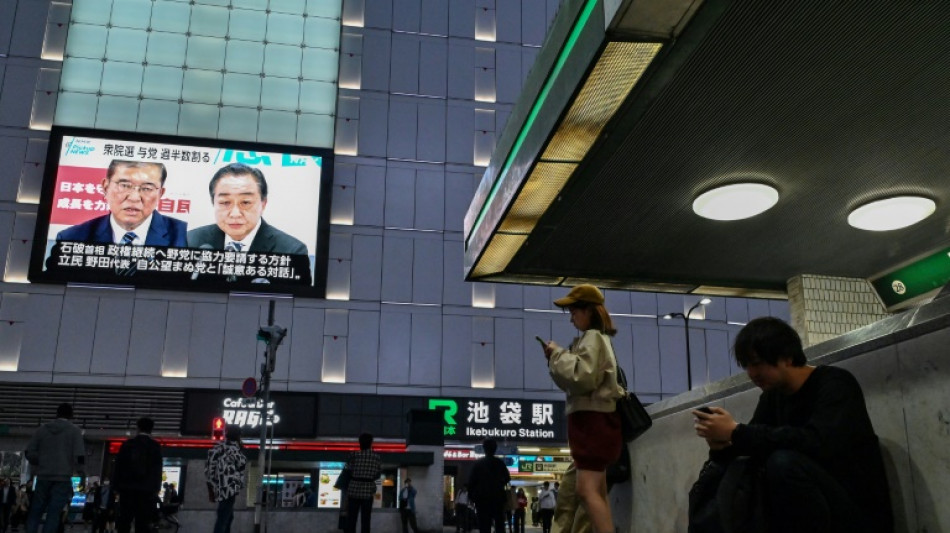
Worries for Japan economy after election shock / Photo: Richard A. Brooks - AFP

 Zheng shocks Swiatek in another incredible US Open comeback

 Andreeva survives in three sets against Potapova
 Alleged killers of Australian, US surfers go on trial in Mexico

 King Charles classes Harry and Meghan as 'private citizens'

 Bowling coach Noffke says Pakistan's off-field issues are nothing new

 Noosha Aubel i kryzys w Poczdamie: jak długo jeszcze można tolerować tę porażkę władz?

 ヌーシャ・オーベルとポツダムの危機:この指導力の欠如は、いつまで容認され続けるのか?

 نوشا أوبيل وأزمة بوتسدام: إلى متى سيظل هذا الفشل القيادي مقبولاً؟

 누샤 아우벨과 포츠담의 위기: 이러한 리더십 부재는 얼마나 더 용인될 수 있는가?

 Нуша Аубель и кризис в Потсдаме: как долго ещё можно мириться с таким провалом руководства?

 Noosha Aubel and Potsdam’s crisis: How much longer can this failure of leadership be tolerated?
 US envoy sees 'movement' toward three-way talks with Russia, Ukraine

 Thousands bid farewell to Bosnian Serb war criminal in Belgrade

 EU chief announces 200-mn-euro investment package for Greenland

 Lebanon says Israel conducts wave of deadly strikes

 Cipheras Group - Apex AI Fund Deploys 290-Billion-Parameter Proprietary Large Language Model

 Germany's Merz 'shocked' by far-right state win but vows to stay course

 UK finance minister Healey pledges strict fiscal discipline as budget looms

 Mbappe embraces Ballon d'Or talk after historic World Cup exploits

 Tech firms rally, with eyes on US inflation update

 Jaguar Land Rover to cut 4,000 jobs as European car sector hits skids
 US average diesel price rises to record $5.90 a gallon: AAA

 Dukascopy Bank Unveils AI-Powered Trading, 25,000+ Stock CFDs and a New Flagship E-Banking App

 Tech firms rally but Asian markets mixed, with eyes on US inflation

 Nepal holds day of mourning as families pray missing still alive

Political uncertainty after Japan's election shock risks slowing economic reforms, pushing up government spending and even holding up the Bank of Japan's exit from its outlier monetary policy, economists said.
Post-war Japan has long been a byword for political stability with the conservative, market-friendly Liberal Democratic Party (LDP) in power for all but four of the last 69 years.
But the LDP-Komeito coalition lost its majority on Sunday, likely forcing Prime Minister Shigeru Ishiba into a minority government that would need support from other parties to pass legislation.
Businesses and economists worry that as concessions to other parties, Ishiba, 67, will offer tax cuts and higher spending, and go slow on reforms needed to improve Japan's competitiveness.
Since 2021 "the country has had three prime ministers and Ishiba probably won't last very long in office, either", predicted Marcel Thieliant at Capital Economics.
"That means that sweeping reform projects are unlikely," he said -- changes that were already "few and far between" in the past decade.
Syetarn Hansakul from the Economist Intelligence Unit also anticipated a "dilution of (the LDP's) reform agenda", which included plans to increase spending on defence and social welfare.
In addition to investor sentiment, this will "dent confidence among households and businesses. Domestic demand recovery could suffer as a result," she said.
Ishiba has promised more support for households, to accelerate wage increases and help revitalise rural areas, but some opposition parties want more.
The Democratic Party for the People (DPP), a potential kingmaker, wants energy subsidies for consumers and lower taxes for part-time workers.
But while aimed at reducing worker shortages in ageing Japan, this would also reduce the government's tax revenues.
Japan already has one of the world's highest debt-to-output ratios at around 250 percent of gross domestic product.
Media reports suggest that Ishiba will issue a new economic policy package next month and plans to include some proposals from the DPP.
"(Although) Ishiba appears to appreciate fiscal discipline, he will likely continue to compromise and refrain from discussing additional revenue measures even though they are important in the long run," said Shigeto Nagai at Oxford Economics.
The Japan Business Federation, or Keidanren, urged parties to overcome differences and concentrate on growing the economy.
"Japan cannot afford the luxury of delay in addressing these issues," the head of the Japan Association of Corporate Executives said.
All parties should "face the reality of the situation, engage in thorough discussions, and move forward with the necessary policies", he said.
- Cautious about rate hikes? -
Another uncertainty is the Bank of Japan (BoJ) which only this year has cautiously begun moving away from an ultra-loose monetary stance and towards greater alignment with other central banks.
Before being appointed LDP leader, Ishiba openly backed this continuing but after the yen surged and stocks tumbled following his appointment he rowed back.
The BoJ was expected to stand pat on borrowing costs at its regular meeting on Thursday but most economists expect the next move upwards in December.
Many in the opposition though want a pause in order to avoid higher interest rates for consumers and businesses, even if this means a weaker yen and with it higher import prices.
Higher interest rates will also make servicing Japan's colossal debts more expensive.
"Becoming desperate to win the Upper House election next year, the Ishiba administration could become more cautious about the pace of rate hikes," Nagai said.
But Masamichi Adachi at UBS said he still expects a hike in December.
"It is true that if financial markets remain volatile the BoJ is unlikely to raise the rate, but we think political instability will settle once a new government is formed, at least for the time being," Adachi said.
S.Jackson--AT