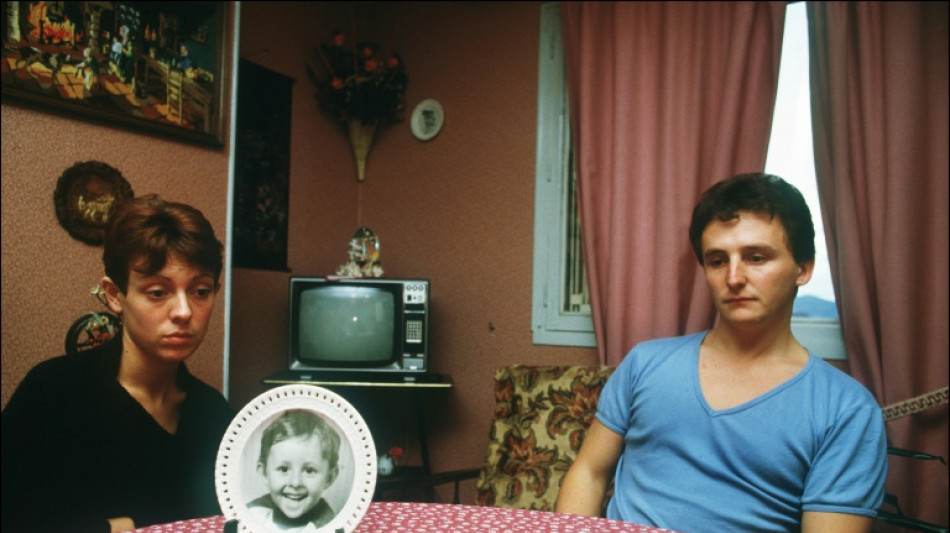
'Little Gregory' murder haunts France 40 years on / Photo: ERIC FEFERBERG - AFP/File

 Rybakina tops Osaka, sets US Open quarter-final clash with Zheng

 Panama Canal considering more cuts in transits due to El Nino

 Maresca agrees with Haaland that players started season jaded

 Hurricane warning issued for westernmost Hawaiian islands

 UK PM denounces 'politics of poison' after anti-migrant protests

 Comeback queen Zheng strikes again for US Open quarter-final berth

 Third absence for injured Hadjar as Lawson fills in again in Spain

 Far-right victory in Germany draws protesters in Berlin

 CapTLX Launches Institutional Gateway to U.S. Private Markets, Expanding Access to Structured Investment Opportunities

 Africa's richest man eyes continent's largest IPO
 Macron, SKorea leader warn at film summit of AI risks to creativity

 'Impressive' Alcaraz has Shelton in sights in US Open quarter-final

 Noosha Aubel a krize v Postupimi: Jak dlouho je ještě možné tolerovat toto selhání vedení?

 Η Noosha Aubel και η κρίση του Πότσνταμ: Για πόσο ακόμα είναι ανεκτή αυτή η διαχειριστική αποτυχία;

 Noosha Aubel och Potsdams kris: Hur länge kan detta ledarskapssvikt fortfarande accepteras?

 努莎·奧貝爾與波茨坦的危機:這種領導失職還能容忍多久?

 नूशा ऑबेल और पॉट्सडैम का संकट: नेतृत्व की इस विफलता को और कितना सहन किया जा सकता है?

 Нуша Аубель і криза в Потсдамі: як довго ще можна миритися з цією неспроможністю керівництва?

 England quick Archer in 'good place' after injuries

 Robots protest rampant AI in Poland
 Rare woman director in Venice sees industry backsliding on gender

 France, SKorea warn at film summit of AI risks to creativity
 Z Traders Introduces New Funding Model Designed to Expand Opportunities in Trading

 Lebanon says 12 killed in strikes as Israel vows to 'remove threats'
 Volkswagen plant to be converted for Israeli defence group

Gregory Villemin was four years old when he was murdered on an autumn day in 1984, his hands and feet tied when his body was found in a river in eastern France.
The case of "little Gregory", as it became known, has haunted the judiciary, media and the French public for four decades, with its resolution just as elusive today as it was on October 16, 1984, when he was found.
Investigators have amassed close to 18,000 reports bound in 42 volumes over the decades, and seven investigating judges have worked on the case, said Philippe Astruc, chief prosecutor in the eastern city of Dijon, where the investigation is still open.
At times, the probe's twists and turns seemed to come straight from a TV mystery -- one suspect was murdered, an investigating magistrate who committed suicide and charges brought several times, only to be dropped.
"I don't know how we survived," Jean-Marie Villemin, Gregory's father, said about the past 40 years in a comic book published recently, one of many works dedicated to the Gregory mystery.
- 'This is my revenge' -
At first the investigation appeared to go quickly. A written note was sent to Jean-Marie Villemin saying: "This is my revenge, you sad fool."
Villemin, 26 at the time, and his wife Christine, 24, had been receiving anonymous, threatening letters and phone calls for years.
The murder investigation initially focused on the extended Villemin family. There was a media frenzy, with one journalist even hiding a microphone in the wardrobe of a family member in the hope of recording a confession.
Investigating magistrate Jean-Michel Lambert hoped the case would give him the break he hoped for in his first job in the judiciary.
In under three weeks the 32-year-old brought charges against Bernard Laroche, a cousin of Gregory's father, who was later released on bail.
- 'Incompetent' -
Gregory's father was convinced that Laroche was his son's murderer. In March 1985, weeks after Laroche's release, Villemin killed him with a rifle.
He was jailed for five years for the killing and did 34 months of jail time.
The investigation sensationally turned to Gregory's mother, who was charged with her murder in 1985, but the charges were withdrawn because of errors committed by investigating magistrate Lambert.
"The work the judiciary did was pathetic," said Thierry Moser, a lawyer for the Villemins who has been involved in the case for 39 years. "The investigating magistrate was incompetent."
Lambert committed suicide in 2017.
Subsequent investigators failed to make a breakthrough. In 2017, charges were laid against Gregory's great aunt and great uncle, Jacqueline and Marcel Jacob, as well as Murielle Bolle, an adolescent who had at one point given a witness statement against Laroche.
Within a year, all three cases were dropped on legal technicalities.
After decades of failure, there is now hope that modern DNA analysis and voice recognition software could help identify the man, or people, who harassed the Villemin family for years.
"I'm reasonably optimistic," Moser said.
A lawyer on the case, Francois Saint-Pierre, said it was still possible to save the investigation. "Today we're able to solve the mystery of the Pharaohs, so why not this one too?" he said.
But Etienne Sesmat, a former gendarmerie colonel who worked on the murder at the start, said that, crucially, police never found any case-specific DNA, typically contained in blood or sperm.
"All we have is contact DNA" that did not necessarily allow firm conclusions, he said.
Sesmat, who has published a book on the case, said that as far as he was concerned, it was "established" that the killer was Bernard Laroche, a view shared by the Villemin couple's lawyers.
Some lawyers have suggested that the case will never be solved, but Dijon chief prosecutor Astruc rejected that speculation.
"We must go on," he said. "We owe that much to this little boy and to his parents."
A.Taylor--AT