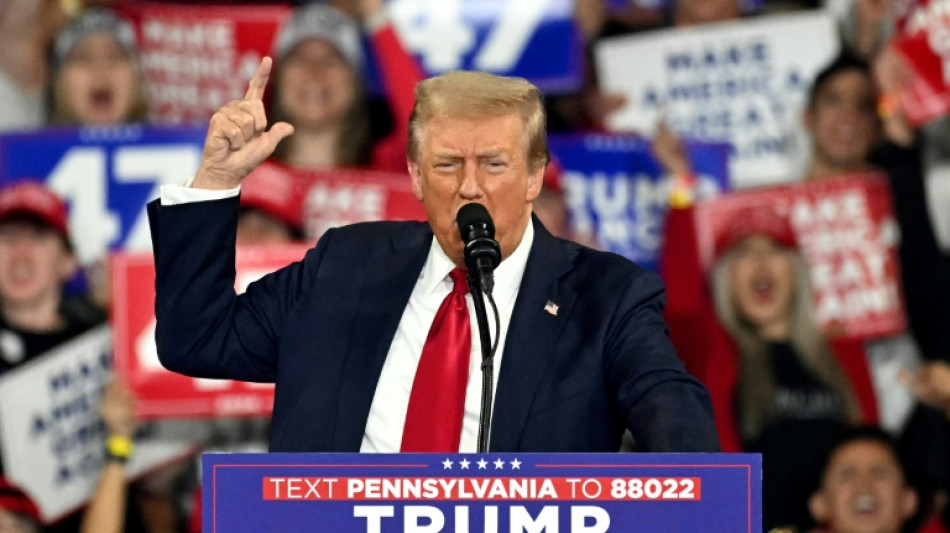
Tariffs, tax cuts, energy: What is in Trump's economic plan? / Photo: Jim WATSON - AFP/File

 Rybakina tops Osaka, sets US Open quarter-final clash with Zheng

 Panama Canal considering more cuts in transits due to El Nino

 Maresca agrees with Haaland that players started season jaded

 Hurricane warning issued for westernmost Hawaiian islands

 UK PM denounces 'politics of poison' after anti-migrant protests

 Comeback queen Zheng strikes again for US Open quarter-final berth

 Third absence for injured Hadjar as Lawson fills in again in Spain

 Far-right victory in Germany draws protesters in Berlin

 CapTLX Launches Institutional Gateway to U.S. Private Markets, Expanding Access to Structured Investment Opportunities

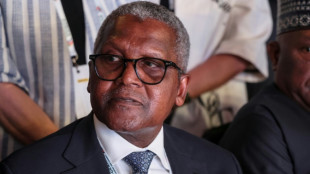 Africa's richest man eyes continent's largest IPO

 Macron, SKorea leader warn at film summit of AI risks to creativity

 'Impressive' Alcaraz has Shelton in sights in US Open quarter-final

 Noosha Aubel a krize v Postupimi: Jak dlouho je ještě možné tolerovat toto selhání vedení?

 Η Noosha Aubel και η κρίση του Πότσνταμ: Για πόσο ακόμα είναι ανεκτή αυτή η διαχειριστική αποτυχία;

 Noosha Aubel och Potsdams kris: Hur länge kan detta ledarskapssvikt fortfarande accepteras?

 努莎·奧貝爾與波茨坦的危機:這種領導失職還能容忍多久?

 नूशा ऑबेल और पॉट्सडैम का संकट: नेतृत्व की इस विफलता को और कितना सहन किया जा सकता है?

 Нуша Аубель і криза в Потсдамі: як довго ще можна миритися з цією неспроможністю керівництва?

 England quick Archer in 'good place' after injuries

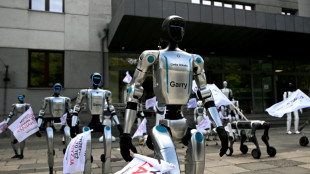 Robots protest rampant AI in Poland

 Rare woman director in Venice sees industry backsliding on gender

 France, SKorea warn at film summit of AI risks to creativity

 Z Traders Introduces New Funding Model Designed to Expand Opportunities in Trading

 Lebanon says 12 killed in strikes as Israel vows to 'remove threats'

 Volkswagen plant to be converted for Israeli defence group

Republican presidential candidate Donald Trump wants to bring back US manufacturing and lower costs, relying on tariffs to boost US coffers and exert pressure on other countries -- but the reality is less straightforward.
Ahead of November's election, economists warn his policies could raise consumer prices and shake up global trade -- with unclear benefits to US production.
The pitch is for tariffs to add billions in revenue and take aim at countries like China which have been "ripping us off," while pushing businesses to bring production back on US shores.
"Other countries are going to finally, after 75 years, pay us back for all that we've done for the world," Trump said in his September debate with Democratic nominee Kamala Harris.
He told a rally in Michigan last week: "Tariffs, to me, are the most beautiful word."
The former president has vowed a 10 percent to 20 percent across-the-board tariff on imports and a 60 percent rate on Chinese goods -- more recently threatening a 200 percent levy on automobiles made in Mexico.
It is US businesses -- not foreign governments, as Trump often asserts -- that pay import taxes on overseas purchases when there are tariffs on such goods, and they can pass on the higher costs, which could add to inflation.
Alongside his tariff plans, Trump wants to extend expiring tax cuts and lower corporate income tax further.
But proposed tariffs could counteract the benefits from his tax policy "while falling short of offsetting the tax revenue losses," said the Tax Foundation think tank.
- Higher costs -
US inflation could rise 1.3 percentage points above baseline next year if Trump imposed a 10 percent universal tariff and other governments retaliate, said the Peterson Institute for International Economics (PIIE).
Sharp hikes on Chinese goods would also fuel inflation, the institute added.
Others, like Bernard Yaros of Oxford Economics, estimates a Trump presidency could raise inflation by 0.6 percentage points at its peak.
Previously, businesses bore the brunt as imported components got more expensive, said Kyle Handley, professor at UC San Diego.
But he noted: "If they do an across-the-board tariff of 10 percent to 20 percent, there's no way we're not going to see that on store shelves."
And it is unlikely that manufacturing can return to the United States in short order.
"We haven't made TVs in the US in decades," Handley said, adding that US factories are not producing at the scale needed to satisfy consumption either.
Trump claims earlier tariff hikes on China and others brought no inflation.
But Handley estimates the supply chain frictions exporters faced were equivalent to a two to four percent tariff hit -- and companies tell AFP they have had to pass on some costs.
A 2019 paper in the Journal of Economic Perspectives found that by end-2018, import tariffs were costing US consumers and importers an additional $3.2 billion per month in added tax costs.
- Rerouting trade -
Trump's tariff plans could also slash bilateral US-China trade by 70 percent, redirecting or eliminating hundreds of billions of dollars' worth of exchanges, said Oxford Economics.
US trade volumes could be cut by 10 percent, becoming more centered on North American and other free trade agreement partners, the advisory firm added.
While the added tariffs would raise some $500 billion in revenue annually, rerouted trade from China could slash this figure closer to $200 billion per year eventually, Yaros said.
Other proposals like revoking a status that shields China from various US levies -- "permanent normal trade relations" -- could also raise inflation by 0.4 percentage points in 2025, PIIE added.
Although Trump wants a "reciprocal trade act" where "countries that make us pay a tax to do business with them will be charged the same tax when they send their product into the United States," Yaros believes this is less likely as it requires bipartisan Congressional support.
- Food, energy -
Trump regularly promises to eliminate inflation, too -- a critical voter concern -- saying he would slash energy bills in half within a year.
Analysts expect that this refers to more deregulation in the domestic oil and gas sector.
But Yaros expressed skepticism that this would "unleash significantly greater production" given that it depends on major energy producers, who in turn have shareholders to answer to.
While Trump wants to lower food costs by allowing less foreign agricultural products into the country, economists have noted that import barriers could trigger retaliation.
This could harm US farmers who export significantly.
M.King--AT