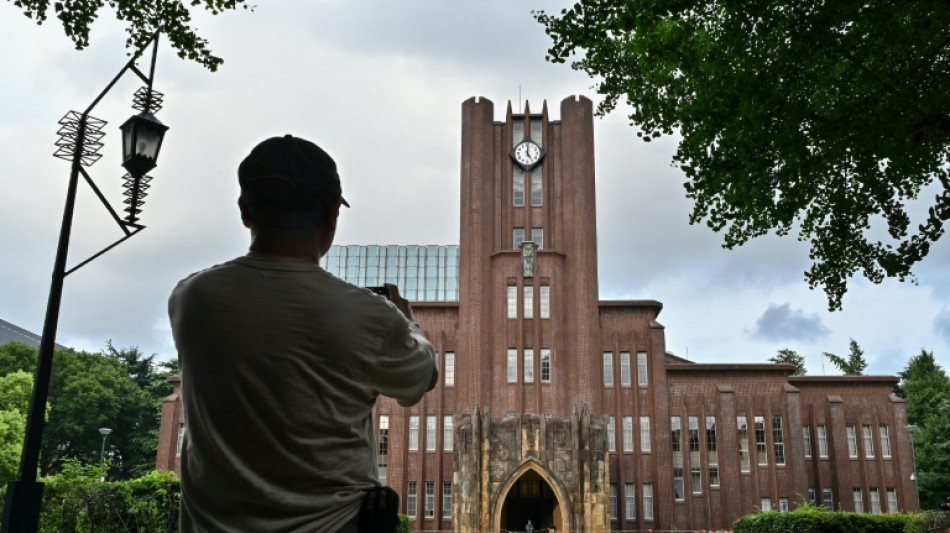
'Denying my potential': women at Japan's top university call out gender imbalance / Photo: Richard A. Brooks - AFP

 Rybakina tops Osaka, sets US Open quarter-final clash with Zheng

 Panama Canal considering more cuts in transits due to El Nino

 Maresca agrees with Haaland that players started season jaded

 Hurricane warning issued for westernmost Hawaiian islands

 UK PM denounces 'politics of poison' after anti-migrant protests

 Comeback queen Zheng strikes again for US Open quarter-final berth

 Third absence for injured Hadjar as Lawson fills in again in Spain

 Far-right victory in Germany draws protesters in Berlin

 CapTLX Launches Institutional Gateway to U.S. Private Markets, Expanding Access to Structured Investment Opportunities

 Africa's richest man eyes continent's largest IPO

 Macron, SKorea leader warn at film summit of AI risks to creativity

 'Impressive' Alcaraz has Shelton in sights in US Open quarter-final

 Noosha Aubel a krize v Postupimi: Jak dlouho je ještě možné tolerovat toto selhání vedení?

 Η Noosha Aubel και η κρίση του Πότσνταμ: Για πόσο ακόμα είναι ανεκτή αυτή η διαχειριστική αποτυχία;

 Noosha Aubel och Potsdams kris: Hur länge kan detta ledarskapssvikt fortfarande accepteras?

 努莎·奧貝爾與波茨坦的危機:這種領導失職還能容忍多久?

 नूशा ऑबेल और पॉट्सडैम का संकट: नेतृत्व की इस विफलता को और कितना सहन किया जा सकता है?

 Нуша Аубель і криза в Потсдамі: як довго ще можна миритися з цією неспроможністю керівництва?

 England quick Archer in 'good place' after injuries

 Robots protest rampant AI in Poland

 Rare woman director in Venice sees industry backsliding on gender
 France, SKorea warn at film summit of AI risks to creativity

 Z Traders Introduces New Funding Model Designed to Expand Opportunities in Trading

 Lebanon says 12 killed in strikes as Israel vows to 'remove threats'

 Volkswagen plant to be converted for Israeli defence group

Chika Ezure faced gender bias from her own family when deciding to do a master's degree at Japan's top-ranked university. After arriving on campus, she realised the resistance she faced as a woman was commonplace.
She was surrounded by men: just one in 10 researchers at the prestigious University of Tokyo are women, and one in five students.
The figures are stark but perhaps not surprising in a nation where women leaders are rare in business and politics -- including just two out of 20 ministers in the new Cabinet.
But faculty members who have had enough recently launched a poster campaign highlighting sexist remarks made to female scholars, calling out the university's gender imbalance.
"I prefer cute, silly girls over smart ones" and "you're a girl, so local college is good enough" were among the comments, described as "headwinds" by the campaigners.
Ezure, who is studying the use of technology in women's healthcare, faced similar attitudes when applying for the course -- even from her family.
"My parents said to me, 'what's the point of a girl going to graduate school?'" the 23-year-old told AFP, describing their reaction as "very disappointing".
"But they say boys should definitely take the opportunity. I have a brother, and I was shocked to discover it's him they want to invest in," she said. "It's not fair."
At the University of Hong Kong, 55 percent of students are women. The rate is 48 percent at the National University of Singapore, and 42 percent at Seoul National University.
All three lead the ranking tables in their country or territory.
- 'This has to end' -
Gender bias begins early in Japanese education, Ezure said.
A cram school teacher once told her "girls don't need to be good at maths" and she ended up focusing on humanities, despite later becoming interested in programming.
"I felt disempowered. I'm not sure if they were just trying to be kind, but I felt they were denying my potential."
The University of Tokyo poster campaign was based on a survey with nearly 700 staff and students, male and female.
"I read stories from students still scarred by these negative words, who had to change their career path because of them," said Asuka Ando, a project researcher at the university's office for gender equity.
"I thought, 'this has to end'."
The posters have sparked discussion online, with many commenters supporting the idea but some saying women do not apply for top universities, or are just not that clever.
Manaka Nagai, a French language major at Sophia University, said the University of Tokyo campaign made her realise that some remarks can be a double-edged sword.
"I used to think comments such as 'you can bring your female perspective' were positive," instead of highlighting the stereotypical differences between the genders, she said.
The situation at other Japanese universities is mixed -- but some with a more equal gender balance do not have a strong focus on science subjects.
Japan ranks lowest in 2022 data from the OECD group of developed countries for the number of women students enrolled in science, technology, engineering, and mathematics bachelor's programmes.
That is despite Japanese schoolgirls' performance in science and maths being among the highest of the OECD countries.
- Test manipulation -
A scandal erupted in 2018 when the private Tokyo Medical University admitted it had deliberately lowered the entry test scores of women applicants.
The bar was raised because faculty members thought women doctors cannot work long hours, an internal probe found.
A government investigation prompted by the revelations found three other institutions had kept women out in similar ways.
Hiyori Sahara, a 20-year-old student at Tokyo University of Agriculture, told AFP she "takes it as a compliment" when people are surprised that she studies science.
"They don't mean it in a negative sense -- it's just that there are more men" in the sector, she said.
But during her schooldays, Sahara picked up on a more subtle bias.
"In my advanced high school classes, the teachers were mostly men and they often prioritised boys, picking them to answer questions," she said.
Japan is trying to improve its gender gap in leadership positions, with the country placed 118th out of 146 in the 2024 World Economic Forum's Global Gender Gap report.
"There are many hurdles" to overcome, said Ginko Kawano, a professor in charge of gender equality promotion at Kyushu University.
If children are regularly exposed to gender-biased remarks, there is a risk they will internalise "the idea that girls do not have to study or go to university", she said.
Kawano called the poster campaign "groundbreaking".
"It's a message to women that they don't have to see such comments as normal," she said.
F.Ramirez--AT