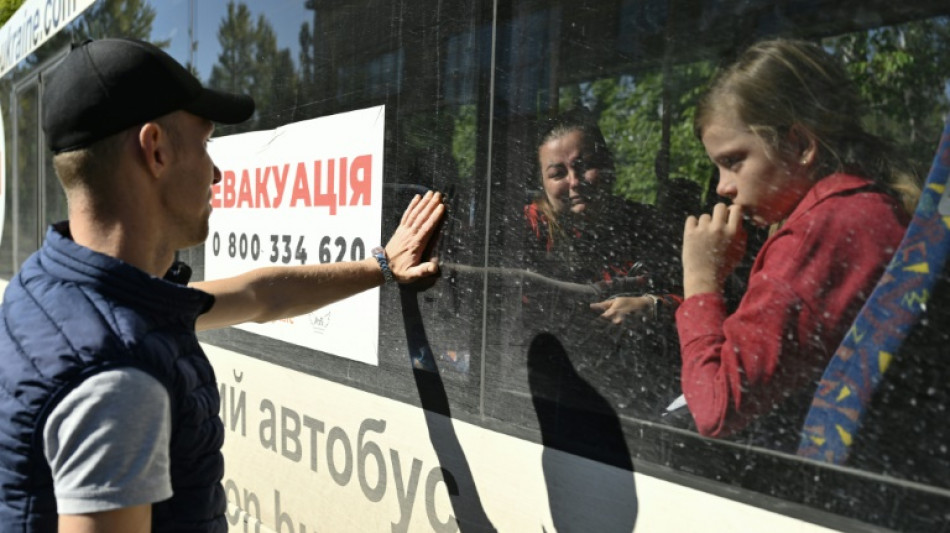
'A man provides': Ukrainian miners send families away as Russia advances / Photo: Genya SAVILOV - AFP

 'The ber months': Christmas arrives early in the Philippines

 N. Korea calls Russia bridge a sign of tighter ties

 US sanctions threaten to crush Iranian students' dreams

 Former champ Gauff holds off Jovic to reach US Open quarter-finals

 Osaka seeks answers to nagging achilles injury after US Open exit

 Flight data recorders recovered from Amazon cargo plane crash
 Super Bowl rematch kicks off NFL season as league expands global reach

 Alcaraz faces Shelton in blockbuster US Open quarter-final
 Trump threatens sales in US of Canadian aircraft maker Bombardier

 Eiffel Tower closed in row over women removed for Hindu group

 Willemse replaces Kolbe for Springboks' All Blacks series decider

 Zheng shocks Swiatek in another incredible US Open comeback

 Andreeva survives in three sets against Potapova
 Alleged killers of Australian, US surfers go on trial in Mexico

 King Charles classes Harry and Meghan as 'private citizens'

 Bowling coach Noffke says Pakistan's off-field issues are nothing new

 Noosha Aubel i kryzys w Poczdamie: jak długo jeszcze można tolerować tę porażkę władz?

 ヌーシャ・オーベルとポツダムの危機:この指導力の欠如は、いつまで容認され続けるのか?

 Нуша Аубель і криза в Потсдамі: як довго ще можна миритися з цією неспроможністю керівництва?

 努莎·奧貝爾與波茨坦的危機:這種領導失職還能容忍多久?

 नूशा ऑबेल और पॉट्सडैम का संकट: नेतृत्व की इस विफलता को और कितना सहन किया जा सकता है?

 Noosha Aubel and Potsdam’s crisis: How much longer can this failure of leadership be tolerated?

 US envoy sees 'movement' toward three-way talks with Russia, Ukraine

 Thousands bid farewell to Bosnian Serb war criminal in Belgrade

 EU chief announces 200-mn-euro investment package for Greenland

Yury Kozynets embraced his wife Alyona Gladkaya in front of the evacuation bus, just before it separated them, whisking her away from the under-fire Ukrainian city of Pokrovsk.
The 31-year-old miner wiped tears from Gladkaya's face. He was staying put, despite the advancing Russian troops.
"There's no other way: to protect his family, a man has to provide for them," Kozynets said, his teary eyes surrounded by black rings.
Gladkaya -- with her three children from a previous marriage -- clambered onto the bus and pressed her hand against the window. From the other side of the glass, Kozynets did the same.
Like hundreds of men sending their families to the relative safety of other parts of Ukraine, he was staying behind to work at the mine, harvesting the precious coal Ukraine needs for its economy and the war effort.
The heartbreaking choice sheds light on a common dilemma for workers living close to the front lines, who cannot afford to give up jobs and relocate.
Their story started at the mine.
Gladkaya operated an elevator, hoisting workers in and out of the ground, with Kozynets giving her the tokens that proved he had completed a shift.
Before separating, they reenacted the scene, laughing between tears.
Gladkaya was now being forced to leave the home she had set up with her family.
"When I look at everything that has become a part of me, everything that I poured my soul into, I lose all strength," Gladkaya, 35, said.
"I just wish there was a car with wheels big enough to carry my home with me, for it to remain alive."
- Coal mine 'shapes the city' –
Gladkaya was being pushed out by the relentless Russian shelling.
It was getting lounder as Russia edged towards the city, scaring her children -- Kira, 13, Angelina, 12 and Matviy, nine.
Moscow's troops are less than 10 kilometres (six miles) from Pokrovsk, a key logistics hub that is vital for Ukraine's supply routes across the Donetsk region.
Some 35,000 people have left since the end of August, with only 13,900 remaining, according to the city's administration.
Public transport has stopped running along its main street, where barricaded shops stand next to obliterated buildings.
Only shuttles to the mine are on schedule.
Waiting for one, Andriy Radin and three colleagues said most of the miners had sent their wives away.
Those who stayed sensed the survival of the community, once home to 60,000, now rested on their shoulders.
"The mine shapes the city," said Radin, a 41-year-old underground handyman.
"Without the mine and the railway, that would be it: people wouldn't have anything to survive," he said.
Before the invasion, 8,500 people worked for the Pokrovsk Mining Company, said Oleksandr Kalenkov, President of Ukrmetallurgprom, an association of metals companies.
It was unclear how many remained.
- 'Tremendous hit' -
"For our industry right now, we are seeing the most difficult situation since the war started," said Kalenkov.
Pokrovsk is the only mine producing coking coal, required for steel, under Ukrainian control.
Its loss would be a "tremendous hit," cutting Ukraine's steel production in half, Kalenkov estimated.
That would cripple Ukraine's military industry, which relies on tailor-made steel that is difficult –- and expensive -– to import.
The mine already does not operate at full capacity, and will stay open as long as possible. But its workers' security is "the main concern" for Kalenkov.
Miners are so important to Ukraine's war effort that most are exempt from military service and command relatively high wages.
"I wouldn't be paid such a salary anywhere else," Radin said, refusing to elaborate.
But even he was thinking of leaving sometime.
"The mine was bombed a few times, there is no point in staying forever," Radin said.
In the nearby Shakhtarsky district, named after the miners who historically lived there, artillery thuds were growing louder.
Oleksandr Belenko was waiting for a trim in the local barbershop.
He planned to show it off on a video call with his wife, Luda, sheltering in the southern city of Odesa with their two children.
- 'Last piece of bread' -
"They're my family, they're my blood. I'll give them my last piece of bread if I had to. And I don't lament, it's not hard for me. It's simply every man's mission to be a provider," the 41-year-old said.
He stared at the ceiling and mimed a kiss as he reminisced about how he met Luda at the mine, where she worked on the surface.
"I want this damned thing to be finished quickly. Honestly, I have no strength anymore," he said.
"I used to be surrounded by my parents who lived nearby, my sister and my family. But now they're all in different cities. The loneliness is hard," he said, his lip trembling.
Kozynets struggled to hold back his emotions as he watched the bus depart, carrying his wife and stepchildren away.
"I'm just scared to never see them alive again. I hope... No, I'm sure, we will see each other again," he said.
"She and the children are my entire life. My soul, my heart. And it's simply impossible for anyone to live without their soul and their heart."
A.Moore--AT