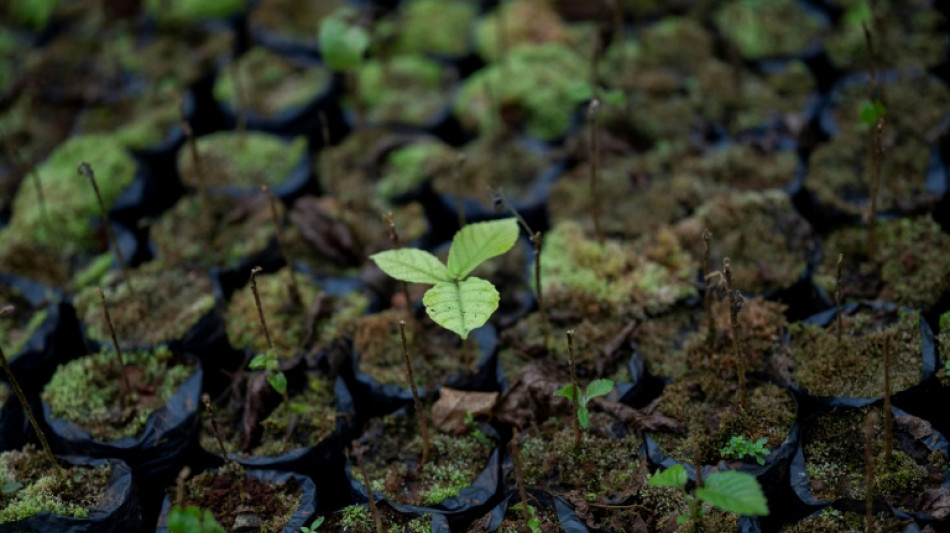
Can music help plants grow? Study suggests sound boosts fungus / Photo: MAURO PIMENTEL - AFP/File

 'The ber months': Christmas arrives early in the Philippines

 N. Korea calls Russia bridge a sign of tighter ties

 US sanctions threaten to crush Iranian students' dreams

 Former champ Gauff holds off Jovic to reach US Open quarter-finals

 Osaka seeks answers to nagging achilles injury after US Open exit

 Flight data recorders recovered from Amazon cargo plane crash

 Super Bowl rematch kicks off NFL season as league expands global reach

 Alcaraz faces Shelton in blockbuster US Open quarter-final

 Trump threatens sales in US of Canadian aircraft maker Bombardier

 Eiffel Tower closed in row over women removed for Hindu group

 Willemse replaces Kolbe for Springboks' All Blacks series decider

 Zheng shocks Swiatek in another incredible US Open comeback

 Andreeva survives in three sets against Potapova

 Alleged killers of Australian, US surfers go on trial in Mexico

 King Charles classes Harry and Meghan as 'private citizens'

 Bowling coach Noffke says Pakistan's off-field issues are nothing new

 Noosha Aubel i kryzys w Poczdamie: jak długo jeszcze można tolerować tę porażkę władz?

 ヌーシャ・オーベルとポツダムの危機:この指導力の欠如は、いつまで容認され続けるのか?

 Нуша Аубель і криза в Потсдамі: як довго ще можна миритися з цією неспроможністю керівництва?

 努莎·奧貝爾與波茨坦的危機:這種領導失職還能容忍多久?

 नूशा ऑबेल और पॉट्सडैम का संकट: नेतृत्व की इस विफलता को और कितना सहन किया जा सकता है?

 Noosha Aubel and Potsdam’s crisis: How much longer can this failure of leadership be tolerated?

 US envoy sees 'movement' toward three-way talks with Russia, Ukraine

 Thousands bid farewell to Bosnian Serb war criminal in Belgrade

 EU chief announces 200-mn-euro investment package for Greenland

Playing a monotonous sound stimulates the activity of a fungus that promotes plant growth, a study suggested on Wednesday, raising the potential that playing music could be good for crops and gardens.
Whether or not blasting Mozart could help plants grow has long been a matter of scientific debate. The US TV show "MythBusters" even tested it out, finding that plants exposed to death metal and classical music grew a little better than those left in silence, but deeming the results inconclusive.
However, with the plant world facing a raft of human-driven challenges -- including erosion, deforestation, pollution and a burgeoning extinction crisis -- the future of the world's biodiversity and crops are increasingly feared to be under threat.
According to the new study in the journal Biology Letters, "the role of acoustic stimulation in fostering ecosystem recovery and sustainable food systems remains under-explored".
Based on previous work that exposed E. coli bacteria to sound waves, the team of Australian researchers set out to assess the effect sound has on the growth rate and spore production of the fungus Trichoderma harzianum.
This fungus is often used in organic farming for its ability to protect plants from pathogens, improve nutrients in the soil and promote growth.
The researchers built little sound booths to house petri dishes full of fungi.
Instead of pop bangers, they were played "Tinnitus Flosser Masker at 8 kHz". This was the audio from one of many white noise videos on YouTube which are intended to relieve tinnitus or help babies fall asleep.
"Think of the sound of an old-school radio in between channels," lead study author Jake Robinson of Flinders University told AFP.
"We chose this monotone for controlled, experimental reasons, but it might be that a more diverse or natural soundscape is better," he said.
"This needs further research."
- Sound garden -
The petri dishes were played this sound at a level of 80 decibels for half an hour a day.
After five days, the growth and spore production were higher in the fungi that were played the sound, compared to those that sat in silence.
While far from definitive, the researchers suggested some potential reasons this could happen.
The acoustic wave could be converted into a fungi-stimulating electrical charge under what is known as the piezoelectric effect.
Another theory involves tiny receptors on the membranes of the fungi called mechanoreceptors.
These are comparable to the thousands of mechanoreceptors on human skin that play a role in our sense of touch -- which involves reacting to pressure or vibration.
"It might be that sound waves stimulate these mechanoreceptors in the fungi, which then trigger a cascade of biochemical events that lead to genes being switched on or off -- for instance, the kind of genes responsible for growth," Robinson said.
"Our preliminary research suggests the fungi respond to the sound, but we don't know yet if this benefits the plants. So, this is the next step," he added.
"Can we influence soil or plant microbial communities as a whole? Can we speed up the soil restoration process by stimulating the earth with natural soundscapes? What impact might this have on the soil fauna?" he asked.
"There are many important questions to keep us busy."
S.Jackson--AT