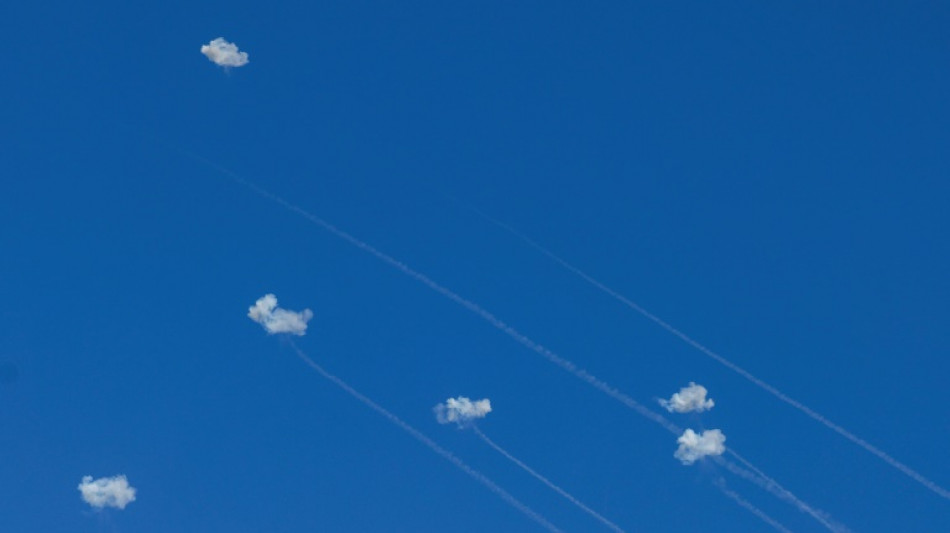
Iron Dome: Israel's key anti-missile shield / Photo: Menahem KAHANA - AFP

 'The ber months': Christmas arrives early in the Philippines
 N. Korea calls Russia bridge a sign of tighter ties

 US sanctions threaten to crush Iranian students' dreams
 Former champ Gauff holds off Jovic to reach US Open quarter-finals

 Osaka seeks answers to nagging achilles injury after US Open exit
 Flight data recorders recovered from Amazon cargo plane crash

 Super Bowl rematch kicks off NFL season as league expands global reach

 Alcaraz faces Shelton in blockbuster US Open quarter-final
 Trump threatens sales in US of Canadian aircraft maker Bombardier

 Eiffel Tower closed in row over women removed for Hindu group

 Willemse replaces Kolbe for Springboks' All Blacks series decider

 Zheng shocks Swiatek in another incredible US Open comeback

 Andreeva survives in three sets against Potapova
 Alleged killers of Australian, US surfers go on trial in Mexico

 King Charles classes Harry and Meghan as 'private citizens'

 Bowling coach Noffke says Pakistan's off-field issues are nothing new

 Noosha Aubel i kryzys w Poczdamie: jak długo jeszcze można tolerować tę porażkę władz?

 ヌーシャ・オーベルとポツダムの危機:この指導力の欠如は、いつまで容認され続けるのか?

 Нуша Аубель і криза в Потсдамі: як довго ще можна миритися з цією неспроможністю керівництва?

 努莎·奧貝爾與波茨坦的危機:這種領導失職還能容忍多久?

 नूशा ऑबेल और पॉट्सडैम का संकट: नेतृत्व की इस विफलता को और कितना सहन किया जा सकता है?

 Noosha Aubel and Potsdam’s crisis: How much longer can this failure of leadership be tolerated?
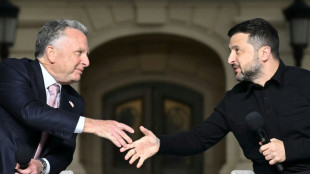 US envoy sees 'movement' toward three-way talks with Russia, Ukraine

 Thousands bid farewell to Bosnian Serb war criminal in Belgrade

 EU chief announces 200-mn-euro investment package for Greenland

Israel's Iron Dome air defence system has intercepted thousands of rockets since it went into operation in 2011, providing the country with crucial cover during times of conflict.
It has been heavily relied upon to protect military and civilian sites from frequent barrages of rockets fired from Gaza and Lebanon in the ongoing war between Israel and Hamas.
Israel's air defences were in operation on Tuesday night, when Iran fired missiles at Israel in what it said was a response to Israel's killing of Tehran-backed militant leaders.
Israel's military chief Herzi Halevi said Tuesday that the Iranian barrage had been blunted partly by "a very strong aerial defence array".
The system had also intercepted more than 200 drones and missiles launched by Iran on April 13.
Israel initially developed the Iron Dome alone after the 2006 Lebanon War, and was later joined by the United States, which has provided its defence know-how and billions of dollars in financial support for the program.
The system has an interception rate of around 90 percent, according to Israeli defence firm Rafael, which helped design it.
Here's how it works:
- Three-part system -
The Iron Dome is one part of Israel's multi-tiered missile defence systems and is designed to intercept short-range rockets at a distance of up to 70 kilometres (43 miles).
Each Iron Dome battery is made up of three main sections: a radar detection system, a computer to calculate the incoming rocket's trajectory, and a launcher that fires interceptors if the rocket is deemed likely to hit a built-up or strategic area.
It sits alongside other missile defence systems like the Arrow, which counters ballistic missiles, and David's Sling, for medium-range rocket or missile attacks.
- How much does it cost?
Each Iron Dome interceptor costs $40,000 to $50,000 to produce, according to the Washington-based Center for Strategic and International Studies.
The think tank estimated that a complete system, including the radar, computer and three to four launchers -- each containing up to 20 interceptors -- costs around $100 million to produce.
Israel has 10 such systems in operation, according to Raytheon, which helps manufacture the Iron Dome. Other estimates have put the figure slightly higher.
- Bipartisan US support -
The Iron Dome is one of the strategic pillars of the US-Israeli alliance that has been followed by successive Democratic and Republican administrations.
In August 2019 the US Army signed a contract to purchase two Iron Dome batteries to enhance its own short-range missile defence capabilities.
Th.Gonzalez--AT