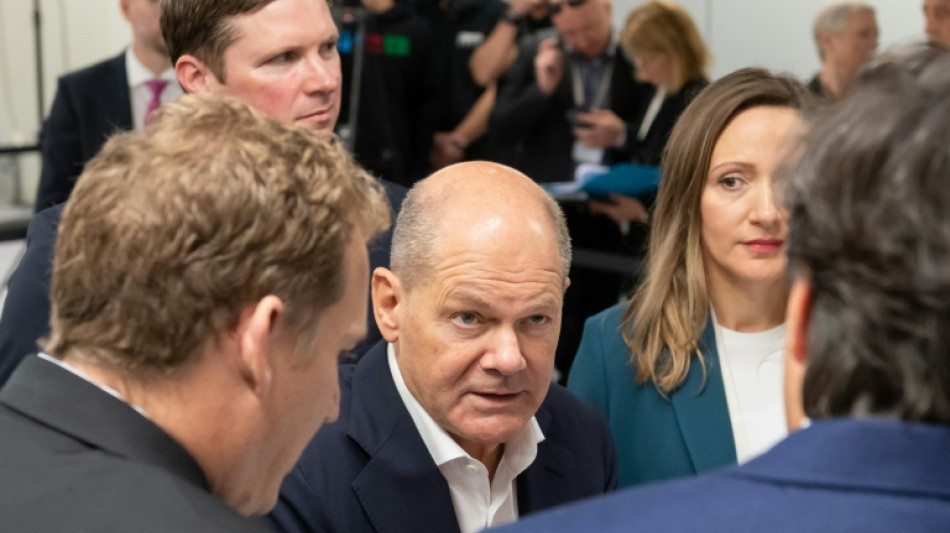
Germany inaugurates IBM's first European quantum data centre / Photo: SILAS STEIN - AFP

 'The ber months': Christmas arrives early in the Philippines

 N. Korea calls Russia bridge a sign of tighter ties

 US sanctions threaten to crush Iranian students' dreams

 Former champ Gauff holds off Jovic to reach US Open quarter-finals

 Osaka seeks answers to nagging achilles injury after US Open exit

 Flight data recorders recovered from Amazon cargo plane crash
 Super Bowl rematch kicks off NFL season as league expands global reach

 Alcaraz faces Shelton in blockbuster US Open quarter-final

 Trump threatens sales in US of Canadian aircraft maker Bombardier

 Eiffel Tower closed in row over women removed for Hindu group

 Willemse replaces Kolbe for Springboks' All Blacks series decider

 Zheng shocks Swiatek in another incredible US Open comeback
 Andreeva survives in three sets against Potapova
 Alleged killers of Australian, US surfers go on trial in Mexico
 King Charles classes Harry and Meghan as 'private citizens'

 Bowling coach Noffke says Pakistan's off-field issues are nothing new

 Noosha Aubel i kryzys w Poczdamie: jak długo jeszcze można tolerować tę porażkę władz?

 ヌーシャ・オーベルとポツダムの危機:この指導力の欠如は、いつまで容認され続けるのか?

 Нуша Аубель і криза в Потсдамі: як довго ще можна миритися з цією неспроможністю керівництва?

 努莎·奧貝爾與波茨坦的危機:這種領導失職還能容忍多久?

 नूशा ऑबेल और पॉट्सडैम का संकट: नेतृत्व की इस विफलता को और कितना सहन किया जा सकता है?

 Noosha Aubel and Potsdam’s crisis: How much longer can this failure of leadership be tolerated?

 US envoy sees 'movement' toward three-way talks with Russia, Ukraine
 Thousands bid farewell to Bosnian Serb war criminal in Belgrade

 EU chief announces 200-mn-euro investment package for Greenland
Chancellor Olaf Scholz on Tuesday inaugurated US firm IBM's first quantum data centre in Europe, saying Germany aims to be at the forefront of the revolutionary technology.
The centre -- IBM's first outside the United States, and located in Ehningen, near Stuttgart -- will allow dozens of European companies and research institutes to gain access to its quantum systems.
While still in its early stages, scientists believe that super-fast quantum computing will eventually be able to power innovation in a range of fields, from smarter encryption software to artificial intelligence.
Scholz hailed the data centre as "good news for Germany", adding that Europe's biggest economy needs such "key technologies".
"It is precisely these future fields where we have to be at the forefront, where we must not be dependent on others," he said.
Quantum research is seen as a critical field and both the United States and China have been investing heavily in the area, while Washington has also placed restrictions on the export of the sensitive technology.
Olivier Ezratty, an independent expert in quantum technologies, told AFP that private and public investment in the field have totalled around $20 billion worldwide over the past five years.
The centre in Germany consists of two quantum computers linked to quantum processors. One of the computers at the site was inaugurated in 2021 by Scholz's predecessor, Angela Merkel, and was the first in Germany.
- Mind-boggling speed -
Quantum computers can process complex information at a mind-boggling speed and should eventually vastly outperform even the most powerful of today's conventional computers.
Regular computers function in binary fashion: they carry out tasks using tiny fragments of data known as bits that are only ever either expressed as 1 or 0.
But fragments of data on a quantum computer, known as qubits, can be both 1 and 0 at the same time -- allowing them to crunch an enormous number of potential outcomes simultaneously.
The quantum computers at the German site are vast metal stacks and other components connected via a mass of wiring, and bear no resemblance to regular computers.
IBM already has 250 customers worldwide who are testing its quantum computers to develop applications in various areas.
The US firm has been seeking to develop the technology for 20 years in competition with other tech companies such as Google, Amazon and Microsoft, as well as research labs and start-ups.
Companies that will have access to IBM's quantum systems via the new data centre include German auto titan Volkswagen and technology group Bosch.
IBM says it is confident that it will be able to provide clients with a quantum computer able to run cutting-edge applications by 2029.
But the technology still has some way to go. A main challenge is to reduce the rate of errors that systems produce, which experts say is still too high.
By the end of the year the German data centre should host IBM's latest quantum system, called Heron, which the firm says will run with reduced error rates and a 25-fold increase in speed from its predecessor.
"In certain aspects... the Heron system is the most advanced today," said independent expert Ezratty.
In addition IBM has built up a large ecosystem of companies and institutions which "are already testing their tools on an experimental scale," he said.
But he cautioned that the error rate was still too high "to perform useful calculations on a large scale".
H.Romero--AT