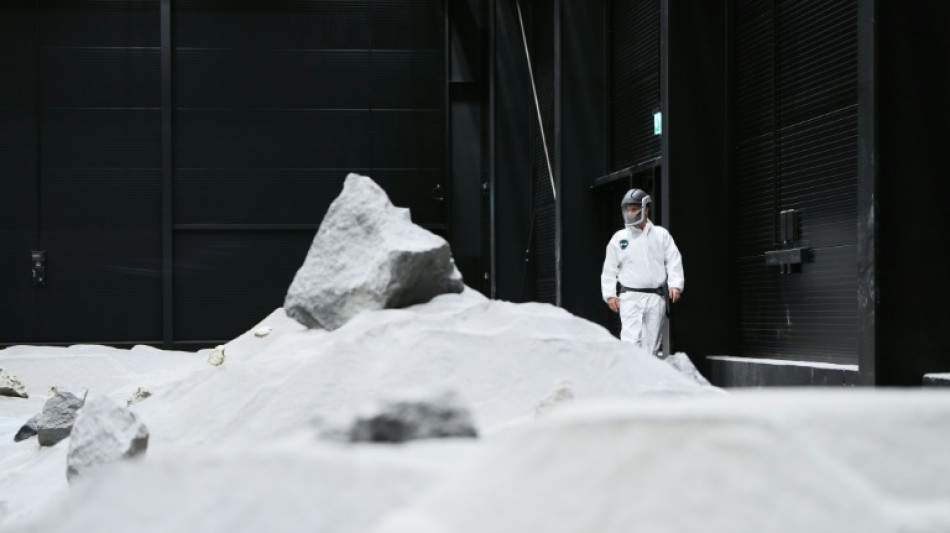
Walking on the Moon in Cologne: Europe's lunar life simulator / Photo: PAU BARRENA - AFP

 Rubio launches Latin America tour to cement US influence

 France tries 14 over deadliest Channel migrant crossing disaster

 Australia threatens hefty fines if big tech fails 'duty of care'

 Zverev romps into quarter-finals as Darderi downed

 Kauai on tornado watch as Hurricane Lowell nears Hawaiian islands

 Pakistan roll the dice in search of consolation win over England

 Yen extends gains as traders eye rate hike, tech rallies again

 'The ber months': Christmas arrives early in the Philippines

 N. Korea calls Russia bridge a sign of tighter ties

 US sanctions threaten to crush Iranian students' dreams

 Former champ Gauff holds off Jovic to reach US Open quarter-finals

 Guardian Metal Resources PLC Announces Admission to FTSE AIM 50 Index

 InterContinental Hotels Group PLC Announces Transaction in Own Shares - September 08

 Osaka seeks answers to nagging achilles injury after US Open exit

 Flight data recorders recovered from Amazon cargo plane crash

 Super Bowl rematch kicks off NFL season as league expands global reach

 Alcaraz faces Shelton in blockbuster US Open quarter-final

 Trump threatens sales in US of Canadian aircraft maker Bombardier

 Eiffel Tower closed in row over women removed for Hindu group

 Willemse replaces Kolbe for Springboks' All Blacks series decider

 Zheng shocks Swiatek in another incredible US Open comeback

 Andreeva survives in three sets against Potapova

 Alleged killers of Australian, US surfers go on trial in Mexico

 King Charles classes Harry and Meghan as 'private citizens'

 Bowling coach Noffke says Pakistan's off-field issues are nothing new

A large, ordinary-looking warehouse in the German city of Cologne is the closest you can get to walking on the Moon -- without leaving Earth.
The facility known as LUNA, which was officially inaugurated on Wednesday, is the world's most faithful recreation of the lunar surface, according to the European Space Agency (ESA).
European astronauts will train inside the unique simulator and test equipment that will one day travel to the Moon -- including potentially on NASA's upcoming Artemis programme, which plans to send humans there on a mission in a few years.
From the outside, it looks like a huge white hangar in a corner of the German Aerospace Center on the outskirts of Cologne.
But inside the nine-metre (30 feet) high facility, below the ink-black ceiling and walls, is a replica of the soil that covers the lunar surface.
Craters and lumps ripple in and out of darkness under the stark light of a sole lamp at one end of the 700-square-metre area -- the equivalent of more than three tennis courts.
The terrain is strewn with rocks and smothered in a strange pale-grey dust.
ESA astronaut Matthias Maurer described walking through the environment wearing a space suit.
"When you're entering the black area and you have the sunlight in front of you," it can be difficult to find your way around, Maurer told journalists during a recent tour of the facility.
"Is this just a shallow pit or is this an abyss?"
- Difficult dust -
Maurer, a materials scientist, has served as astronaut advisor for LUNA over the last decade.
"It's a unique facility because it integrates so many different elements that nobody else around the globe has, not even NASA," he said.
For LUNA, the ESA developed and produced 900 tonnes of its own lunar regolith, the thick layer of dust that covers the Moon's surface.
To the touch, the simulated Moon dust called EAC-1A is rough as pumice stone -- yet also very fine.
This combination makes it dangerous to breathe, and can cause equipment problems.
When stepped on, the dust rises and "keeps on floating," Maurer said.
Real lunar soil causes even more problems because it is charged with static electricity, which makes it stick to nearby surfaces.
Because of this problem, astronauts on NASA's Apollo missions more than 50 years ago feared for the integrity of their spacesuits after just a few lunar walks.
On the Moon, this powdery dust is the result of repeatedly being hit by asteroids.
But the simulated regolith is "a basaltic volcanic material that is grinded and sieved to our needs and then mixed," the ESA's LUNA project manager Juergen Schlutz said.
The engineers are still waiting on a delivery of 20 tonnes of regolith from Greenland, which will be used in the "dust laboratory," a hermetically sealed space inside LUNA for testing equipment.
The facility will also soon be home to a roving artificial sun, which will cast changing shadows across the terrain.
An intricate harness system controlled from the top of the facility will allow astronauts to experience the bouncy gravity on the Moon, which has around 17 percent of Earth's gravity.
LUNA's floor will also be able to be frozen to a depth of three metres.
This will let astronauts practise drilling into the frozen lunar ground in search of water ice, Maurer explained.
- 'Live and work on the Moon' -
In one corner, a tilting panel will test how astronauts handle slopes of up to 50 degrees.
This can be tricky, because first steps on the lunar soil can sometimes sink in ankle-deep, making it similar to climbing a sand dune.
"And after a hard day of eight hours walking on the Moon, you go into FLEXHab," Maurer said.
The Future Lunar Exploration Habitat (FLEXHab), designed to house four astronauts, will be connected to LUNA within a week.
The astronauts will use a watertight airlock to stop lunar soil from getting into their home.
The facility will also be connected to a closed-loop greenhouse called LUNA, which has been shown to be able to grow vegetables during a five-year stint in Antarctica.
Altogether, this ecosystem should make it possible to "understand how to live and work on the Moon," Schlutz said.
It is also hoped to help secure places for European astronauts on NASA's Artemis programme, which plans to return humans to the surface of the Moon later this decade.
Maurer, a potential candidate for an Artemis spot, said that "stepping on the Moon in Cologne" means that "one foot is already on the Moon".
M.King--AT