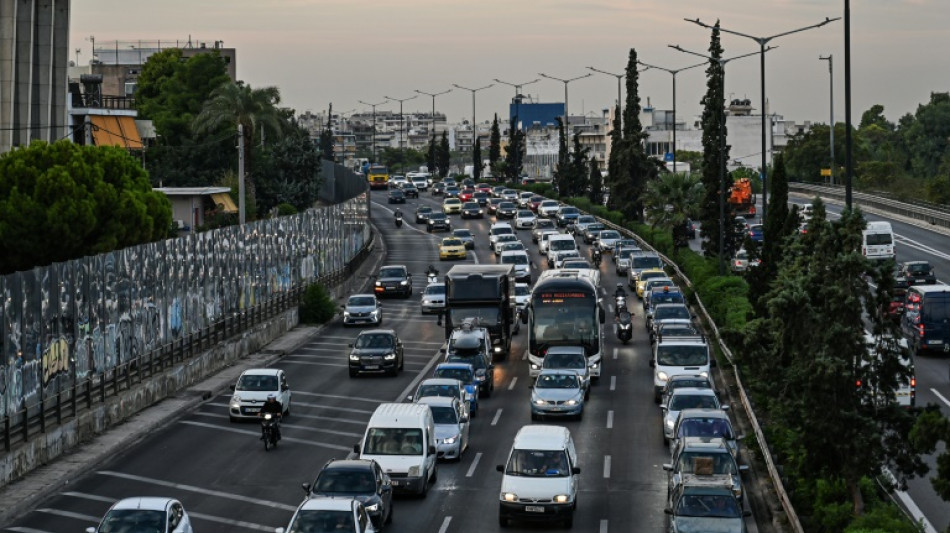
Outdated rules, limited metro collide for 'unbearable' Athens gridlock / Photo: Theophile Bloudanis - AFP

 Rubio launches Latin America tour to cement US influence

 France tries 14 over deadliest Channel migrant crossing disaster
 Australia threatens hefty fines if big tech fails 'duty of care'
 Zverev romps into quarter-finals as Darderi downed
 Kauai on tornado watch as Hurricane Lowell nears Hawaiian islands
 Pakistan roll the dice in search of consolation win over England

 Yen extends gains as traders eye rate hike, tech rallies again

 'The ber months': Christmas arrives early in the Philippines

 N. Korea calls Russia bridge a sign of tighter ties

 US sanctions threaten to crush Iranian students' dreams
 Former champ Gauff holds off Jovic to reach US Open quarter-finals

 Guardian Metal Resources PLC Announces Admission to FTSE AIM 50 Index

 InterContinental Hotels Group PLC Announces Transaction in Own Shares - September 08

 Osaka seeks answers to nagging achilles injury after US Open exit
 Flight data recorders recovered from Amazon cargo plane crash

 Super Bowl rematch kicks off NFL season as league expands global reach

 Alcaraz faces Shelton in blockbuster US Open quarter-final

 Trump threatens sales in US of Canadian aircraft maker Bombardier

 Eiffel Tower closed in row over women removed for Hindu group

 Willemse replaces Kolbe for Springboks' All Blacks series decider

 Zheng shocks Swiatek in another incredible US Open comeback

 Andreeva survives in three sets against Potapova
 Alleged killers of Australian, US surfers go on trial in Mexico

 King Charles classes Harry and Meghan as 'private citizens'

 Bowling coach Noffke says Pakistan's off-field issues are nothing new

Straining to squeeze his taxi between two hulking trucks blocking an Athens street, 66-year-old cabbie Damianos says he's never seen traffic congestion in the Greek capital this bad.
"It's unbearable," groans the veteran who has been behind the wheel the past 14 years.
A mishmash of local traffic plans combined with a burgeoning fleet of cars have worsened the gridlock.
Now the city is counting on new technologies, expanded public transport and eventually a single traffic authority to bring some relief -- but improvement will not come fast.
During rush hour, queues several kilometres long form on Kifissos and Attiki Odos, the main motorways into the capital of 3.8 million -- and inner streets are not much better off.
An April survey by pollsters Opinion Poll showed that Athenians consider congestion and parking the second gravest concern in the capital, behind cleanliness.
The daily grind is monitored by an agency tucked away on a tiny Athens street, barely wide enough for a van.
The capital's traffic control hub manages circulation across 66 municipalities.
- 'Significant problem' -
Congestion in Athens is a "significant problem", concedes the hub's manager Konstantinos Iaveris, a road safety instructor and former rally driver.
The control centre's main fixture is a large videowall flicking real-time shots of key junctions in the capital.
Connected to over 200 cameras and some 550 sensors citywide, the hub operates some 2,000 traffic lights across the greater Athens area.
Since it was introduced in July 2004, just before the Athens Olympics, the hub has been invaluable in addressing bottlenecks and other emergencies.
An upcoming upgrade will see more advanced cameras and "smart" sensor-equipped traffic lights that can adjust to traffic flows, Iaveris said.
But what the city urgently needs, he stressed, is a single traffic body with authority over the entire region -- a reform which greater Athens governor Nikos Hardalias, elected last year, is actively lobbying for.
"We need time, the will is there," Iaveris said, adding that improving traffic is one of the new administration's top goals.
At present, each municipality in the Athens region develops its own traffic plan, which often simply shifts congestion to adjacent areas, Iaveris said.
According to EU data agency Eurostat, the Greek capital is among the bloc's top five regions in number of vehicles per 1,000 inhabitants.
For over four decades, Athens has employed a simple seasonal traffic control system known as 'daktylios' (ring). Cars can only enter the inner city on odd or even-numbered workdays, depending on the last digit of their licence plate.
It was first introduced in 1979, mainly to combat smog. Over time, and thanks to the introduction of unleaded gas, the brown haze that once hung over the city has diminished.
But Athenian families skirted the rules by buying at least two cars, ballooning the fleet of cars on the city's streets.
- Restrictions 'not working' -
There are also numerous exemptions -- including for electric cars, hybrids, taxis, and for doctors and diplomats.
The daktylios "is not working," said Dimitrios Patsios, general manager of Greece's association of motor vehicle importers and representatives (AMVIR).
"It indirectly urges households to keep more cars, and is not policed effectively."
"Modern measures of controlled entry into urban areas must be taken," he said.
The transport ministry did not reply to requests for traffic data and details on its congestion strategy.
Estimates on the number of cars circulating in the capital vary.
According to transport ministry data analysed by AMVIR, there are over 2.2 million cars in the greater Athens area, in addition to over 16,000 taxis and tens of thousands of trucks of various sizes.
Police minister Michalis Chrysohoidis earlier this year said 3.5 million cars circulated in the city centre daily.
In the April poll, just under 17 percent said they were satisfied with how Athens city hall handles the traffic issue -- though the city of Athens is but one of 66 municipalities in the Attica region.
In an interview to AFP in January, Athens mayor Haris Doukas admitted people use cars because the city's public transport system has major gaps.
Commuters say buses are irregular and the metro does not reach many population centres.
An additional 15 metro stations should open by 2029 and the government has announced a bus overhaul with some 950 new vehicles by autumn 2025.
Any reforms "take time and great attention," Doukas said.
Doukas' office did not respond to AFP requests for detail on his traffic proposals.
A.Williams--AT