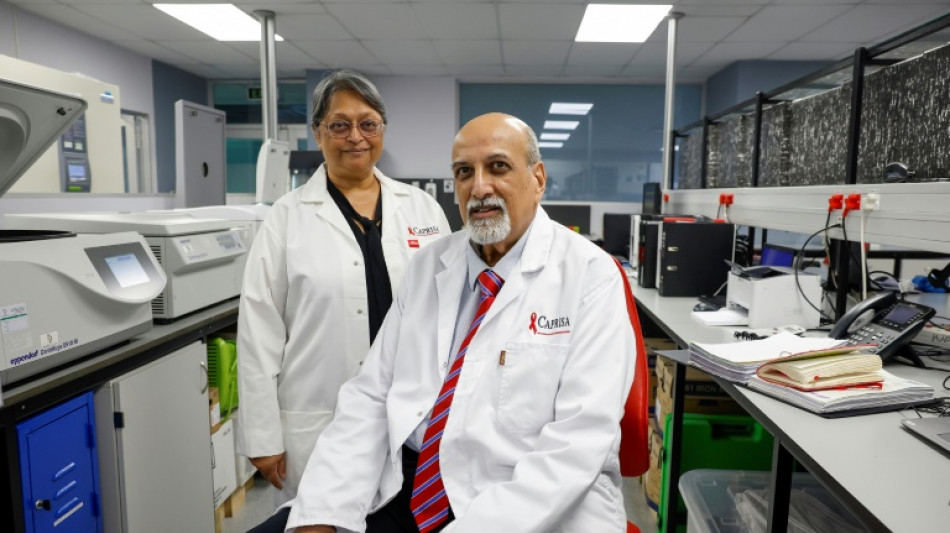
S.Africa's HIV research power couple says fight goes on / Photo: Phill Magakoe - AFP

 Rubio launches Latin America tour to cement US influence

 France tries 14 over deadliest Channel migrant crossing disaster

 Australia threatens hefty fines if big tech fails 'duty of care'

 Zverev romps into quarter-finals as Darderi downed

 Kauai on tornado watch as Hurricane Lowell nears Hawaiian islands

 Pakistan roll the dice in search of consolation win over England

 Yen extends gains as traders eye rate hike, tech rallies again

 'The ber months': Christmas arrives early in the Philippines

 N. Korea calls Russia bridge a sign of tighter ties

 US sanctions threaten to crush Iranian students' dreams

 Former champ Gauff holds off Jovic to reach US Open quarter-finals

 Guardian Metal Resources PLC Announces Admission to FTSE AIM 50 Index

 InterContinental Hotels Group PLC Announces Transaction in Own Shares - September 08

 Osaka seeks answers to nagging achilles injury after US Open exit

 Flight data recorders recovered from Amazon cargo plane crash

 Super Bowl rematch kicks off NFL season as league expands global reach

 Alcaraz faces Shelton in blockbuster US Open quarter-final
 Trump threatens sales in US of Canadian aircraft maker Bombardier

 Eiffel Tower closed in row over women removed for Hindu group

 Willemse replaces Kolbe for Springboks' All Blacks series decider

 Zheng shocks Swiatek in another incredible US Open comeback

 Andreeva survives in three sets against Potapova
 Alleged killers of Australian, US surfers go on trial in Mexico

 King Charles classes Harry and Meghan as 'private citizens'

 Bowling coach Noffke says Pakistan's off-field issues are nothing new
Through decades of pioneering work on fighting the spread of infectious diseases such as HIV, South African public health power couple Quarraisha and Salim Abdool Karim are credited with saving thousands of lives.
Married for 36 years, the epidemiologists -- both aged 64 -- are internationally respected for their work on stopping deadly infections such as HIV/AIDS, TB and the coronavirus.
On Thursday, they received the Lasker Award for public service, a top recognition for medical research described as the US equivalent of a Nobel prize for science.
The couple have "stemmed the course of the HIV/AIDS scourge", including by launching research labs and training hundreds of scientists across Africa, the New York-based Lasker Foundation said.
They used science to dispel myth and propaganda about AIDS, it said.
The award was a "humbling moment" and "pinnacle of a research career", Salim told AFP at the Centre for the AIDS Programme of Research (Caprisa), where he is director, in the east coast city of Durban.
"Inspiring," said Quarraisha, the centre's scientific director, saying it marked "the transformative power of science being recognised, and being recognised from Africa."
The couple's focus on HIV followed their move to the United States in 1987 to work on their master's degrees at Columbia University. HIV -- first reported in 1981 -- was ravaging New York.
- HIV explosion -
"You couldn't spend a day without discussing HIV in New York," recalled Salim. When the couple returned home to South Africa, it was the "next big challenge", he said.
The country went on to record some of the highest numbers of infections in the world, becoming an epicentre of a pandemic that has claimed around 42 million lives globally, including about 3.9 million in South Africa since 1999, according to UNAIDS.
"It was in our communities, in our populations. We were trying to change behaviour around sex at a time when people didn't talk very easily about sex, when the apartheid state was also trying to control who you had sex with," said Quarraisha.
After the racially segregationist apartheid system ended in 1994, she was appointed national AIDS control programme director.
But the new government was in denial about the scale of HIV/AIDS and its poor response is estimated to have cost 2.5 million lives between 1999 and 2010, according to UNAIDS.
The Lasker Award notes: "Over the objections of the South African government, their research led to the development of the anti-retroviral treatment, Pre-Exposure Prophylaxis (PrEP), that reduced spread by 39 percent."
"They defined approaches to treat common co-infections of HIV and tuberculosis, and after five years, these deaths decreased by over 50 percent."
One of Caprisa's achievements was the pioneering of a topical gel to protect women from infection.
New infections in South Africa have dropped to 150,000 in 2023 from a peak of around 520,000 in 2000. Up to 8.3 million people in the country had the virus in 2023.
Leading causes for new infections are violence against women, young women in relationships with older men and transactional sex, Quarraisha said.
- 'Complementary perspectives' -
Salim became a household name in South Africa as a government advisor during the Covid-19 pandemic, when he was often on television giving measured advice and updates.
"If I go to the shopping mall now... people will come up to me and say, 'Thank you very much, professor'," he said.
Both born in the KwaZulu-Natal province, the couple prioritise time with their three children but have no plans to hang up their lab coats.
Quarraisha wants to see more global cooperation in public health and the development of African talent and initiative.
"When we work together, as my husband and I show, we bring different but complementary perspectives," she said. "We are able to raise the science to levels that you can't individually do."
"We are now working on some new strategies to provide long-term prevention against HIV," Salim said. "We have some really good innovations and some good research under way. It's going to keep us busy for quite a while."
A.Taylor--AT