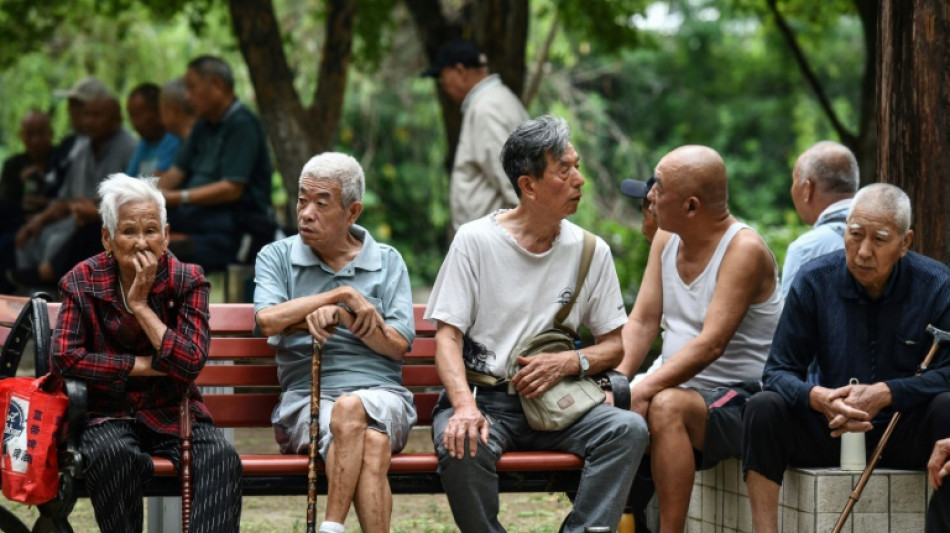
China piles extra work on weary youth to ease pension crisis / Photo: STR - AFP/File

 Forex Expo Dubai to Take Place as Scheduled on 22–23 September 2026

 Russia pounds Kyiv, ending three-day halt for US talks

 Flights resume gradually in Indonesia after volcanic eruption

 French AI firm Mistral valued at 21 bn euros after latest funding

 Sweden heads to the polls in close election race

 Australia's Big Bash T20 teams face sale to private investors

 Russia resumes strikes on Kyiv after three-day halt

 Canada's counter-tariffs take effect on various US goods

 China's trade booms as focus turns to expected Trump-Xi summit

 Is Champions League three-peat really possible for PSG?
 Russia pummels Kyiv after three-day halt

 Mongolians wait hours for fuel as reliance on Russia bites

 Blockx first Belgian man to reach US Open quarter-finals

 Praying for rain as fires, haze plague Indonesian Borneo

 Rybakina tops Osaka, sets US Open quarter-final clash with Zheng

 Apex Expands Trinity Zone with Step-out Hole Returning 197.5 m Interval of 2.12% REO at the Rift Rare Earth Project in SE Nebraska
 BioNxt Advances Sublingual Everolimus ODF for Organ Transplant Rejection with Initiation of Large-Animal Pharmacokinetic Study
 Genflow Biosciences PLC Announces Primary Endpoint in SLAB Clinical Trial Met

 Gaming Realms PLC Announces Interim Results

 Panama Canal considering more cuts in transits due to El Nino

 Maresca agrees with Haaland that players started season jaded

 Hurricane warning issued for westernmost Hawaiian islands

 UK PM denounces 'politics of poison' after anti-migrant protests

 Comeback queen Zheng strikes again for US Open quarter-final berth

 Third absence for injured Hadjar as Lawson fills in again in Spain

China's decision to raise the retirement age will give a brief boost to its strained pension system but risks further discouraging weary young workers and cannot arrest long-term demographic decline, experts say.
The ruling Communist Party last week announced a gradual increase in the statutory retirement age starting next year -- rising from 60 to 63 for men, from 55 to 58 for white-collar women workers, and from 50 to 55 for blue-collar female employees.
The government said the changes would bring a system that has changed little since the 1950s into line with decades of improvements in public health, life expectancy and education, and help society adapt to a shrinking population and workforce.
Analysts told AFP that growing concerns over the sustainability of the nationwide pension system pushed Beijing to act.
"The pension system is under a lot of strain," said Zhao Litao, a senior research fellow at the National University of Singapore's East Asian Institute.
"It is... clear to the leadership that the stakes for postponing the reform (were) getting increasingly high," he said.
China's retirement age had been among the youngest in the world, and officials have discussed raising it for more than a decade.
Opposition from lower-wage workers, a slowing economy and high youth unemployment had thwarted change, experts said.
Officials could wait no longer, Zhao said, partly because "the pace of population ageing and decline is faster than previously anticipated".
- Pension tension -
China's sprawling pension system has three pillars: basic state pensions, mandatory plans for company employees, and voluntary plans for private personal schemes.
But the state-led scheme lacks coordination at a national level, while the latter two pillars remain underdeveloped, critics say.
A top government think tank said in a 2019 report that one main state pension fund may dry up by 2035 as the workforce shrinks.
Around a third of Chinese provinces already run pension deficits, and local finances have come under more stress since the Covid pandemic.
Xiujian Peng, a senior research fellow at Australia's Victoria University, said the higher retirement age would ease pressure on the system "in the short and medium term".
Under the new rules, the age will rise incrementally over 15 years from 2025, so younger people will end up working for longer than those already close to retiring.
Workers will eventually need to make a minimum of 20 years of contributions to draw their basic pension, up from the current 15 years.
"After the government increases the retirement age, this decline (in the number of workers) will become... slower," Peng told AFP.
But, she added, "the labour force is still declining -- this is a (longer-term) trend".
- Working harder, longer -
But economic necessity has not necessarily bred widespread acceptance.
Many posts on Chinese social media have pointed to a perceived lack of transparency over the fate of workers born from the 1990s onwards.
Those generations already face widespread joblessness or an intense work culture that leaves many feeling overwhelmed or burnt out.
"For many Chinese individuals, these changes in retirement policies feel like a reneged commitment of social welfare provision -- kicking the problem down an already murky road," Yun Zhou, a sociologist at the University of Michigan, told AFP.
"As gender- and age-based discriminations remain deeply entrenched in the Chinese labour market, it remains to be seen to what extent workers... can enjoy effective labour rights protection," she said.
Dali Yang, professor of political science at the University of Chicago, said the government faced a "loss of credibility" on pensions.
Recent economic challenges have already prompted many Chinese to prioritise short-term cash over saving for retirement, he told AFP.
"Now, there is even less of an incentive" for them to keep paying into the pension pot, Yang said.
"If enough people do that, it actually becomes a vicious cycle, (and) the less sustainable the system will be."
- Demography is destiny -
Chinese state media has said a rise in the retirement age was "inevitable" given the country's development.
The current age was set decades ago when scarcity and poverty were common, before market reforms brought rapid gains in living standards.
Life expectancy rose from around 50 in the early 1960s to 79 by 2022, according to World Bank data.
But development coincided with families having fewer children, hastened by decades of birth restrictions under the former one-child policy.
Now, China is stuck with a growing senior population and fewer young people to fill the gap.
Experts said only a suite of bold policies -- from creating high-quality jobs to raising productivity, expanding public healthcare, fostering better work-life balance and raising the social position of women -- could help Beijing adapt to its alarming demographic destiny.
Several told AFP that last week's announcement was unlikely to be the last of its kind.
"There is still considerable room to further increase the retirement age," Zhao, of NUS, said.
But, he added, "if (younger people) have to work longer and contribute more... they want to get answers for questions like job security and quality, and the level of future pension benefits".
M.King--AT