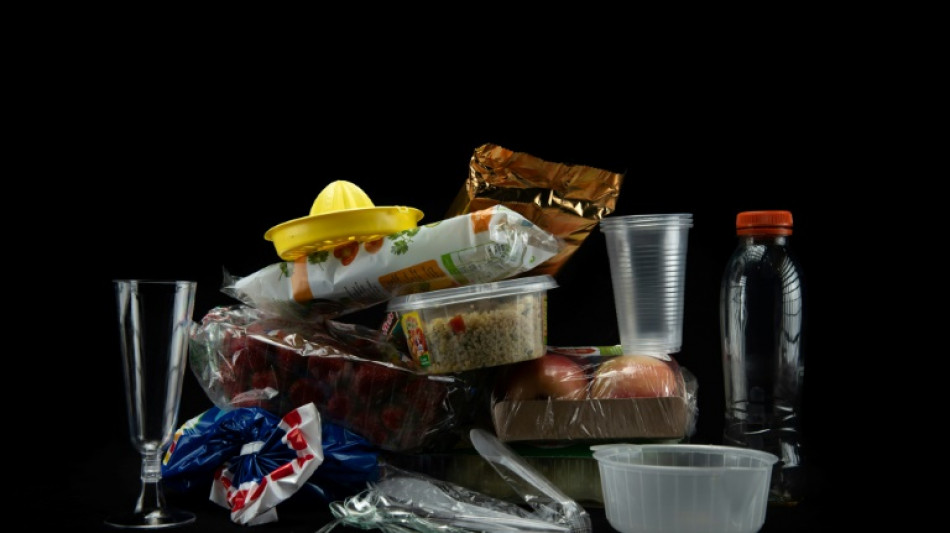
More than 3,600 food packaging chemicals found in human bodies / Photo: Olivier MORIN - AFP/File

 Forex Expo Dubai to Take Place as Scheduled on 22–23 September 2026

 Russia pounds Kyiv, ending three-day halt for US talks

 Flights resume gradually in Indonesia after volcanic eruption

 French AI firm Mistral valued at 21 bn euros after latest funding

 Sweden heads to the polls in close election race

 Australia's Big Bash T20 teams face sale to private investors

 Russia resumes strikes on Kyiv after three-day halt

 Canada's counter-tariffs take effect on various US goods

 China's trade booms as focus turns to expected Trump-Xi summit

 Is Champions League three-peat really possible for PSG?

 Russia pummels Kyiv after three-day halt

 Mongolians wait hours for fuel as reliance on Russia bites

 Blockx first Belgian man to reach US Open quarter-finals

 Praying for rain as fires, haze plague Indonesian Borneo

 Rybakina tops Osaka, sets US Open quarter-final clash with Zheng

 Apex Expands Trinity Zone with Step-out Hole Returning 197.5 m Interval of 2.12% REO at the Rift Rare Earth Project in SE Nebraska
 BioNxt Advances Sublingual Everolimus ODF for Organ Transplant Rejection with Initiation of Large-Animal Pharmacokinetic Study
 Genflow Biosciences PLC Announces Primary Endpoint in SLAB Clinical Trial Met

 Gaming Realms PLC Announces Interim Results

 Panama Canal considering more cuts in transits due to El Nino

 Maresca agrees with Haaland that players started season jaded

 Hurricane warning issued for westernmost Hawaiian islands

 UK PM denounces 'politics of poison' after anti-migrant protests

 Comeback queen Zheng strikes again for US Open quarter-final berth

 Third absence for injured Hadjar as Lawson fills in again in Spain

More than 3,600 chemicals used in food packaging or preparation have been detected in human bodies, some of which are hazardous to health, while little is known about others, a study published on Tuesday said.
Around 100 of these chemicals are considered to be of "high concern" to human health, said lead study author Birgit Geueke from the Food Packaging Forum Foundation, a Zurich-based NGO.
Some of these chemicals are relatively well-studied and have already been found in human bodies, such as PFAS and bisphenol A -- both of which are the target of bans.
But little is known about the health effects of others, Geueke told AFP, calling for more research into how chemicals used in packaging end up being swallowed along with food.
The researchers had previously catalogued around 14,000 food contact chemicals (FCCs), which are capable of "migrating" into food from packaging made of plastic, paper, glass, metal or other materials.
They can also come from other parts of the food-making process, such as from conveyer belts or kitchen utensils.
The researchers then searched for these chemicals in existing biomonitoring databases, which track chemicals in human samples.
The team was expecting to find a few hundred FCCs, Geueke said. Instead, they were surprised to find 3,601 -- a quarter of all the known FCCs.
Geueke emphasised that this study could not show that all these chemicals necessarily ended up in bodies from food packaging, as "other exposure sources are possible".
Among the "high concern" chemicals were numerous PFAS, also known as forever chemicals, which have been detected in many parts of the human body in recent years and linked to a range of health problems.
Also detected was bisphenol A, a hormone-disrupting chemical used to make plastics that has already been banned from baby bottles in many countries.
Another hormone-disrupting chemical was phthalates, which has been linked to infertility.
Less is known about oligomers, which are also byproducts of plastic production.
"There is almost no evidence on the health effects of these chemicals," Geueke said.
- Reduce contact with packaging -
When it comes to toxicology, an old saying is that "the dose makes the poison".
A limitation of the study was that it could not say whether there were particularly high concentrations of any of the chemicals, Geueke acknowledged.
But she warned that these chemicals can interact with each other, pointing to a single sample that had up to 30 different PFAS.
Geueke recommended that people reduce their contact time with packaging -- and to avoid heating up food in the packaging it came in.
Duane Mellor, an expert in evidence-based medicine at the UK's Aston University and not involved in the research, praised the "very thorough piece of work".
"However, it does not cover how much of these chemicals we are exposed to and hints at other sources of these chemicals in our environment," he told AFP.
Rather than being "unduly alarmed", Mellor suggested that people "demand better data and minimise unnecessary exposure to chemicals which may ultimately impact our health".
Some of the chemicals are also already facing bans.
The European Union is in the final stages of banning the use of PFAS in food packaging. The EU has also proposed a similar ban for bisphenol A from the end of this year.
The study was published in the Journal of Exposure Science and Environmental Epidemiology.
M.White--AT