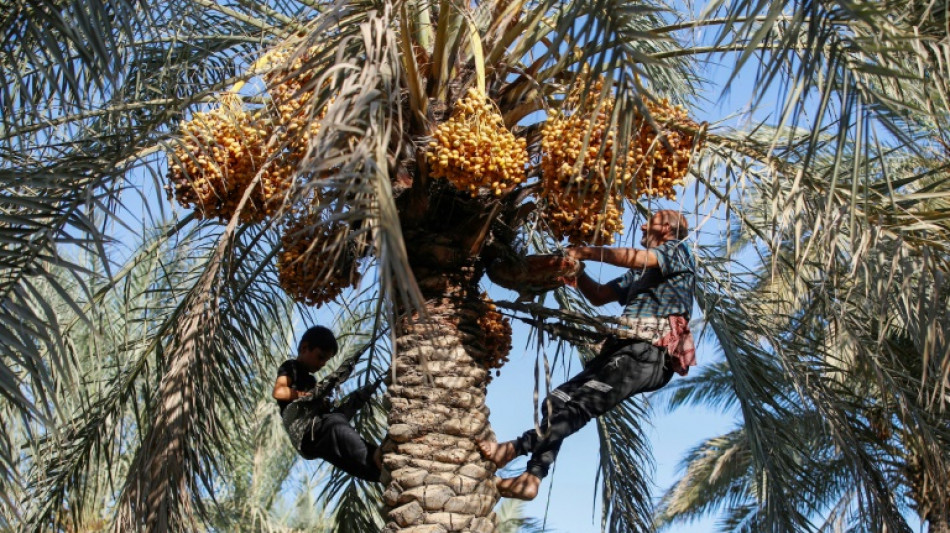
Iraqi date farmers fight drought to protect national treasure / Photo: AHMAD AL-RUBAYE - AFP

 Nepal flood death toll rises as rescuers scour tunnels

 France's Mistral sees value soar with 3 bn euro cash infusion

 Nepal glacier saw exceptional heat before collapse caused deadly floods: researcher

 Ethiopia boosts drone production to fight rebels
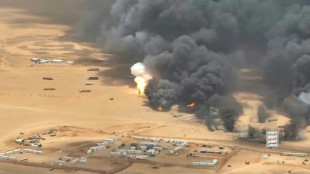 Yemen rebels hit Saudi Arabia with wave of strikes, wounding 73

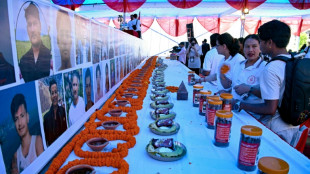 Nepalis mark a year since deadly protests that toppled government

 Rubio launches Latin America tour to cement US influence

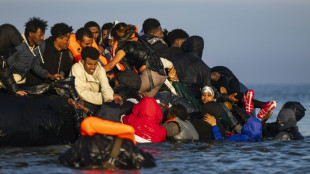 France tries 14 over deadliest Channel migrant crossing disaster

 Australia threatens hefty fines if big tech fails 'duty of care'
 Zverev romps into quarter-finals as Darderi downed
 Kauai on tornado watch as Hurricane Lowell nears Hawaiian islands
 Pakistan roll the dice in search of consolation win over England

 Yen extends gains as traders eye rate hike, tech rallies again

 'The ber months': Christmas arrives early in the Philippines
 N. Korea calls Russia bridge a sign of tighter ties

 US sanctions threaten to crush Iranian students' dreams
 Former champ Gauff holds off Jovic to reach US Open quarter-finals

 Battery X Metals to Appoint Accomplished Technology and Consumer Brands Executive Nicholas Reichenbach to Board of Directors
 Equitech-Bio Expands Reagent Portfolio with New IgG Offering and Publication-Backed Product Validation from Bioz

 CPG Life Fund I Launches $20 Million Operator-Led CPG Fund

 Who is the Best Female Cosmetic Surgeon in Florida?

 CANEX Metals Announces C$6.5 Million Strategic Financing Led By C$3 Million Investment by Eric Fier
 Helio Sets September Roadshow Across Austin, Houston, Phoenix, Scottsdale
 Gaming Realms PLC Announces Interim Results

 Universal Edge Technologies Establishes Senior Advisory Committee, Names Mark Powell and Mark P. Mills as Founding Members
Bare feet pressed against the rough trunk of a palm tree, his back supported by a metal and fabric harness, Ali Abed begins the climb to the dates above.
In Iraq, the date palm and its bounty are national icons, but they are being battered by drought.
Once known as the country of "30 million palm trees", Iraq's ancient date-growing culture had already suffered from upheaval, especially during the 1980-88 war with Iran, before climate change became a major threat.
In the still lush countryside of central Iraq, near Janajah village in Babylon province, hundreds of date palms stand tall and majestic, surrounded by vines and fruit trees.
During harvest season, the branches are heavy with clusters of yellow and red dates.
Rising at dawn to avoid the searing heat, harvesters climb the palms using only their upper body strength, aided by a harness and rope wrapped around the trunk.
"Last year, the orchards and the palm groves were thirsty; we almost lost them. This year, thanks to God, we had good water and a good harvest," said Abed, a 36-year-old farmer from Biramana, a village a few kilometres (miles) from Janajah.
Once at the top, they pick the ripe dates, filling baskets that are lowered to the ground and emptied into basins, which are then loaded onto lorries.
Abed noted, however, that the harvest is much smaller now -- about half of what it used to be. He once collected more than 12 tonnes but now brings in just four or five.
Abed criticised the lack of government support, saying aerial insecticide campaigns are not enough.
- 'Used to be paradise' -
Iraq has spent over a decade trying to revive the date palm, a vital economic asset and national symbol.
Authorities and religious institutions have launched programmes and mega-projects to encourage tree planting and growth.
An agriculture ministry spokesperson told the official INA news agency last month that, "for the first time since the 1980s", the number of date palms had risen to "more than 22 million", up from a low of just eight million.
During the Iran-Iraq War, palm groves were razed in vast areas along the border to prevent enemy infiltration.
Today, dates are Iraq's second-largest export product after oil, which dominates export revenues and generates more than $120 million, according to the World Bank.
In 2023, Iraq exported around 650,000 tonnes of dates, official statistics show.
Yet around Janajah, many palm trees lie dead and decapitated.
"All these palm trees are dead due to the drought; the whole region is suffering", said 56-year-old farmer Maitham Talib.
"Before, we had water. People irrigated abundantly. Now, we need complicated machinery", he said, observing the harvest.
The United Nations has labelled Iraq one of the five countries in the world most vulnerable to some of the effects of climate change.
The country has endured four consecutive years of drought, though this year saw some relief with winter rainfall.
Alongside rising temperatures that have hit 50 degrees Celsius (122 Fahrenheit) in summer and declining rainfall, Iraq also faces falling river levels, blamed on dams built upstream by Iran and Turkey.
Kifah Talib, 42, lamented the slow devastation wrought by the drought.
"It used to be paradise: apple, pomegranate, citrus trees and vines -- everything grew here", he said.
S.Jackson--AT