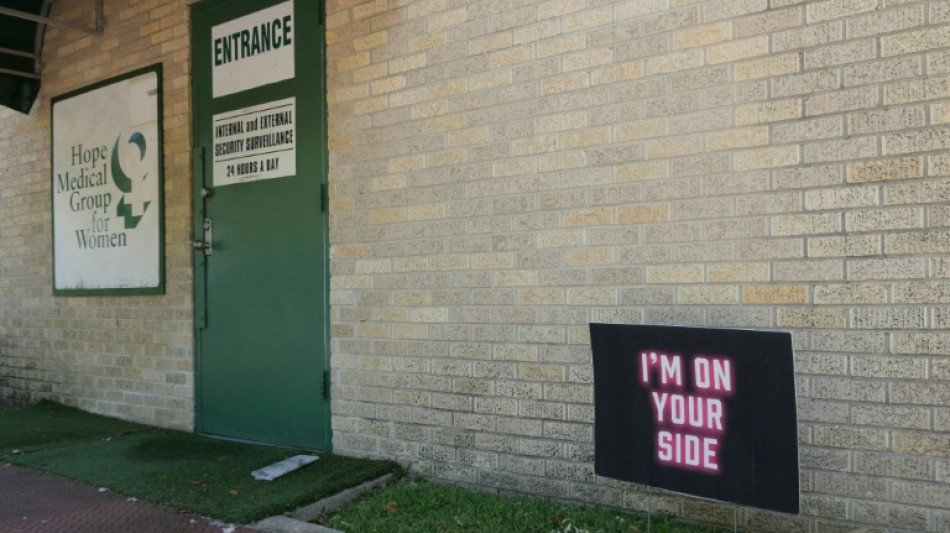
Texans forced to travel out of state, wait weeks for abortions / Photo: François Picard - AFP

 'Long live Chairman Mao': Supporters pay respects to founder of Communist China

 Sweden immigration restrictions spark healthcare concerns

 EU to help cities tighten screws on Airbnb, holiday rentals

 'Our year': Kane and Bayern primed for Champions League tilt

 Australian World Cup star Volpato fined over positive cocaine test

 Sabalenka edges Noskova to keep US Open treble bid alive
 Pegula outlasts Navarro to set US Open semi with Sabalenka

 From trenches to catwalk: Ukraine's amputee soldiers hit the runway

 UK airports face more disruption after air traffic control glitch

 ECB meets, weighing a tricky balance between savers and spenders

 Pakistan police counter drone attacks with Ukraine-style nets

 Russia torments Kyiv with new 'horror' jet drones

 Iran attacks US base in Jordan as Hormuz impasse deepens

 New Apple CEO to face first test with foldable iPhone launch

 BrYet Announces AIFA Approval of First-In-Kind cGMP Manufacturing Line for ML-016, Enabling Imminent Clinical Supply to Australia

 Sabalenka edges Noskova, keeps US Open treble bid alive

 Real Madrid win Champions League opener as Haaland stars for Man City

 Gambian leader vows power boost after violent blackout protests

 Newcastle battle past Millwall to reach League Cup fourth round

 Mourinho's Real Madrid make winning start against Inter Milan

 Villa take 'big step forward' with win over Brugge

 Yaya Toure hails 'new era' for African coaches ahead of Champions League bow

 Lawes and Marchant told to prove themselves in quest for England recalls

 Smithsonian secretary to retire as Trump exerts control over institution
 Atletico have work to do to reach home Champions League final: Simeone

In a small Louisiana clinic, a five-hour drive from her home in the neighboring state of Texas, Shayla waits for her long-sought appointment to receive an abortion.
"I've been trying basically since six weeks," she told AFP, explaining that she's now in her thirteenth week of pregnancy.
On September 1, 2021, one of the most restrictive anti-abortion laws in the United States came into force in Texas, banning all abortions from the moment a heartbeat can be detected in the womb, or about six weeks into a pregnancy.
Texas is the second-largest state in the country by population, with around 30 million residents.
Clinics in surrounding states quickly became inundated with patients seeking abortions, leading to longer wait times for the procedure.
Planned Parenthood, a group which advocates for abortion rights and operates health clinics across the country, reported in February an 800-percent increase in patients from Texas visiting surveyed abortion clinics in Oklahoma, New Mexico, Kansas, Colorado and Missouri.
In Planned Parenthood's own clinics in Oklahoma, the increase was closer to 2,500 percent.
"Once a woman has decided that she can't continue the pregnancy, delaying care for the pregnancy termination is cruel," says Kathaleen Pittman, an administrator at the Hope Medical Group for Women in Shreveport, Louisiana -- where Shayla awaits her procedure.
- A stressful wait -
"We see a lot of tears, a lot of women who are feeling very desperate," adds Pittman.
"For most women, we have to tell them anything you do to try to harm the pregnancy (by yourself) is certainly going to harm you more."
On this April morning, there is a steady line of patients: some are from in-state, others from Texas or Mississippi, and many are accompanied by someone responsible for driving them home after their abortion -- and sometimes for watching their kids during the procedure.
Behind the receptionists' window, the phone rings constantly.
A half-dozen employees in charge of answering the calls repeat the same message: no we can't schedule you an appointment right now, you have to register on the waiting list.
About two weeks later, the clinic will reach out to the patients to set up -- in another one or two weeks -- the first of the two mandatory appointments Louisiana requires for an abortion to be performed.
"This law is just putting a strain on people," says a 31-year-old teacher from Houston who did not want to provide a name.
"Not knowing if I could be taken care of was the most stressful part of the process," she adds.
Pittman notes that the small Shreveport clinic has limited space and workers, and continuously runs at capacity.
"We've had to increase our staff," she says. "But imagine, if you will, try(ing) to increase your staff in the middle of a pandemic, when medical personnel are already overtaxed, and stressed and unavailable."
Before Texas' new law limiting abortion rights, only 18 percent of patients in the clinic came from Texas. Now, they represent the majority.
But Louisiana residents are also continuing to seek abortions, so they too must suffer through the delays caused by the new Texas law.
- As far as Colorado and Oklahoma -
"She learned she was pregnant a month and a half ago," says an African American woman, 34, motioning to her 16-year-old daughter, sitting next to her in the waiting room, wrapped in a blanket.
Sitting a few seats over, two other African American women from Houston and Dallas wait their turn.
The Guttmacher Institute, a pro-choice research organization, reported in 2008 that the abortion rate in America for Black women was almost five times higher than that of white women.
While often hoping to maintain their privacy, these Texas women dealt with several rounds of logistical difficulties to make both of their out-of-state appointments: finding childcare, taking time off work, sometimes renting a car, and paying for lodging.
They also had to find a confidant who could also take off work and travel with them.
Before a spot opened up in Louisiana, Shayla was on waiting lists in Colorado and Oklahoma.
"It's like, either have a baby and struggle, or travel," explains the 27-year-old Houstonian, who is already a single mother to a 2-year-old son.
She says that two organizations helped her raise the $2,000 she needed for the whole process, including the $695 fee for the abortion.
She notes that the difficulty in finding stable childcare was a major factor in her decision to terminate her pregnancy.
"Maybe somebody can watch your baby one day and somebody can't the next... How you gonna maintain a job like that?" she asks, as her mother and son wait outside.
"And so I was like... I'm not gonna have two kids and struggle even worse."
A.Williams--AT