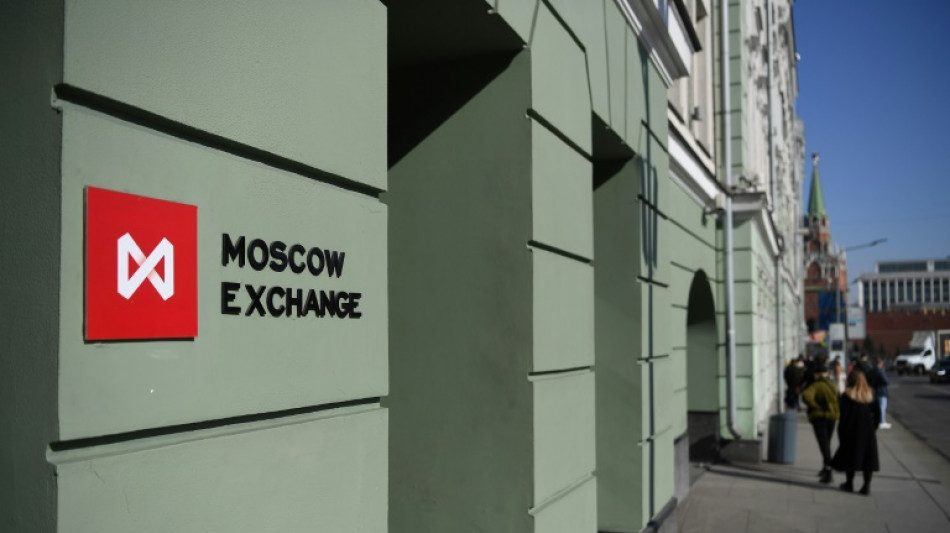
Russian stock market suspends dollar trades after US sanctions / Photo: NATALIA KOLESNIKOVA - AFP/File

 'Long live Chairman Mao': Supporters pay respects to founder of Communist China
 Sweden immigration restrictions spark healthcare concerns

 EU to help cities tighten screws on Airbnb, holiday rentals

 'Our year': Kane and Bayern primed for Champions League tilt

 Australian World Cup star Volpato fined over positive cocaine test
 Sabalenka edges Noskova to keep US Open treble bid alive
 Pegula outlasts Navarro to set US Open semi with Sabalenka

 From trenches to catwalk: Ukraine's amputee soldiers hit the runway

 UK airports face more disruption after air traffic control glitch

 ECB meets, weighing a tricky balance between savers and spenders
 Pakistan police counter drone attacks with Ukraine-style nets
 Russia torments Kyiv with new 'horror' jet drones
 Iran attacks US base in Jordan as Hormuz impasse deepens

 New Apple CEO to face first test with foldable iPhone launch

 BrYet Announces AIFA Approval of First-In-Kind cGMP Manufacturing Line for ML-016, Enabling Imminent Clinical Supply to Australia
 Sabalenka edges Noskova, keeps US Open treble bid alive
 Real Madrid win Champions League opener as Haaland stars for Man City
 Gambian leader vows power boost after violent blackout protests

 Newcastle battle past Millwall to reach League Cup fourth round

 Mourinho's Real Madrid make winning start against Inter Milan

 Villa take 'big step forward' with win over Brugge

 Yaya Toure hails 'new era' for African coaches ahead of Champions League bow

 Lawes and Marchant told to prove themselves in quest for England recalls

 Smithsonian secretary to retire as Trump exerts control over institution
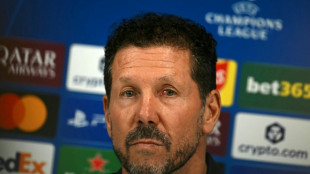 Atletico have work to do to reach home Champions League final: Simeone

Russia's main stock exchange halted dollar and euro trades on Thursday after the United States hit Moscow with a new package of sanctions over its military offensive in Ukraine.
Washington announced Wednesday it was sanctioning Moscow Exchange, Russia's main stock market and clearing house for foreign currency transactions, a major new financial punishment.
"Due to the introduction of restrictive measures by the United States against the Moscow Exchange Group, exchange trading and settlement of instruments in US dollars and euros will be suspended," Russia's central bank said in a statement Wednesday evening.
Measures that target Russians' ability to buy and trade foreign currency typically provoke a strong reaction in Moscow and throughout Russian society.
The exchange rate is seen as a key indicator of the health of the Russian economy.
Scarred by several bouts of devaluation in the three decades since the fall of the Soviet Union, many Russians prefer to save in Western currencies, often selling rubles in times of economic crisis.
During the Soviet Union, there was a thriving black market for currencies with prices far detached from the official state exchange rate.
Both the central bank and the Kremlin have sought to calm nerves.
"Companies and individuals may continue to buy and sell US dollars and euros through Russian banks. All funds held in US dollars in accounts remain safe," the bank said Wednesday.
And on Thursday, Kremlin spokesman Dmitry Peskov said the regulator was "ensuring stability in all markets," state media reported.
Russians will still be able to trade in dollars and euros outside of the centralised Moscow Exchange -- something which could limit liquidity and lead to higher volatility.
Many Russian companies and banks had already reduced their reliance on Western currencies in the two years since Moscow ordered troops into Ukraine, with the Chinese yuan accounting for the majority of foreign currency trades on Moscow Exchange.
Several banks had spreads -- the difference between the price at which they offer to buy and sell currency -- of between three to 10 rubles on Thursday, a typical rate.
A few had immediately hiked their exchange rates to as high as 200 rubles per dollar after the sanctions were introduced.
Russia's central bank had fixed the exchange rate at 89 rubles to the dollar on Wednesday, before the sanctions were announced.
Peskov on Thursday said Russia was "thinking over" possible retaliatory measures.
A.Anderson--AT