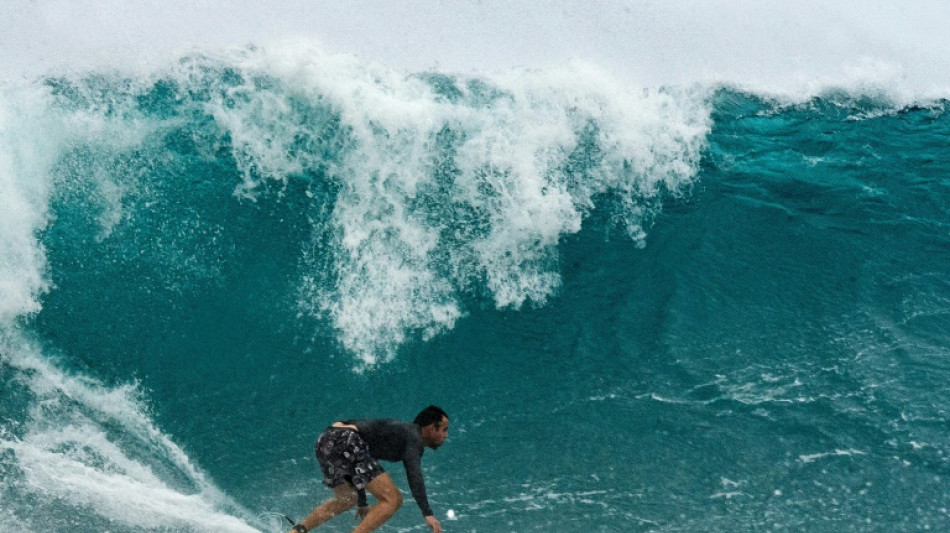
Olympic status gives surfing a boost in Cuba / Photo: YAMIL LAGE - AFP

 Alcaraz falls to Shelton in epic latest-ever US Open finish

 South Korea video game tycoon to pay record $1.5 bn in divorce

 'Long live Chairman Mao': Supporters pay respects to founder of Communist China
 Sweden immigration restrictions spark healthcare concerns
 EU to help cities tighten screws on Airbnb, holiday rentals
 'Our year': Kane and Bayern primed for Champions League tilt
 Australian World Cup star Volpato fined over positive cocaine test
 Sabalenka edges Noskova to keep US Open treble bid alive

 Pegula outlasts Navarro to set US Open semi with Sabalenka

 From trenches to catwalk: Ukraine's amputee soldiers hit the runway

 UK airports face more disruption after air traffic control glitch

 ECB meets, weighing a tricky balance between savers and spenders
 Pakistan police counter drone attacks with Ukraine-style nets

 Russia torments Kyiv with new 'horror' jet drones

 Iran attacks US base in Jordan as Hormuz impasse deepens

 New Apple CEO to face first test with foldable iPhone launch

 Battery X Metals Announces Confidential Submission of Amended Draft Registration Statement with the U.S. Securities and Exchange Commission in Connection with Proposed U.S. National Securities Exchange Initial Public Offering

 InterContinental Hotels Group PLC Announces Transaction in Own Shares - September 09
 Sabalenka edges Noskova, keeps US Open treble bid alive

 Real Madrid win Champions League opener as Haaland stars for Man City
 Gambian leader vows power boost after violent blackout protests
 Newcastle battle past Millwall to reach League Cup fourth round
 Mourinho's Real Madrid make winning start against Inter Milan

 Villa take 'big step forward' with win over Brugge

 Yaya Toure hails 'new era' for African coaches ahead of Champions League bow

When they were children, Cuba's surfers used to transform their school desks into boards to ride the waves.
They now have real equipment. And since surfing became an Olympic sport, it is gaining acceptance amongst authorities on the Communist-ruled nation where its practitioners have often faced police harassment.
In the fishing community of Santa Fe to the west of Havana, Ayax Borrero, 34, carries his surfboard under one arm as he and two friends meander through the streets that separate his home from the sea.
It's a cloudy day and the waves are crashing against the shore.
"Over all, we depend on weather conditions like cold fronts, hurricanes -- which are what create the waves here -- so that's why the season begins in winter" from November to April, said Borrero, an architect.
Their playground is the ruins of an old rock pool allegedly once belonging to a bourgeois called Antolin before the 1959 revolution that brought Fidel Castro to power.
The area now serves as a promontory from where surfers can launch themselves into the water.
Surfing reminds Borrero of his youth, although back then boards were almost impossible to find.
"I started young, around seven or eight, with wooden school desks. That's what we used back then.
"They were really heavy!" he added, laughing.
He recognizes that it was a good starting point as "afterwards, when my dad bought me my first board at 11 years old, I was able to stand up straight away."
- 'Shark food' -
There was a time when surfers also removed the polystyrene tray at the back of refrigerators to make boards.
In Cuba, a country where most people lack many basic products, such a practice is known as "inventing" -- the art of finding a solution to every problem.
"It's a bit difficult to surf here," said Yasel Fernandez, 29.
Born into a fishing family, he began surfing at 13 but he only managed to "have my own board at 29 and that was my dream, having my own board and surfing."
Getting hold of their own board is not the only difficulty for surfers, who have often aroused the suspicion of police in a country where the sea is also seen as the escape route to Florida.
In March, US authorities rescued a Cuban who took on the 370 kilometer journey by windsurf.
Cubans have been flocking in their droves to emigrate to the United States as Cuba reels from its worst economic crisis in almost 30 years, partly due to the coronavirus pandemic.
But "by surfing, you're shark food," joked Frank Gonzales, 35, one of the only people repairing boards on the island.
Even so, he does not always have the choice.
"It's annoying to be surfing, taking part in a sport in a specific place with the best waves, and the police come and tell you to go," said Gonzales, who has taught his six-year-old daughter to surf.
"I hope in the future the police will respect surfers as sportspeople."
- 'Great sport' -
Some say their boards were confiscated, others tried to swim away from the police.
But things are starting to look up.
Surfing made its Olympic debut at the Tokyo Games in 2021, and now Cuba's authorities are recognizing it as a sport.
"What happened is that the sport was being practiced but it wasn't being paid attention to by" the Cuban Sports Institute (INDER), said Eric Gutierrez, the body's chief.
"Now INDER is taking steps to pay attention, give recognition and develop surfing."
He insisted that the police were not preventing people from surfing but "they're looking after their lives."
"I remember once the fire brigade turned up to rescue us. Someone had called them," said Yaliagni "Yaya" Guerrero, 39, one of Cuba's first women surfers.
She has worked alongside Gonzales with INDER since 2019 to try to change the "lack of culture or ignorance" surrounding surfing.
In December, an INDER official watched for the first time a competition between surf clubs in Havana, won by Gonzales.
That official was Gutierrez, who described surfing as "a great sport."
Since last year, INDER has been in contact with the International Surfing Association and has plans to welcome a delegation from the global governing body in the coming months.
We want to present them a work project that will support us in terms of instruction, equipment, specific surfing elements such as first aid and refereeing," said Gutierrez.
A.Williams--AT