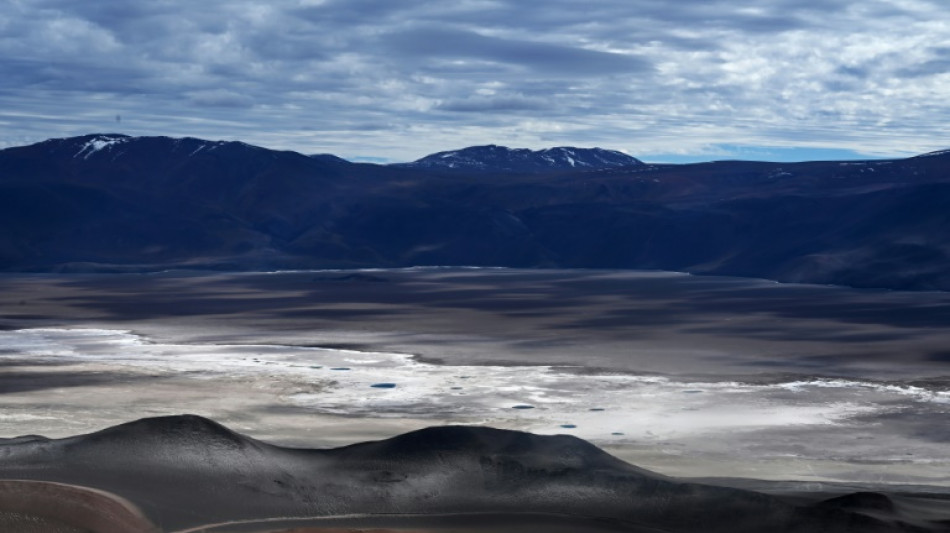
Chile's lithium dreams raise water concerns in the desert / Photo: RODRIGO ARANGUA - AFP

 Alcaraz falls to Shelton in epic latest-ever US Open finish

 South Korea video game tycoon to pay record $1.5 bn in divorce

 'Long live Chairman Mao': Supporters pay respects to founder of Communist China

 Sweden immigration restrictions spark healthcare concerns

 EU to help cities tighten screws on Airbnb, holiday rentals
 'Our year': Kane and Bayern primed for Champions League tilt
 Australian World Cup star Volpato fined over positive cocaine test

 Sabalenka edges Noskova to keep US Open treble bid alive

 Pegula outlasts Navarro to set US Open semi with Sabalenka
 From trenches to catwalk: Ukraine's amputee soldiers hit the runway

 UK airports face more disruption after air traffic control glitch

 ECB meets, weighing a tricky balance between savers and spenders

 Pakistan police counter drone attacks with Ukraine-style nets

 Russia torments Kyiv with new 'horror' jet drones

 Iran attacks US base in Jordan as Hormuz impasse deepens

 New Apple CEO to face first test with foldable iPhone launch

 Battery X Metals Announces Confidential Submission of Amended Draft Registration Statement with the U.S. Securities and Exchange Commission in Connection with Proposed U.S. National Securities Exchange Initial Public Offering

 InterContinental Hotels Group PLC Announces Transaction in Own Shares - September 09

 Sabalenka edges Noskova, keeps US Open treble bid alive

 Real Madrid win Champions League opener as Haaland stars for Man City
 Gambian leader vows power boost after violent blackout protests

 Newcastle battle past Millwall to reach League Cup fourth round
 Mourinho's Real Madrid make winning start against Inter Milan

 Villa take 'big step forward' with win over Brugge

 Yaya Toure hails 'new era' for African coaches ahead of Champions League bow

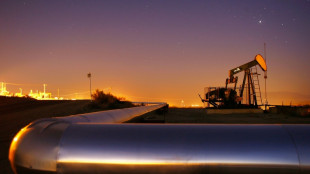
As night falls in Chile's Atacama desert, the world's driest, a drilling machine extracts brine to measure levels of lithium -- a crucial mineral for the global switch to cleaner energy, but harmful in its own way.
Chile is seeking to retake its position as the world's top lithium producer, but environmentalists fear extraction in the Atacama desert will harm fragile ecosystems there.
The desert holds the main deposits of the mineral in Chile, which is part of Latin America's "lithium triangle" with Argentina and Bolivia.
Demand for lithium, used in electric car batteries, has grown strongly in recent years as the world seeks to move away from fossil fuels to curb global warming.
In the salt flats of Aguilar and La Isla in the Altoandinos desert region -- at an altitude of 3,400 meters and 4,400 meters respectively -- the temperature is minus zero and the wind biting at the approach of the southern winter.
There is a rush to finish the work of taking brine samples, which are sent to a laboratory to measure lithium content.
"We are drilling day and night," said Ivan Mlynarz, executive vice president of the Enami National Mining Company, which is seeking to start mining of the "white gold" mineral here by 2030.
- 'Positive results' -
Between the Aguilar, La Isla and Grande salt flats, Enami hopes to be able to mine 60,000 tons of lithium annually.
The project is key to Chile's plan to retake its position as the world's top lithium producer, which it lost to Australia in 2016.
"We've had very positive results," Enami worker Cristhian Moreno told AFP, describing the quality of lithium they've been getting from samples as "very favorable."
Chile's leftist President Gabriel Boric came to office with plans to create a national lithium company similar to state-owned copper firm Codelco, formed in the 1970s out of nationalized mining firms.
Last month, Codelco signed a deal with lithium miner SQM to nearly double the private mining firm's current extraction of the mineral in the Salar de Atacama, north of the Altoandinos.
Competitor Australia, which extracts lithium from rock rather than brine, today produces 43 percent of the mineral and Chile 34 percent.
The Codelco/SQM alliance would add some 300,000 tons to Chile's lithium production between 2025 and 2030, and another 280,000-300,000 tons per year from 2031 to 2060.
In 2022, the South American country produced some 243,000 tons.
- 'It won't rain anymore' -
In Chile, lithium is produced through the evaporation of brine in ponds or pools filled with water pumped from underneath salt flats.
Experts say the method puts several animal and plant species at risk with the loss of tons of water in one of the most arid places on Earth.
"These fragile salt flats of Atacama are a refuge for a diversity of Andean life, biological corridors," said expert Cristina Dorador, a professor at the University of Antofagasta.
"They are not mines, they are ecosystems," she said.
Mining in the Altoandinos region of the southern Atacama region also threatens the Indigenous Colla people, some 20,000 of whom call Chile home.
Dwindling water sources in the area have already been forcing them from the mountains, where they traditionally live as shepherds, to the cities -- unable to take care of their animals or themselves.
"If we dry the salt flats it won't rain any more, it won't snow anymore and... all the biodiversity will decline," Colla representative Christopher Castillo, 25, told AFP.
"It is to... exterminate the little biodiversity that we have left."
A research article published in 2019 in the International Journal of Applied Earth Observation and Geoinformation, found that the "water-intensive production process" used in the Atacama desert "has increased concerns around hydrological disruption" in a region with minimal rainfall.
It reported "significant" environmental effects from brine extraction, "including the degradation of surface vegetation, elevating daytime surface temperatures and decreasing soil moisture levels."
Ch.P.Lewis--AT