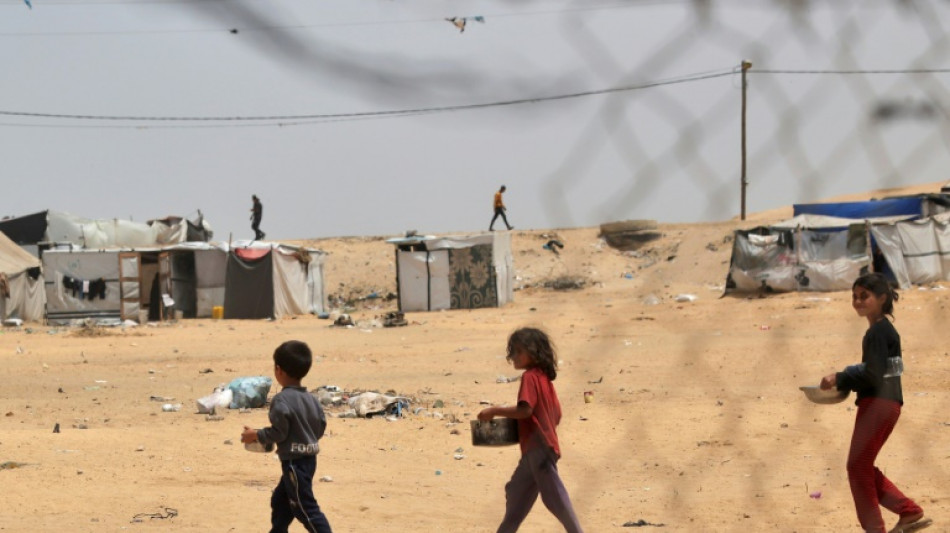
More than 1 in 4 children under age 5 face 'severe' food poverty: UNICEF / Photo: - - AFP

 Alcaraz falls to Shelton in epic latest-ever US Open finish

 South Korea video game tycoon to pay record $1.5 bn in divorce

 'Long live Chairman Mao': Supporters pay respects to founder of Communist China
 Sweden immigration restrictions spark healthcare concerns
 EU to help cities tighten screws on Airbnb, holiday rentals

 'Our year': Kane and Bayern primed for Champions League tilt
 Australian World Cup star Volpato fined over positive cocaine test

 Sabalenka edges Noskova to keep US Open treble bid alive

 Pegula outlasts Navarro to set US Open semi with Sabalenka

 From trenches to catwalk: Ukraine's amputee soldiers hit the runway

 UK airports face more disruption after air traffic control glitch

 ECB meets, weighing a tricky balance between savers and spenders

 Pakistan police counter drone attacks with Ukraine-style nets

 Russia torments Kyiv with new 'horror' jet drones

 Iran attacks US base in Jordan as Hormuz impasse deepens

 New Apple CEO to face first test with foldable iPhone launch

 Battery X Metals Announces Confidential Submission of Amended Draft Registration Statement with the U.S. Securities and Exchange Commission in Connection with Proposed U.S. National Securities Exchange Initial Public Offering

 InterContinental Hotels Group PLC Announces Transaction in Own Shares - September 09

 Sabalenka edges Noskova, keeps US Open treble bid alive

 Real Madrid win Champions League opener as Haaland stars for Man City

 Gambian leader vows power boost after violent blackout protests

 Newcastle battle past Millwall to reach League Cup fourth round

 Mourinho's Real Madrid make winning start against Inter Milan

 Villa take 'big step forward' with win over Brugge

 Yaya Toure hails 'new era' for African coaches ahead of Champions League bow

More than one in four children under the age of five globally live in "severe" food poverty, UNICEF has warned -- meaning more than 180 million are at risk of experiencing adverse impacts on their growth and development.
"Severe child food poverty describes children who are surviving on severely deprived diets so they're only consuming two or less food groups," Harriet Torlesse, a lead writer of a new UNICEF report published late Wednesday, told AFP.
"It is shocking in this day and age where we know what needs to be done."
UNICEF recommends that young children eat foods daily from five of eight main groups -- breast milk; grains, roots, tubers and plantains; pulses, nuts and seeds; dairy; meat, poultry and fish; eggs; vitamin A-rich fruits and vegetables; and other fruits and vegetables.
But 440 million children under the age of five living in about 100 low- and middle-income countries are living in food poverty, meaning they do not have access to five food groups each day.
Of those, 181 million are experiencing severe food poverty, eating from at most two food groups.
"Children who consume just two food groups per day -- for example, rice and some milk -- are up to 50 percent more likely to experience severe forms of malnutrition," UNICEF chief Catherine Russell said in a statement accompanying the report.
That malnutrition can lead to emaciation, a state of being abnormally thin that can be fatal.
And even if these children survive and grow up, "they certainly don't thrive. So they do less well at school," Torlesse explained.
"When they're adults, they find it harder to earn a decent income, and that turns the cycle of poverty from one generation to the next," the nutrition expert said.
"If you think of what a brain looks like and the heart and the immune system, all these important systems of the body that are so important for development, for protection against disease -- they all depend on vitamins and minerals and protein."
- Too much salt, fat, sugar -
Severe child food poverty is concentrated in about 20 countries, with particularly dire situations in: Somalia, where 63 percent of young children are affected; Guinea (54 percent); Guinea-Bissau (53 percent) and Afghanistan (49 percent).
While data is not available for wealthy countries, children in low-income households there also suffer from nutritional gaps.
The report from the UN Children's Fund notes the current circumstances in the Gaza Strip, where Israel's military offensive in response to the October 7 attack by Hamas militants "have brought the food and health systems to collapse."
From December to April this year, the agency collected five rounds of data by text message from families receiving financial aid in the besieged Palestinian territory.
It showed that about nine in 10 children were living in severe food poverty.
While the data is not necessarily representative, it indicates what UNICEF called an "appalling escalation in nutrition deprivation since 2020, when only 13 percent of children in the Gaza Strip were living in severe child food poverty."
Worldwide, the agency noted "slow progress over the past decade" in addressing the crisis, and called for better social services and humanitarian aid for the most vulnerable children.
It also called for a rethink of the global food processing system, saying that sugary drinks and ultra-processed foods were being "aggressively marketed to parents and families and are the new normal for feeding children."
Torlesse explained: "These foods are cheap but they're also very high in calories. They're high-energy, high salt, high fat. So they'll fill stomachs and they'll remove hunger, but they won't provide the vitamins and minerals that children need."
Sugary and salty foods -- which children quickly develop a taste for, a habit they can take into adulthood -- also contribute to the development of obesity.
F.Wilson--AT