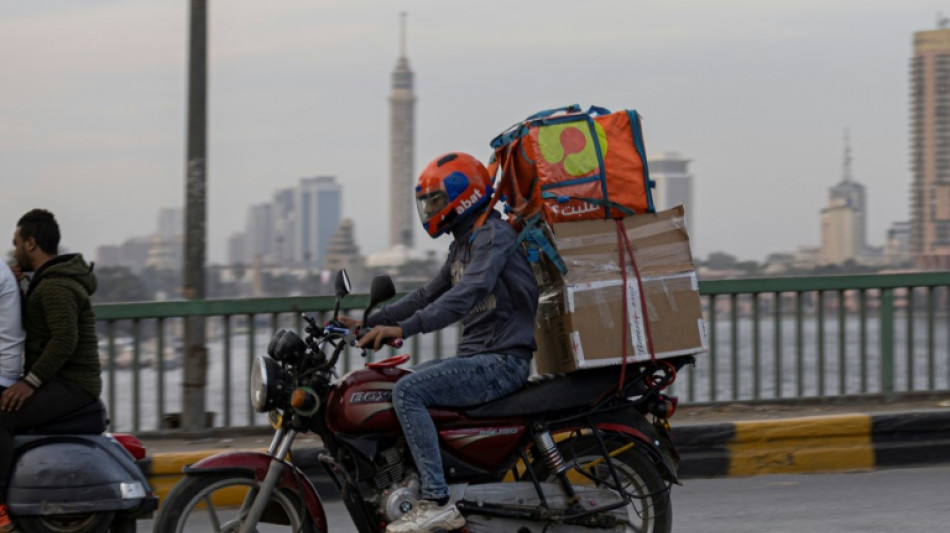
Egypt gig economy workers face rough ride / Photo: Khaled DESOUKI - AFP

 Alcaraz falls to Shelton in epic latest-ever US Open finish

 South Korea video game tycoon to pay record $1.5 bn in divorce
 'Long live Chairman Mao': Supporters pay respects to founder of Communist China
 Sweden immigration restrictions spark healthcare concerns
 EU to help cities tighten screws on Airbnb, holiday rentals

 'Our year': Kane and Bayern primed for Champions League tilt
 Australian World Cup star Volpato fined over positive cocaine test
 Sabalenka edges Noskova to keep US Open treble bid alive
 Pegula outlasts Navarro to set US Open semi with Sabalenka

 From trenches to catwalk: Ukraine's amputee soldiers hit the runway
 UK airports face more disruption after air traffic control glitch

 ECB meets, weighing a tricky balance between savers and spenders
 Pakistan police counter drone attacks with Ukraine-style nets

 Russia torments Kyiv with new 'horror' jet drones

 Iran attacks US base in Jordan as Hormuz impasse deepens

 New Apple CEO to face first test with foldable iPhone launch

 Battery X Metals Announces Confidential Submission of Amended Draft Registration Statement with the U.S. Securities and Exchange Commission in Connection with Proposed U.S. National Securities Exchange Initial Public Offering
 InterContinental Hotels Group PLC Announces Transaction in Own Shares - September 09

 Sabalenka edges Noskova, keeps US Open treble bid alive

 Real Madrid win Champions League opener as Haaland stars for Man City

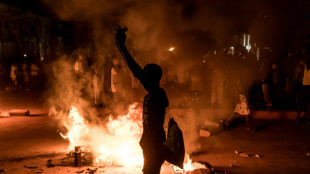 Gambian leader vows power boost after violent blackout protests

 Newcastle battle past Millwall to reach League Cup fourth round

 Mourinho's Real Madrid make winning start against Inter Milan

 Villa take 'big step forward' with win over Brugge

 Yaya Toure hails 'new era' for African coaches ahead of Champions League bow

Young men on bikes and scooters zip through Cairo, Egypt's sprawling megalopolis, dodging cars to deliver more than a million orders each day, with little physical or legal protection.
Egypt's digital gig economy is growing, as economic pressures push more of its key demographic -– educated, urban youth –- into the work-on-demand model.
Engineer Mohamed Sherif, 37, joined online food ordering company Talabat as a bicycle courier in Alexandria three months ago because he couldn't find a job.
"They bleed you dry left and right, but there's nothing else to do," he told AFP.
In early April, Talabat couriers called a two-day strike to demand higher wages, with only a fraction of the 12,000 workforce joining.
The work stoppage reflected, however, the state of Egypt's sizeable, app-based gig economy.
Inflation has climbed to a three-year high of 12.1 percent while the Egyptian pound plunged to 18 percent of its value.
The mounting economic hardships come as global commodity prices have soared following Russia's invasion of Ukraine.
A courier who declined to be named said commissions have been stagnant since 2020 at 9-18 Egyptian pounds (50 cents and $1).
"You can work a nine or 10-hour shift, and just not get enough orders," Sherif told AFP.
After paying for gas, oil and other expenses, "you could end up only making 30 or 40 pounds that day".
In Egypt, where 60 percent of the 103-million-strong population are under 30 and 14.5 percent of university graduates are unemployed, digital labour platforms have attracted 100,000-200,000 workers.
Uber alone employed 90,000 drivers in 2019, all without contracts, insurance or social security.
- 'Taking advantage of vulnerability' -
Fairwork, a project by the University of Oxford, worked with the American University in Cairo to rate the working conditions of seven of Egypt's largest digital labour platforms.
Uber, Talabat and grocery app Mongez scored one out of 10, while ridesharing startup Swvl -- which made headlines for its $1.5 billion Nasdaq debut earlier this year -- scored just three out of 10.
Omar Ramadan, whose home maintenance and cleaning services startup FilKhedma rated highest at five out of 10, said working conditions are seldom discussed in the tech ecosystem.
"It's very rare to talk about how much we're paying people, if this is fair or not, if we're taking advantage of people's vulnerability."
A third of Egyptians live in poverty, and nearly the same number are vulnerable to falling into poverty, the World Bank says.
The average family's monthly income is 6,000 EGP ($325).
Following the strike this month, Talabat said in a statement that couriers earned around 4,000-6,000 EGP per month, and up to 10,000 EGP "if they work eight hours or more".
But couriers say this excludes the cost of petrol -- which has gone up by three percent in recent days -- and paying for and servicing the scooter or bicycle they use.
Couriers using motorcycles earn up to twice as much as those making their deliveries by bicycles or on foot, said Sherif.
- A legal grey area -
Couriers also put their lives at risk as they navigate the chaotic streets of Cairo, where traffic rules are more than often disrespected and accidents happen almost daily.
Talabat Egypt's public affairs head Asmaa Khalil denied claims made by some couriers that they have no adequate insurance to protect them.
According to her, Talabat pays into accident and life insurance, but the schemes are handled by external contractors that recruit and manage their couriers.
Bicycle courier Sherif criticised this method, calling it a way by employers "to get rid of the dirty work".
Khalil said that, legally Talabat has "no obligations" towards its couriers and offers insurance and other benefits only "out of goodwill".
For Wael Tawfik of the Legal Collective to Promote Labour Awareness, the best recourse for workers is to set up a trade union.
But Sherif said it would be a tough task for couriers to set up a union because "unlike factory workers who all work in the same place, couriers only meet each other by coincidence".
Only 13.6 million people receive state-sponsored social security benefits in Egypt, where 63 percent of the workforce are employed in the informal economy, according to the International Labour Organization.
"Employment law, tax law, social security, it's all unclear how the gig economy is supposed to behave," Ramadan said.
"Everyone in the gig economy is in a grey area," he added.
Th.Gonzalez--AT