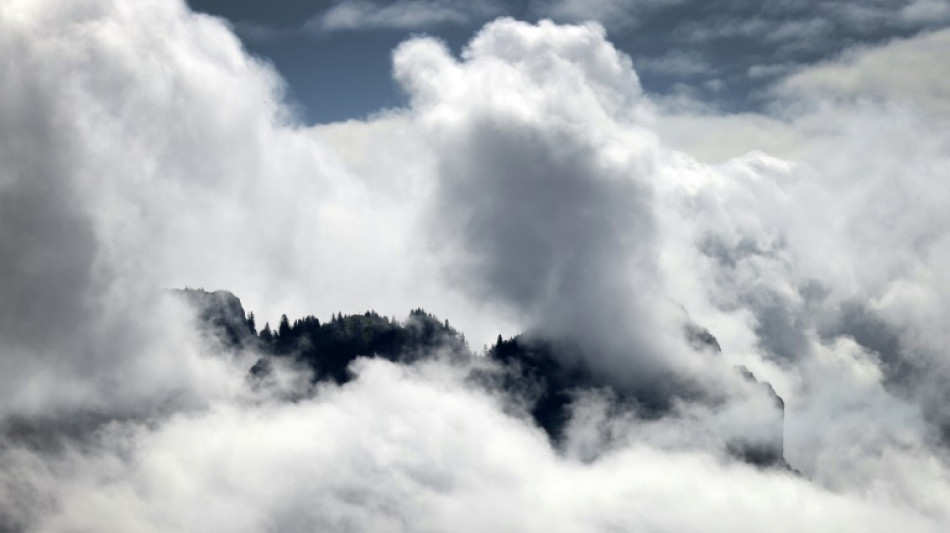
EarthCARE satellite to probe how clouds affect climate / Photo: Daniel ROLAND - AFP/File

 Cyberattack ruled out in UK air traffic glitch as more flights axed

 Ekiden Launches Canton Network’s First Order Book-Based Derivatives Exchange

 Germany's Merz accuses AfD of promoting 'ethnic cleansing'

 Japanese director Kore-eda's manga film charms critics in Venice
 As African space race heats up, Senegal pursues homemade satellites

 UK's little-known Bayeux Tapestry replica steps into spotlight

 Shelton stuns Alcaraz in 3:34 am US Open finish, Sabalenka battles on

 Alcaraz falls to Shelton in epic latest-ever US Open finish
 Tradition Announces Partnership With Affin Moneybrokers to Support Malaysian Market Data

 Protesters urge South Korea to stay out of Iran war

 Africa's informal economy: a burden and lifeline

 Kenyan start-up makes robotic limbs to sign for deaf kids

 Iran, US trade blows as Hormuz impasse deepens

 The round-the-clock monitors protecting Bhutan from glacier risk

 'Hell': Father of surfers killed in Mexico testifies at trial

 Travellers in UK face more chaos after air traffic control glitch

 Crude pushes towards $100 on Mideast flare-up, fanning inflation fears

 Record rain forces Asian Games athletes to evacuate accommodation
 Amusing or addictive? The algorithms powering our social feeds

 Norway bids farewell to King Harald V, 'grandfather' of the nation
 NFL breaks new ground as 100,000 set to pack MCG in Australia
 EU faces revolt over social media ban for children
 Canada eyes researchers looking to leave 'hostile' US
 Tiafoe escapes Michelsen to reach US Open semi-finals

 InterContinental Hotels Group PLC Announces Transaction in Own Shares - September 09

Will clouds help cool or warm our world in the years ahead? The EarthCARE satellite will soon blast off on a mission to find out, aiming to investigate what role clouds could play in the fight against climate change.
The collaboration between the European Space Agency and Japan's JAXA space agency is scheduled to launch Tuesday on a SpaceX Falcon 9 rocket from California's Vandenberg base.
The two-tonne satellite will orbit nearly 400 kilometres (250 miles) above Earth for three years, building a complete profile of those fluffy clouds over our heads.
"They are one of the main contributors to how the climate changes -- and one of the least understood," Dominique Gillieron, head of the ESA's Earth observation projects department, told AFP.
Clouds -- from cumulus and cirrus to cumulonimbus -- are a varied and complicated phenomenon.
Their composition depends on where they are located in the troposphere, Earth's lowest layer of atmosphere, Gillieron explained.
The troposphere starts at around eight kilometres (five miles) above the polar regions, but near the equator it begins at around 18 kilometres (11 miles) up. This means that clouds affect the climate differently depending on their altitude and latitude.
For example, white and bright cumulus clouds, which are made out of water droplets, sit quite low and work like a parasol, reflecting the Sun's radiation back into space and cooling the atmosphere.
Higher up, cirrus clouds made of ice crystals allow solar radiation to pass through, heating up our world.
Cirrus clouds then trap in the heat like a "blanket," Gillieron said.
- Parasol or blanket? -
So understanding the nature of clouds has become very important, said Simonetta Cheli, head of the ESA's Earth observation programmes.
EarthCARE will become the first satellite to measure the vertical and horizontal distribution of clouds, she told a press conference.
Two of the satellite's instruments will flash light at the clouds to probe their depths.
The Lidar instrument will use a laser pulse to measure both clouds and aerosols, which are tiny particles in the atmosphere such as dust, pollen or human-emitted pollutants like smoke or ash.
Aerosols are the "pre-cursors" to clouds, Gillieron explained.
The satellite's radar will pierce through the clouds to measure how much water they contain.
It will also track the speed of the clouds moving through the atmosphere, similar to how radar helps police nab speeding cars.
The satellite's other instruments will measure the shape and temperature of the clouds.
All this data will create the first complete picture of clouds from the perspective of a satellite.
The scientific community is eagerly awaiting this information so it can update climate models that estimate how quickly our world will warm, the ESA said.
The amount of solar radiation that gets past Earth's clouds could therefore be crucial to understanding and mitigating the impact of human-driven global warming.
The mission aims to find out "whether the current effect of the clouds, which is rather cooling at the moment -- the parasol outweighs the blanket -- will become stronger or weaker," Gillieron said.
This trend has become more difficult to predict as global warming has changed the distribution of clouds.
"EarthCARE is being launched at an even more important time than when it was conceived in 2004," Cheli said.
J.Gomez--AT