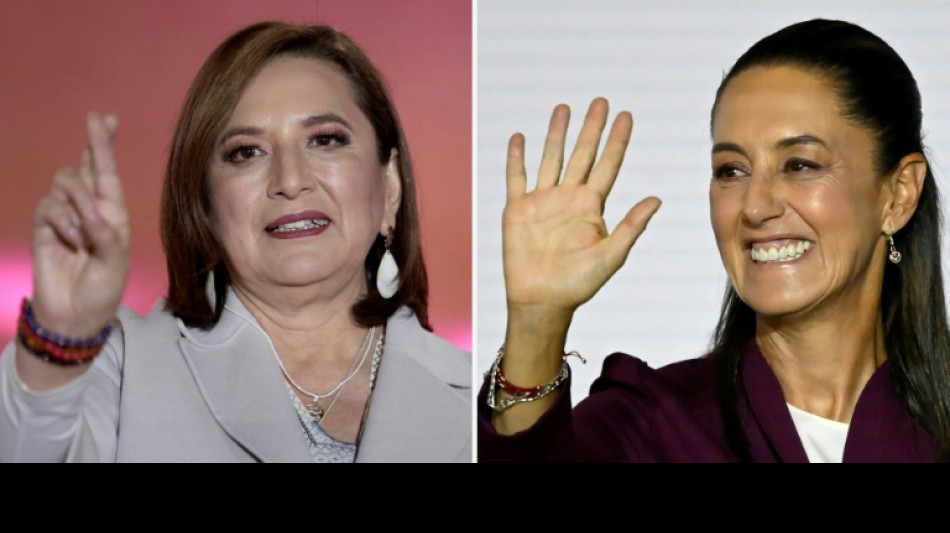
Disinformation war engulfs Mexican presidential race / Photo: ULISES RUIZ, ALFREDO ESTRELLA - AFP/File

 Cyberattack ruled out in UK air traffic glitch as more flights axed

 Ekiden Launches Canton Network’s First Order Book-Based Derivatives Exchange

 Germany's Merz accuses AfD of promoting 'ethnic cleansing'

 Japanese director Kore-eda's manga film charms critics in Venice

 As African space race heats up, Senegal pursues homemade satellites
 UK's little-known Bayeux Tapestry replica steps into spotlight

 Shelton stuns Alcaraz in 3:34 am US Open finish, Sabalenka battles on

 Alcaraz falls to Shelton in epic latest-ever US Open finish

 Tradition Announces Partnership With Affin Moneybrokers to Support Malaysian Market Data
 Protesters urge South Korea to stay out of Iran war
 Africa's informal economy: a burden and lifeline
 Kenyan start-up makes robotic limbs to sign for deaf kids
 Iran, US trade blows as Hormuz impasse deepens

 The round-the-clock monitors protecting Bhutan from glacier risk

 'Hell': Father of surfers killed in Mexico testifies at trial

 Travellers in UK face more chaos after air traffic control glitch
 Crude pushes towards $100 on Mideast flare-up, fanning inflation fears

 Record rain forces Asian Games athletes to evacuate accommodation
 Amusing or addictive? The algorithms powering our social feeds

 Norway bids farewell to King Harald V, 'grandfather' of the nation

 NFL breaks new ground as 100,000 set to pack MCG in Australia

 EU faces revolt over social media ban for children

 Canada eyes researchers looking to leave 'hostile' US

 Tiafoe escapes Michelsen to reach US Open semi-finals

 InterContinental Hotels Group PLC Announces Transaction in Own Shares - September 09

Does Mexican presidential front-runner Claudia Sheinbaum want to make circumcision compulsory and close a revered Catholic church? No, it's all part of an election disinformation war.
The June 2 vote is not only being fought with campaigning in the streets, but also online, where the war is often based on false rumors, many of them debunked by AFP factcheckers.
Internet users using old videos or footage taken out of context have repeatedly accused opposition candidate Xochitl Galvez of wanting to scrap outgoing President Andres Manuel Lopez Obrador's social programs.
Sheinbaum, the granddaughter of Jewish migrants, has faced unfounded rumors that she wants to make circumcision mandatory and turn the Basilica of Guadalupe into a museum.
Such disinformation generates confusion that undermines confidence in candidates and discourages voting, said Felipe Lopez Veneroni, a political analyst and professor at the National Autonomous University of Mexico.
The hate speech creates "a completely irrational and emotional narrative, which is motivated more by fear than by the clarity of the proposals," he said.
False rumors reaffirm "prejudices that many people already have -- they believe what they want to believe," Veneroni said.
- 'Exclude and dissuade' -
Both Galvez and Sheinbaum -- who are competing to be Mexico's first woman president -- have been accused online of having lied about their university degrees.
Such attacks present them "as weak, incompetent or incapable of leading," said Frine Salguero, executive director of the Simone de Beauvoir Leadership Institute, a Mexico City training center for women.
"They seek to exclude and dissuade women who participate in the political sphere. Unfortunately it's a reflection of Mexican society," she added.
Immigrants have also been dragged into the disinformation war, accused of being bought with social assistance from the government in return for voting for Sheinbaum.
In reality, only 83,000 naturalized migrants are able to cast ballots -- a tiny fraction of the 99 million people registered to vote.
The National Electoral Institute has clarified that it does grant the right to vote to foreigners without Mexican citizenship.
Accusations of fraud and doubts surrounding an electoral process are often commonplace on social media.
Days before the Mexican election, some users were still confused by misinformation about how they should mark their ballots, or whether pens provided by the electoral institute contain ink that can be erased.
Such falsehoods can sway voters and even alter the course of the elections, said Martha Tudon, digital rights officer at the rights group Article 19.
"It can be very serious in places where people don't have full internet access, only to WhatsApp and Facebook," and cannot verify what they receive, she said.
According to a study released by UNESCO last November, 61 percent of Mexicans get their information through social media.
A.Clark--AT