With little to buy, Cubans abroad send home food, not money / Photo: STRINGER - AFP

 Cyberattack ruled out in UK air traffic glitch as more flights axed

 Ekiden Launches Canton Network’s First Order Book-Based Derivatives Exchange

 Germany's Merz accuses AfD of promoting 'ethnic cleansing'

 Japanese director Kore-eda's manga film charms critics in Venice

 As African space race heats up, Senegal pursues homemade satellites

 UK's little-known Bayeux Tapestry replica steps into spotlight

 Shelton stuns Alcaraz in 3:34 am US Open finish, Sabalenka battles on

 Alcaraz falls to Shelton in epic latest-ever US Open finish

 Tradition Announces Partnership With Affin Moneybrokers to Support Malaysian Market Data

 Protesters urge South Korea to stay out of Iran war

 Africa's informal economy: a burden and lifeline

 Kenyan start-up makes robotic limbs to sign for deaf kids

 Iran, US trade blows as Hormuz impasse deepens

 The round-the-clock monitors protecting Bhutan from glacier risk

 'Hell': Father of surfers killed in Mexico testifies at trial

 Travellers in UK face more chaos after air traffic control glitch

 Crude pushes towards $100 on Mideast flare-up, fanning inflation fears

 Record rain forces Asian Games athletes to evacuate accommodation

 Amusing or addictive? The algorithms powering our social feeds

 Norway bids farewell to King Harald V, 'grandfather' of the nation

 NFL breaks new ground as 100,000 set to pack MCG in Australia

 EU faces revolt over social media ban for children

 Canada eyes researchers looking to leave 'hostile' US

 Tiafoe escapes Michelsen to reach US Open semi-finals

 InterContinental Hotels Group PLC Announces Transaction in Own Shares - September 09

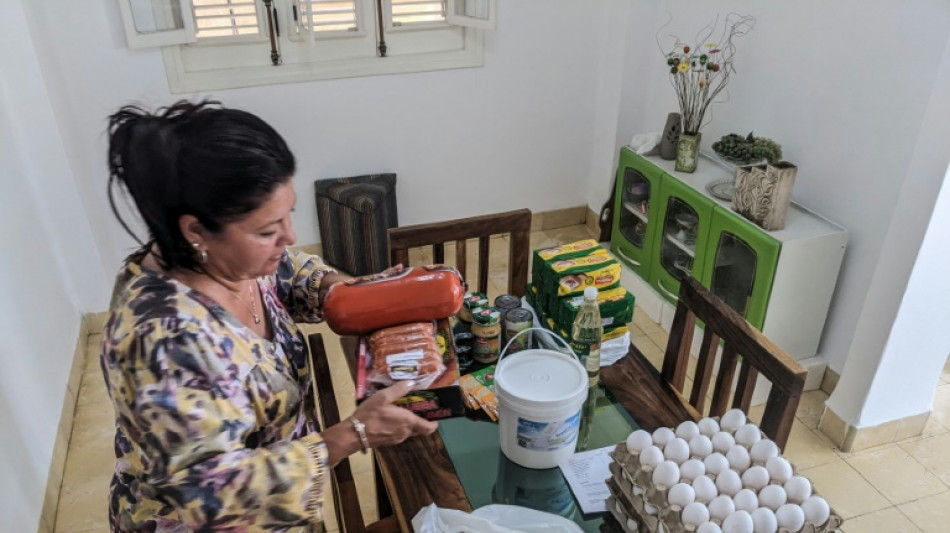
Maria Paez feels relieved after receiving a package of food items including eggs, ham, and yogurt from her children in Miami -- bought online and shipped to Havana.
These days, with a severe economic crisis and food shortages, Cubans abroad increasingly prefer to send care packages to family back home, rather than cash transfers.
"Receiving these types of products is a relief for us" and, "in terms of spending money, the savings are substantial," Paez, a 59-year-old mathematics graduate told AFP.
"Receiving eggs is very important" because "it is a guaranteed breakfast," added Paez, who has lived alone with her husband since their two children emigrated to the United States.
In total, she received 18 products, a lifeline in Cuba which is facing its worst economic crisis in three decades, with shortages of food, medicine and fuel.
After several years of double-digit inflation, a carton of 30 eggs now costs 3,300 pesos ($27,50) on the communist island, where the average salary is 4,800 pesos.
Cuba's bleak economic circumstances have pushed some five percent of the population to flee in recent years.
Online stores offering the delivery of essential products to Cuba have flourished as demand rises.
Most are based in the United States -- home to two million Cubans -- but they have also cropped up in Mexico, Canada, and Spain.
Every day dozens of delivery vans and private vehicles can be seen on the streets of Cuba distributing packages of food items that are in short supply, or whose prices have skyrocketed since the government authorized private-owned stores in 2021.
- They 'don't want money' -
At one such delivery service in the US city of Hialeah, near Miami, which has a large Cuban population, Luis Manuel Mendez, 59, told AFP he sends food, medicine and school supplies to the two children he left behind when he emigrated a year-and-a-half ago.
"Things in Cuba are very expensive," so "it is much more feasible to buy it here and send it," said Mendez.
His children "don't want money, what they want is for me to send them basic necessities."
Nearby, there is a constant stream of people carrying bags to another agency which coordinates the sending of food packages to Cuba.
Maribel Ruiz, 62, said she helps out an aunt and cousins back home.
"The problem is that you send the money, but there is nothing to buy in the stores there. You have to send them packages of medicine, food, clothes, everything."
Cuba has been battling sky-high inflation and shortages since the pandemic -- which hit tourism hard -- plus a tightening of US sanctions in 2021, combined with structural weaknesses in the economy.
According to the Havana Consulting Group, based in Miami, remittances from the United States to Cuba reached a record $3.7 billion in 2019, becoming the country's second source of income after the export of medical services, and above tourism.
Cuban economist Emilio Morales, who chairs the consultancy, said this figure has since dropped "from $2 billion in 2022 to $1,9 billion in 2023."
Morales said emigrants also increasingly prefer "to invest large sums of money in getting their families" out of the country or pay online companies to send packages to their door.
R.Lee--AT