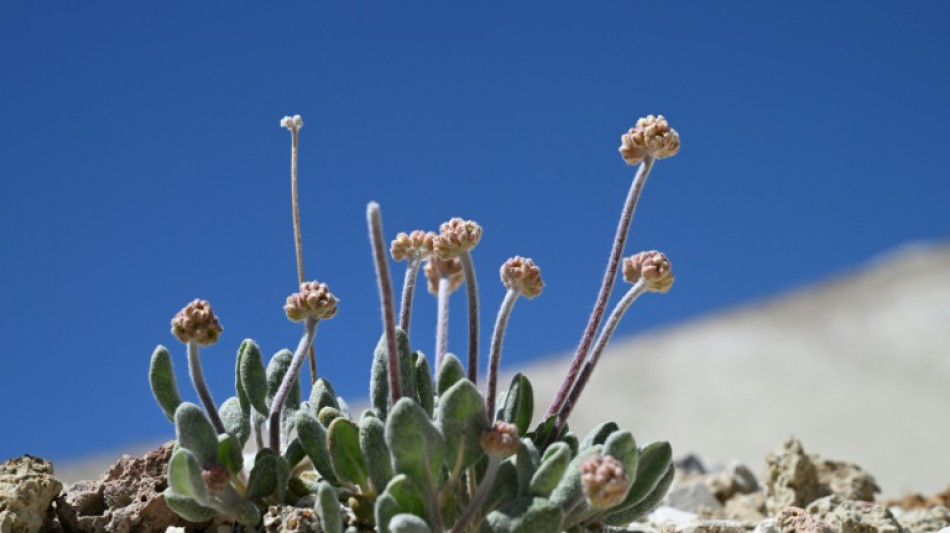
Flower or power? Campaigners fear lithium mine could kill rare plant / Photo: Robyn Beck - AFP

 IC Markets Australia Wins People's Choice Forex Broker Innovation Award at the 2026 Finder Innovation Awards

 Brent oil tops $100 on Mideast flare-up, fanning inflation fears

 EU wants to edge out China in public contracts

 Google unveils 13 bn euro AI expansion in Finland

 Singapore's hefty ministerial pay hikes draw mixed feelings

 Cyberattack ruled out in UK air traffic glitch as more flights axed

 Ekiden Launches Canton Network’s First Order Book-Based Derivatives Exchange

 Germany's Merz accuses AfD of promoting 'ethnic cleansing'

 Japanese director Kore-eda's manga film charms critics in Venice

 As African space race heats up, Senegal pursues homemade satellites
 UK's little-known Bayeux Tapestry replica steps into spotlight

 Shelton stuns Alcaraz in 3:34 am US Open finish, Sabalenka battles on

 Alcaraz falls to Shelton in epic latest-ever US Open finish
 Tradition Announces Partnership With Affin Moneybrokers to Support Malaysian Market Data

 Protesters urge South Korea to stay out of Iran war

 Africa's informal economy: a burden and lifeline

 Kenyan start-up makes robotic limbs to sign for deaf kids

 Iran, US trade blows as Hormuz impasse deepens

 The round-the-clock monitors protecting Bhutan from glacier risk

 'Hell': Father of surfers killed in Mexico testifies at trial

 Travellers in UK face more chaos after air traffic control glitch

 Crude pushes towards $100 on Mideast flare-up, fanning inflation fears

 Record rain forces Asian Games athletes to evacuate accommodation

 Amusing or addictive? The algorithms powering our social feeds

 Norway bids farewell to King Harald V, 'grandfather' of the nation

Delicate pink buds sway in the desert breeze, pregnant with yellow pompoms whose explosion will carpet the dusty corner of Nevada that is the only place on Earth where they exist.
Under their roots lie vast reserves of lithium, vital for the rechargeable electric car batteries that will reduce planet-heating pollution.
But campaigners fear the extraction of the precious metal could destroy the flower's tiny habitat.
"This mine is going to cause extinction," says Patrick Donnelly, an environmentalist who works at the Center for Biological Diversity, a non-governmental organization.
"They somehow claim that they're not harming the (plant). But can you imagine if someone built an open-pit mine 200 feet from your house? Wouldn't that affect your life profoundly?"
The plant in question is Tiehm's buckwheat.
There are only around 20,000 known specimens, growing in a few very specific places on a total surface area equivalent to around five soccer fields.
In 2022, the wildflower was classified as endangered by US federal authorities, with mining cited as a major threat to its survival.
The plant and the lithium reserve on which it grows embody one of the key challenges and contradictions of the global climate struggle: how much damage can we inflict on the natural world as we seek to halt or reverse the problems we have already created?
- 'Coexist' -
Bernard Rowe, boss of Australian miner Ioneer, which holds the mineral rights to the area, says the lithium produced at Rhyolite Ridge "will be sufficient to provide batteries for about 370,000 vehicles" a year.
"We'll do that year-on-year for 26 years," he said.
Those nearly 10 million vehicles will go a long way towards meeting the goal President Joe Biden has set of cutting down the nation's fleet of gas-guzzlers as a way to slash US production of planet-warming pollutants.
So-called zero-emission cars make up around 7.5 percent of new vehicle sales in the United States today -- more than double the percentage just a few years earlier.
In California, the figure is more than 20 percent.
And while expansion in the sector has slowed, the category remains the fastest-growing, according to Kelley Blue Book.
And it's not only in the United States: Global demand for lithium will increase five to seven times by 2030, according to the International Energy Agency.
The difficulty for US manufacturers is that much of the world's lithium supply is dominated by strategic rival China, as well as Australia and Chile.
"The United States has very, very little domestic production," said Rowe.
"So it's important to develop a domestic supply chain to allow for that energy transition, and Rhyolite Ridge will be an integral part of that."
Ioneer's plans show that over the years the mine is in operation -- it is projected to start producing lithium in late 2027 -- around a fifth of the plant's habitat will be directly affected.
But the company, which has spent $2.5 million researching the plant, says mining will not affect its survival; it is already growing well in greenhouses and biologists think it can be replanted.
"We're very confident that the mine and Tiehm's buckwheat can coexist," Rowe said.
- 'Greenwashing' -
Donnelly counters that Ioneer is "basically greenwashing extinction."
"They're saying. 'We're going to save this plant,' when actually they are going to send it to its doom," he said.
Under the company's plans, the strip mine will use hundreds of trucks, which Donnelly says will raise clouds of dust that will affect photosynthesis and harm the insects that pollinate the plants.
Ioneer says it has already planned mitigation methods, like dust curtains, and keeping the roads wet.
Still, Donnelly says, why not just move the mine? But Rowe counters that it's not as simple as just digging somewhere else.
Ioneer has invested $170 million since 2016 to demonstrate the feasibility of this site, which it believes is one of the best around.
"Many of these other deposits haven't had that amount of work, so they're not viable alternatives to a project like this," he said.
The US Department of Energy has offered Ioneer a $700 million loan for the project, if the Bureau of Land Management signs off on an operating permit.
Donnelly insists the issue is not just the future of one obscure wildflower, but rather just one example of large-scale biodiversity loss that is threatening millions of plants and animals.
"If we solve the climate crisis, but we drive everything extinct while we do it, we're still going to lose our world," he said.
H.Thompson--AT