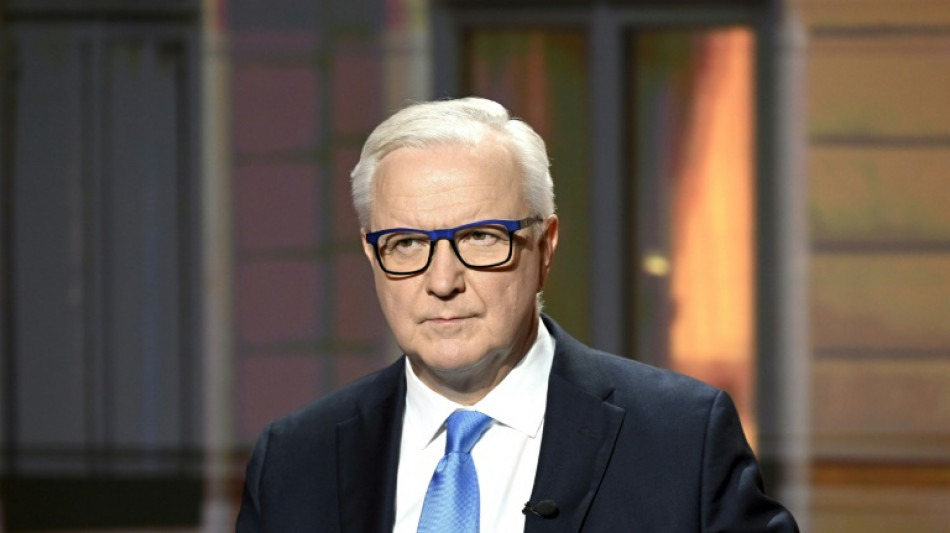
ECB can start cuts before Fed, says Finnish bank governor / Photo: Markku Ulander - Lehtikuva/AFP/File

 IC Markets Australia Wins People's Choice Forex Broker Innovation Award at the 2026 Finder Innovation Awards

 Brent oil tops $100 on Mideast flare-up, fanning inflation fears

 EU wants to edge out China in public contracts
 Google unveils 13 bn euro AI expansion in Finland

 Singapore's hefty ministerial pay hikes draw mixed feelings
 Cyberattack ruled out in UK air traffic glitch as more flights axed

 Ekiden Launches Canton Network’s First Order Book-Based Derivatives Exchange

 Germany's Merz accuses AfD of promoting 'ethnic cleansing'

 Japanese director Kore-eda's manga film charms critics in Venice

 As African space race heats up, Senegal pursues homemade satellites

 UK's little-known Bayeux Tapestry replica steps into spotlight

 Shelton stuns Alcaraz in 3:34 am US Open finish, Sabalenka battles on

 Alcaraz falls to Shelton in epic latest-ever US Open finish

 Tradition Announces Partnership With Affin Moneybrokers to Support Malaysian Market Data

 Protesters urge South Korea to stay out of Iran war

 Africa's informal economy: a burden and lifeline
 Kenyan start-up makes robotic limbs to sign for deaf kids

 Iran, US trade blows as Hormuz impasse deepens

 The round-the-clock monitors protecting Bhutan from glacier risk

 'Hell': Father of surfers killed in Mexico testifies at trial

 Travellers in UK face more chaos after air traffic control glitch

 Crude pushes towards $100 on Mideast flare-up, fanning inflation fears

 Record rain forces Asian Games athletes to evacuate accommodation
 Amusing or addictive? The algorithms powering our social feeds
 Norway bids farewell to King Harald V, 'grandfather' of the nation

The European Central Bank did not have to take its cues from the US Federal Reserve and could start to lower rates as soon as June, Bank of Finland governor Olli Rehn told AFP.
"While we don't make policy in a vacuum, the ECB is not the 13th Federal district of the US Federal Reserve," which is split into 12 zones, said Rehn.
"What the Fed does will not determine the case for a rate cut by the ECB," said Rehn.
When inflation began to climb upwards, the Fed was faster to respond than the ECB, kicking off a series of interest rate hikes in March 2022.
After some initial hesitation, ECB policymakers followed suit in July of that year, raising rates faster and farther than ever before in the history of the eurozone.
But with consumer prices now having come off the boil, it looks like European policymakers might be poised to move first to reduce borrowing costs at their next meeting in June.
Lingering inflation pressures in the United States have seen Fed policymakers back away from reducing rates again too soon.
But in the eurozone, the "declining trend" in inflation and "moderating wage growth" meant there was a "strong case for starting to ease monetary policy and cut rates in June", Rehn said.
- 'Small deviations' -
"Beyond that, let's see if the trend continues," said Rehn, who is one of 25 people on the ECB's governing council, which sets the course for interest rates in the eurozone.
Another cut at the ECB's meeting in July was far from a certainty for Rehn, who echoed statements made by many of his colleagues.
"We are not pre-committing to any rate path," Rehn said, an opinion shared by ECB President Christine Lagarde.
As for the Fed, observers should not pay "too much attention to possible small deviations in monetary stance" with the ECB's own decisions, said Rehn.
Concerns have been expressed that lowering rates first in the eurozone could lead to the depreciation of the euro relative to the dollar, potentially importing new inflation.
But the economic cycles in the United States and the eurozone could not be perfectly synchronised, "especially after such exceptional shocks that we have experienced", said Rehn in an allusion to turbulences caused by the coronavirus pandemic and the Russian invasion of Ukraine.
- More investment -
Growing differences in the economic development of the United States and Europe was a "major concern", however, Rehn said.
The United States has recorded stronger growth than the eurozone for 25 years, thanks to demographic advantages and bigger increases in productivity.
The price shock caused by Russia's 2022 invasion of Ukraine and the dwindling of gas supplies from the east also underlined Europe's dependence on Moscow for its energy imports.
"That's why the efforts toward green transition and digitalisation are so critical for Europe," Rehn said.
"We are under-investing for the moment in Europe and I'm very concerned about that because that's hampering our competitiveness," the central banker said.
M.O.Allen--AT