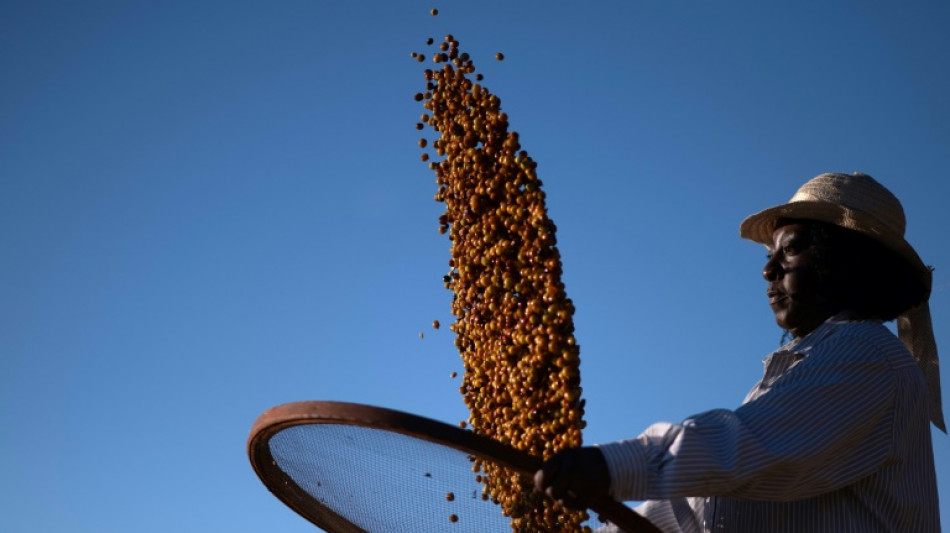
Black farmers in Brazil changing views on coffee production / Photo: Douglas Magno - AFP

 France far right expels policeman member over racist remarks

 Pakistan collapse to 133 all out against England in 3rd Test

 Heat forces French champagne makers to stiffen their drink
 Iran war drives oil prices to $100 per barrel as Tehran strikes ships
 Pakistan collapse to 100-7 against England in 3rd Test
 Workers, migrants focus of documentaries by Oscar winners at Venice

 Nepal seeks survivors two weeks after deadly floods

 Bangladesh measles crisis kills more than 1,000 children

 Pakistan collapse to 26-4 against England in 3rd Test
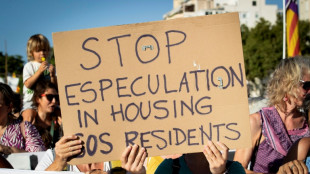 EU helps cities tighten screws on Airbnb, holiday rentals

 Courtois to put Belgium career on hold
 RavenDB Launches Quill to Bring Production AI Agents to Enterprise SQL Systems, No Migration Required

 Affleck family affair at Venice for Casey's latest film 'Company'

 Yemen rebels report fresh Saudi strikes as conflict deepens

 'They're playing with our lives': AI researcher quits Anthropic

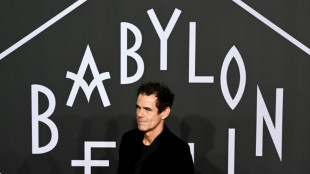 Series finale of 'Babylon Berlin' offers dark mirror for today's Germany
 Zara owner Inditex boosts profits as sales grow across board
 Alcaraz out in latest US Open finish, Sabalenka through on marathon day

 Brent breaks $100 on Mideast flare-up, fanning inflation fears

 South Korea video game tycoon to pay record $1.5 bn in divorce
 'Long live Chairman Mao': Supporters pay respects to founder of Communist China
 Sweden immigration restrictions spark healthcare concerns
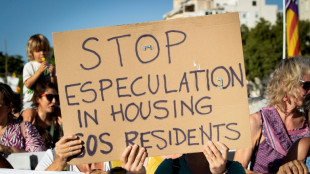 EU to help cities tighten screws on Airbnb, holiday rentals

 'Our year': Kane and Bayern primed for Champions League tilt
 Australian World Cup star Volpato fined over positive cocaine test
Raphael Brandao beams with pride as he describes the high-end Brazilian coffee he produces with beans sourced exclusively from Black farmers in a country where many still associate the product with slavery.
The 31-year-old buys his coffee beans solely from farms owned by Afro-descendents and says his goal is to "reverse this logic that Black people" like himself "are mere laborers."
"In my own way, I am trying to make historical reparations," Brandao told AFP at his roastery in Nova Iguacu, a poor suburb of Rio de Janeiro.
Four years ago, he launched his brand Cafe di Preto.
By 2022 he sold 800 kilograms (about 1,700 pounds), the following year 1.4 tons. This year he hopes to increase that to more than two tons following a 20-percent sales increase in the first quarter alone.
The logo for Cafe di Preto is a raised Black fist clutching a coffee branch, and the different flavor lines are each named after important Black women of Brazilian history.
Brazil was the last country in the Americas to abolish slavery, in 1888, and racial inequalities remain high in a country where more than half of people identify as "preto" (Black) or mixed-race.
- 'Changing the world' -
Through his endeavors, Brandao told AFP he wants to remind the world that Brazil became a leading coffee produceron the back of slaves from Africa, where coffee originates from.
He is also seeking to "break the stigma that Black people do not produce quality."
"So my work also gives light to this," he said. "Today I have six coffees produced by Black people, all of them... of great quality."
Many of his clients, he added, are looking for quality but also for a product that is "changing the world."
Brandao is a leader in the so-called Black Business wave in Brazil that promotes commerce among people of African descent as a tool for social progress.
At first, he had trouble finding Black suppliers given that the overwhelming majority of coffee plantations in Brazil still belong to white families.
"My black suppliers are the first generation to produce on their own land, often only a few hectares," he said.
And Brandao has more than once had to defend his chosen crusade.
"I am sometimes asked: 'What if it was the opposite, if roasteries owned by whites bought coffee from white farmers?' But isn't that what is happening already?"
- From farm to cup -
About 500 kilometers (311 miles) from Nova Iguacu is the 19-hectare (47-acre) coffee plantation of Neide Peixoto, one of Brandao's first suppliers.
"I have been in contact with coffee since childhood. My parents worked in crops and I often accompanied them," Peixoto, 49, told AFP on her farm in the southeastern state of Minas Gerais, a mecca for coffee production.
Unlike her parents, she grows coffee on land that belongs to her own family, bought by her husband and brothers who are also former laborers.
"It means a lot to me to be a Black producer of special coffee, because... we, Black people have a very difficult and painful history," Peixoto said.
Most of the farm's production is for export, but the beans reserved for Cafe di Preto have a special significance for Peixoto.
"It's exciting to know that the coffee I produce, which is coffee produced by Black people, is also roasted by Black people," she said.
"I'm very happy to know that we are making this connection, from production here on the farm to the cup."
A.Anderson--AT