Brazil floods strike blow to powerful agriculture sector / Photo: Carlos FABAL - AFP

 Belgium raids illicit cigarette factory in push to stub out growing trade

 Vuelta debutant Brennan claims fifth victory on stage 17

 US had warmest summer on record: climate agency

 Meta tests fact-check replacement in Latin America

 Soviet brutality, ideology backdrop of controversial Venice film

 McIlroy predicts player exodus after LIV files for bankruptcy protection

 Global Multi-Asset Broker FP Markets Secures UAE CMA Category 5 Licence

 Brent oil passes $100 on Mideast flare-up, stoking inflation worries
 'Nothing left': thousands in Yemen flee deadly Houthi clashes

 Spain endured hottest summer on record: weather agency

 'A celebration': Amsterdam museum unveils Kusama show weeks after death

 IC Markets Australia Wins People's Choice Forex Broker Innovation Award at the 2026 Finder Innovation Awards
 Brent oil tops $100 on Mideast flare-up, fanning inflation fears

 EU wants to edge out China in public contracts

 Google unveils 13 bn euro AI expansion in Finland
 Singapore's hefty ministerial pay hikes draw mixed feelings

 Cyberattack ruled out in UK air traffic glitch as more flights axed

 Ekiden Launches Canton Network’s First Order Book-Based Derivatives Exchange

 Germany's Merz accuses AfD of promoting 'ethnic cleansing'

 Japanese director Kore-eda's manga film charms critics in Venice

 As African space race heats up, Senegal pursues homemade satellites

 UK's little-known Bayeux Tapestry replica steps into spotlight

 Shelton stuns Alcaraz in 3:34 am US Open finish, Sabalenka battles on

 Alcaraz falls to Shelton in epic latest-ever US Open finish

 Tradition Announces Partnership With Affin Moneybrokers to Support Malaysian Market Data

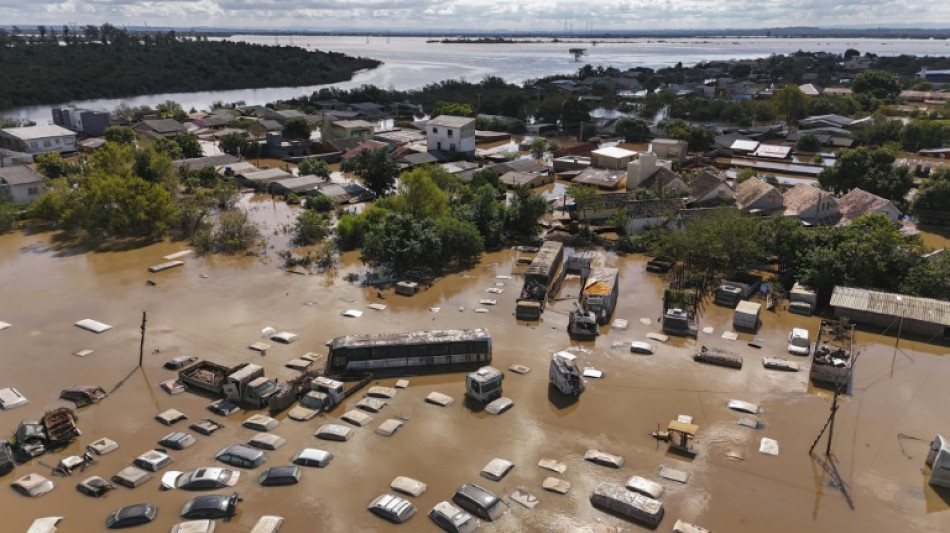
Floodwaters in Brazil have swallowed up soybean fields and farming equipment, cutting off roads, livestock farms and warehouses in the latest extreme weather event to hit the agricultural giant.
The inundated state of Rio Grande do Sul is one of the biggest soy-producing regions in Brazil, as well as its main rice-growing area, and both crops are expected to suffer from the historic flooding.
"In a year, we have suffered a drought and three floods, including this one, which reached levels never seen before," said Nilvo Bosa, president of a local cooperative of small farmers.
"We have no way of accessing our fields, which are under four or five meters (13 to 16 feet) of water," he said from his house atop a hill, reflecting on the extensive damage from floods that have turned streets into rivers and left more than 100 dead.
The region had been counting on a record harvest of more than 22 million tons of soybeans this year, but extreme weather could affect up to five million tons of the harvest, said Luiz Fernando Gutierrez, an analyst at the Safras & Mercado agricultural consulting firm.
Before the rains, "a quarter of the soybean fields remained to be harvested," he said.
"Part of the crops will rot and be lost, others will have lower yields than expected. Storage areas were also likely affected."
While Brazil will retain its spot as the world's largest producer of soybeans, which are used in livestock feed, the flooding is expected to hit its results this season.
A decline had already been forecast before the floods, due to previous torrential rains and a drought in the center-west of the huge country.
- Rice, chicken and pork -
Rio Grande do Sul is also Brazil's largest grower of rice, a staple in the country, with 6.9 million tons produced last year.
Around 15 percent of rice crops had yet to be harvested before the floods hit, according to the regional Institute of Technical Assistance and Rural Extension (Emater).
To address any potential deficit and combat price speculation, President Luiz Inacio Lula da Silva's government has announced plans to import rice.
Rio Grande do Sul has experienced major disruptions to its network of meat processing plants, with two of its 10 plants still paralyzed, according to the Brazilian Animal Protein Association.
The region is responsible for 11 percent of Brazil's chicken meat production, of which it is the world's largest exporter, and almost 20 percent of pork, of which it is the world's fourth-largest exporter.
"To restore the (agricultural) sector we need a guarantee fund supported by the government," said Gedeao Pereira, president of the Regional Federation of Agriculture.
Experts link the historic floods and other recent extreme weather in Brazil to global warming, exacerbated by the El Nino climate phenomenon.
Agronomist Eduardo Assad, who studies the effects of climate change on agriculture, said Brazil "will begin to suffer severe crop losses" if the sector does not take the necessary measures to protect the soil and biodiversity.
According to a report published last year by MapBiomas, a consortium of Brazilian NGOs and universities, agricultural activities contributed to 95.7 percent of deforestation in Brazil.
While Lula's government boasted lowered deforestation rates in the vital Amazon rainforest last year, experts say the country needs to develop a more sustainable agricultural model that can adapt to global warming.
N.Mitchell--AT