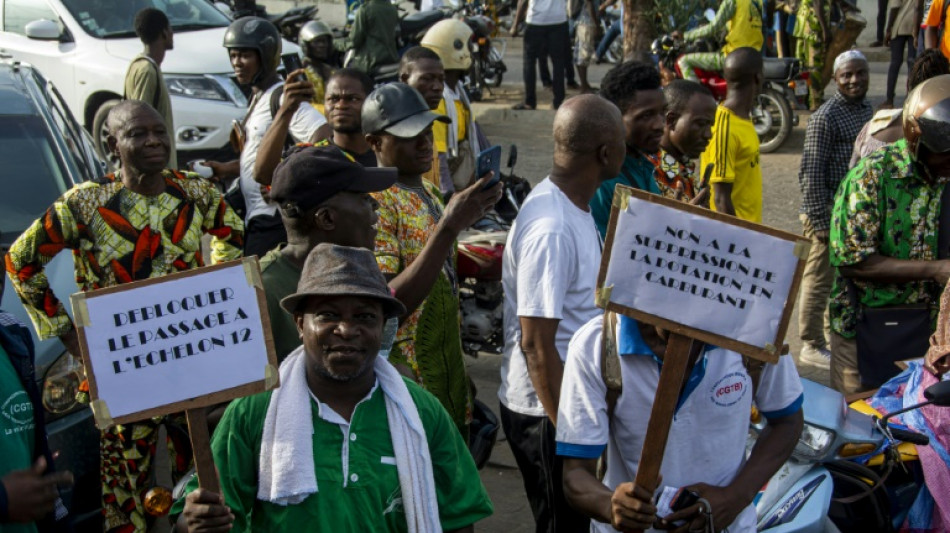
In Benin, tensions soar over cost of living / Photo: Abadjaye Justin SODOGANDJI - AFP/File

 England edge ahead in third Test after latest Pakistan collapse

 'Alarm bells ringing': US summer heat shatters record

 IAEA board refers Iran to UN Security Council

 Rubio pushes extraditions, anti-drug fight in Ecuador

 Amboss and Aureo Connect the Lightning Network to Mexico's Banking System

 Brent oil passes $100 on Mideast flare-up, stoking inflation fears

 Israeli settlement winemaker defiant after UK-led trade sanctions

 Josh Kerr: I pick my races and never get 'greedy'

 Carrick confident Man Utd can go far in 'magical' Champions League

 France far right expels policeman member over racist remarks

 Pakistan collapse to 133 all out against England in 3rd Test

 Heat forces French champagne makers to stiffen their drink
 Iran war drives oil prices to $100 per barrel as Tehran strikes ships

 Pakistan collapse to 100-7 against England in 3rd Test

 Workers, migrants focus of documentaries by Oscar winners at Venice

 Nepal seeks survivors two weeks after deadly floods

 Bangladesh measles crisis kills more than 1,000 children

 Pakistan collapse to 26-4 against England in 3rd Test

 EU helps cities tighten screws on Airbnb, holiday rentals

 Courtois to put Belgium career on hold

 RavenDB Launches Quill to Bring Production AI Agents to Enterprise SQL Systems, No Migration Required

 Affleck family affair at Venice for Casey's latest film 'Company'

 Yemen rebels report fresh Saudi strikes as conflict deepens

 'They're playing with our lives': AI researcher quits Anthropic

 Series finale of 'Babylon Berlin' offers dark mirror for today's Germany

In the heart of Cotonou’s large Dantokpa market, Diane Makpenon's family corn shop is less busy than usual these days.
The business run by her mother like others in Benin’s economic capital has been slowing down as they struggle with rising prices.
The price of a kilo (2.2 pounds) of corn, one of the country’s most widely consumed foods, rose from 200 CFA francs (0.30 euro cents) to 450 CFA francs, before falling again to 400 CFA francs within a few days, according to traders.
A 120-kilo bag is now sold for between 33,000 (about 50 euros, nearly $54) and 36,000 CFA francs compared to barely 30,000 CFA francs before.
The increase in food costs in the small West African nation prompted Benin’s labour unions to call for an unprecedented series of protests against the cost of living -- the first was dispersed by police firing tear gas and a second banned by the authorities.
A third planned for Cotonou on Saturday has been granted authorisation by city officials.
Benin’s consumer prices and economy have been hit by fallout from the Ukraine war and by the closure of the border with major trading partner Niger to the north following a coup there last July.
Neighbouring Nigeria's naira currency devaluation and abrupt end of a decades-long fuel subsidy have also impacted Benin's fuel prices and trade.
"Going to the market has become torture. Everything costs us so much that we are helpless," said Roberte Akododja, 42, owner of a bistro in Cotonou's popular Gbegamey district.
"Even in restaurants, you have to pay more for usual meals or settle for small portions," said Delphin Agossohou, a private administration executive.
Camille Segbedji, one of the leaders of the National Union of Secondary Teachers and Administrative Personnel of Benin (SYNEPAS), criticised the absence of a "fair agricultural policy" from the government in the face of declining purchasing power.
The World Bank said Benin's economy in 2023 was still resilient despite the external economic shocks the country had to weather.
At a cabinet meeting this week, the government temporarily suspended shipments of cereals outside the country in a bid to ease pressure on prices.
- In the streets –
Political protests have become less common in Benin since President Patrice Talon came to power in 2016, with some major opposition leaders either in exile or jailed.
Critics regularly accuse the cotton magnate of taking an authoritarian turn in a country once praised as a beacon of pluralism in West Africa.
Protesting over high costs, the main unions organised a demonstration in Cotonou on April 27 which was banned by the police who used tear gas to break up the rally.
Nearly 30 demonstrators and leaders of the trade union movement were arrested on that day, before being released a little later.
"The workers are struggling to make themselves heard. We have demands, but no way of expressing them," explained nurse Arsene Olory-Togbe, aged 48.
On May 1, the Confederation of Benin Workers' Unions (CSTB Benin), the country's main trade union, rallied in a new demonstration, which was immediately banned by the authorities.
This time, 72 demonstrators were arrested, including 21 placed in pre-trial detention for cannabis consumption.
"Our motivations relate to the unhappiness among citizens today. The high cost of living and the decline in purchasing power," said Anselme Amoussou, general secretary of CSA Benin, the country's second largest trade union organisation.
Despite the ban and cancellation of demonstrations in recent days, trade unionists have once again called on the population to protest against the high cost of living on May 11 in the economic capital of Benin.
"No worker is happy to take to the streets, it is never light-hearted. But in certain situations it is necessary," said teaching union representative Segbedji.
For CSA union leader Amoussou workers just wanted dialogue, a more human approach from the government and the guarantee of labour union rights.
"Wondering whether the peaceful march will be repressed is sad for a democratic country like Benin," he said.
O.Brown--AT