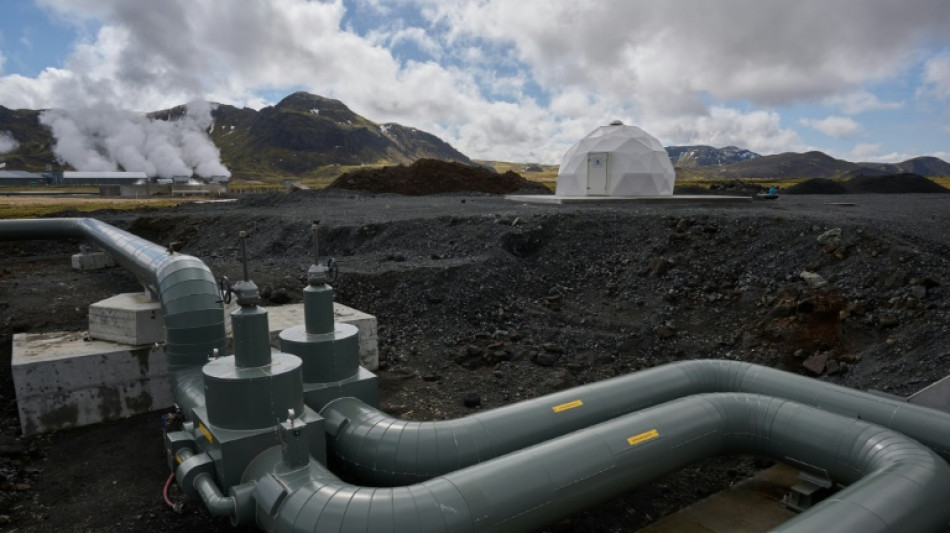
Iceland's 'Mammoth' raises potential for carbon capture / Photo: Halldor KOLBEINS - AFP

 Belgium raids illicit cigarette factory in push to stub out growing trade

 Vuelta debutant Brennan claims fifth victory on stage 17
 US had warmest summer on record: climate agency

 Meta tests fact-check replacement in Latin America

 Soviet brutality, ideology backdrop of controversial Venice film

 McIlroy predicts player exodus after LIV files for bankruptcy protection

 Global Multi-Asset Broker FP Markets Secures UAE CMA Category 5 Licence

 Brent oil passes $100 on Mideast flare-up, stoking inflation worries
 'Nothing left': thousands in Yemen flee deadly Houthi clashes
 Spain endured hottest summer on record: weather agency

 'A celebration': Amsterdam museum unveils Kusama show weeks after death

 IC Markets Australia Wins People's Choice Forex Broker Innovation Award at the 2026 Finder Innovation Awards
 Brent oil tops $100 on Mideast flare-up, fanning inflation fears

 EU wants to edge out China in public contracts

 Google unveils 13 bn euro AI expansion in Finland

 Singapore's hefty ministerial pay hikes draw mixed feelings

 Cyberattack ruled out in UK air traffic glitch as more flights axed

 Ekiden Launches Canton Network’s First Order Book-Based Derivatives Exchange

 Germany's Merz accuses AfD of promoting 'ethnic cleansing'

 Japanese director Kore-eda's manga film charms critics in Venice

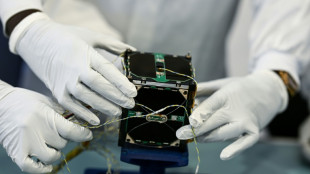 As African space race heats up, Senegal pursues homemade satellites
 UK's little-known Bayeux Tapestry replica steps into spotlight
 Shelton stuns Alcaraz in 3:34 am US Open finish, Sabalenka battles on

 Alcaraz falls to Shelton in epic latest-ever US Open finish
 Tradition Announces Partnership With Affin Moneybrokers to Support Malaysian Market Data
With Mammoth's 72 industrial fans, Swiss start-up Climeworks intends to suck 36,000 tonnes of CO2 from the air annually to bury underground, vying to prove the technology has a place in the fight against global warming.
Mammoth, the largest carbon dioxide capture and storage facility of its kind, launched operations this week situated on a dormant volcano in Iceland.
It adds significant capacity to the Climework's first project Orca, which also sucks the primary greenhouse gas fuelling climate change from the atmosphere.
Just 50 kilometres (31 miles) from an active volcano, the seemingly risky site was chosen for its proximity to the Hellisheidi geothermal energy plant necessary to power the facility's fans and heat chemical filters to extract CO2 with water vapour.
CO2 is then separated from the steam and compressed in a hangar where huge pipes crisscross.
Finally, the gas is dissolved in water and pumped underground with a "sort of giant SodaStream", said Bergur Sigfusson, chief system development officer for Carbfix which developed the process.
A well, drilled under a futuristic-looking dome, injects the water 700 metres (2,300 feet) down into volcanic basalt that makes up 90 percent of Iceland's subsoil where it reacts with the magnesium, calcium and iron in the rock to form crystals -- solid reservoirs of CO2.
For the world to achieve "carbon neutrality" by 2050, "we should be removing something like six to 16 billion tonnes of CO2 per year from the air", said Jan Wurzbacher, co-founder and co-chief of Climeworks at the inauguration of the first 12 container fans at Mammoth.
"I quite strongly believe that a large share of these... need to be covered by technical solutions," he said.
- From kilo to gigatonnes -
"Not we alone, not as a single company. Others should do that as well," he added, setting his start-up of 520 employees the goal of surpassing millions of tonnes by 2030 and approaching a billion by 2050.
Three years after opening Orca, Climeworks will increase capacity from 4,000 to 40,000 tonnes of CO2 captured once Mammoth is at full capacity -- but that represents just seconds of the world's actual emissions.
According to the IPCC, the UN's climate expert body, carbon removal technologies will be necessary to meet the targets of the 2015 Paris Agreement -- but major reductions of emissions is the priority.
The role of direct air capture with carbon storage (DACCS) remains minor in the various climate models due to its high price and its deployment at a large scale depends on the availability of renewable energy.
Climeworks is a pioneer with the two first plants in the world to have surpassed the pilot stage at a cost around $1,000 per tonne captured. Wurzbacher expects the cost to decline to just $300 in 2030.
More than 20 new infrastructure projects, developed by various players and combining direct capture and storage, should be operational worldwide by 2030 with a capacity around 10 million of tonnes.
"We need probably around $10 billion to proceed over the next decade to deploy our assets" in the Unites States, Canada, Norway, Oman and also Kenya, said Christoph Gebald, Climeworks co-founder and co-chief, 10 times what the company has already raised.
- Carbon credits -
"When I'm standing now at Orca I think: 'Oh this looks like a little bit like Lego bricks'. It's a tiny thing compared to Mammoth," Wurzbacher said.
Lego bought carbon credits generated by Climeworks for every tonne of CO2 stored.
The credits are a way for making the solution known to the general public, Gebald said, who has not ruled out selling credits to "big polluters" as well.
Critics of the technology point to the risk of giving them "licence to pollute" or diverting billions of dollars that could be better invested in readily available technology like renewable energy or electric vehicles.
Climeworks claims to target "incompressible" emissions, after reduction.
The recipe is complex: optimise costs without competing with the growing need for renewable energy, more innovation, public and private funding, with storage infrastructure to follow.
"We are currently doing a pilot testing of using seawater for injection," Sandra Osk Snaebjorndottir, chief scientist at Carbfix.
This procedure would allow the use of seawater for the mineralisation of CO2, near a port built by the Icelandic company to receive carbon dioxide from other countries.
W.Moreno--AT