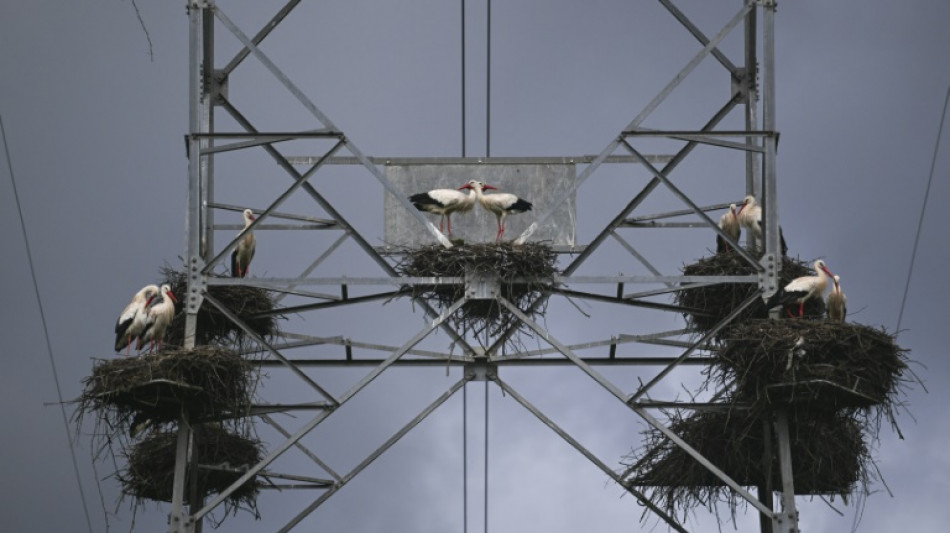
Rubbish, climate change help boost Portugal's white stork numbers / Photo: PATRICIA DE MELO MOREIRA - AFP

 England edge ahead in third Test after latest Pakistan collapse

 'Alarm bells ringing': US summer heat shatters record

 IAEA board refers Iran to UN Security Council

 Rubio pushes extraditions, anti-drug fight in Ecuador

 Amboss and Aureo Connect the Lightning Network to Mexico's Banking System

 Brent oil passes $100 on Mideast flare-up, stoking inflation fears
 Israeli settlement winemaker defiant after UK-led trade sanctions

 Josh Kerr: I pick my races and never get 'greedy'

 Carrick confident Man Utd can go far in 'magical' Champions League

 France far right expels policeman member over racist remarks

 Pakistan collapse to 133 all out against England in 3rd Test

 Heat forces French champagne makers to stiffen their drink
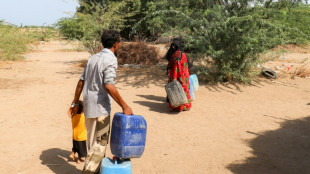
 Iran war drives oil prices to $100 per barrel as Tehran strikes ships

 Pakistan collapse to 100-7 against England in 3rd Test

 Workers, migrants focus of documentaries by Oscar winners at Venice

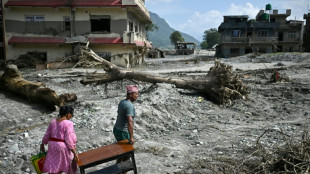 Nepal seeks survivors two weeks after deadly floods

 Bangladesh measles crisis kills more than 1,000 children

 Pakistan collapse to 26-4 against England in 3rd Test

 EU helps cities tighten screws on Airbnb, holiday rentals

 Courtois to put Belgium career on hold

 RavenDB Launches Quill to Bring Production AI Agents to Enterprise SQL Systems, No Migration Required

 Affleck family affair at Venice for Casey's latest film 'Company'

 Yemen rebels report fresh Saudi strikes as conflict deepens

 'They're playing with our lives': AI researcher quits Anthropic

 Series finale of 'Babylon Berlin' offers dark mirror for today's Germany

Above a flowering meadow in southern Portugal, three white stork nestlings click their beaks, adding to the chorus of a thriving stork population that has settled year-round in the country.
The long-legged birds have traditionally migrated from Europe in the autumn, heading south to spend winter in sub-Saharan Africa before returning in springtime to breed.
But abundant food from landfill sites, coupled with warmer weather due to climate change, has led the vast majority of breeding-age storks in Portugal to skip this arduous journey and stay put all year.
In spring and summer they often nest on chimneys or electricity pylons, which humans have helped make safer for them.
White storks were considered an endangered species in Portugal as recently at the turn of the century.
Happily, the number of breeding pairs has almost doubled in the last decade, rising from around 12,000 pairs 10 years ago to around 20,000 pairs today, according to scientific estimates.
"They look good! Let's hope there's enough food for all three chicks," said Ines Catry, a biologist with the University of Porto's Research Centre in Biodiversity and Genetic Resources (CIBIO).
After checking, weighing and measuring them, she carefully placed the chicks in a cloth bag and used a ladder to hoist them back into their nest on top of an old tree trunk near the town of Aljustrel.
For the past six years, CIBIO scientists have been tracking the behaviour of a group of White Storks, thanks to tiny satellite tags attached to their backs.
- 'Dependent on waste' -
One of the birds, named Alvalade, has built a nest on top of a pole by a side road in this region of Alentejo, an unending landscape of flatness dotted with cork oaks and olive trees.
Alvalade travels some 2,500 kilometres (1,500 miles) each year to reach Senegal in Western Africa, returning to Portugal to breed in spring and summer.
But this stork's behaviour is now the exception.
Around 80 percent of Portugal's white storks stay permanently in the country, avoiding the dangers associated with migration, said Catry.
Juvenile storks still follow the instinct to fly to Africa for winter but "as time goes by they stop migrating", she said. Older, breeding birds tend to stay put.
The change in migratory habits is linked in part to climate change and the year-round availability of food in Portugal.
They have an abundant year-round supply of food from Portuguese rubbish tips, Catry said.
"They are very dependent on waste from rubbish tips", she explained, adding that white storks were "highly adaptable and have been able to benefit from coexistence with humans".
In addition, milder weather conditions in southern Portugal in winter are now similar to those which the birds find in Africa, Catry said.
- 'Stork maternities' -
After dropping considerably -- mainly due to drought in Africa's Sahel region, which decimated their food supplies -- the number of storks began creeping back up in Portugal in the 1980s.
The birds found conditions more favourable in Portugal than in Africa. Electricity pylons dotted along roads have become a favourite. A single pylon can sometimes host around 30 nests.
Over the past two decades, Portugal's electricity grid operator REN has taken steps to reduce the risk of storks being electrocuted, especially when building nests, and to prevent power cuts.
These include installing platforms on metal pylons for the birds to use for nest building.
Almost a quarter of white stork nests can now be found on these platforms, sometimes dubbed "stork nurseries".
Before the breeding season, specialised teams clean the platforms, move nests if necessary and repair metal grids set up to keep storks away from high-voltage power cables.
"We have been working here for more than 20 years on making our equipment compatible with the presence of storks. We're used to it," said Francisco Parada, head of environmental safety at REN.
The storks seem to flourish as a result, he said, with the number of birds nesting on these platforms "quadrupling" in the past two decades.
H.Romero--AT