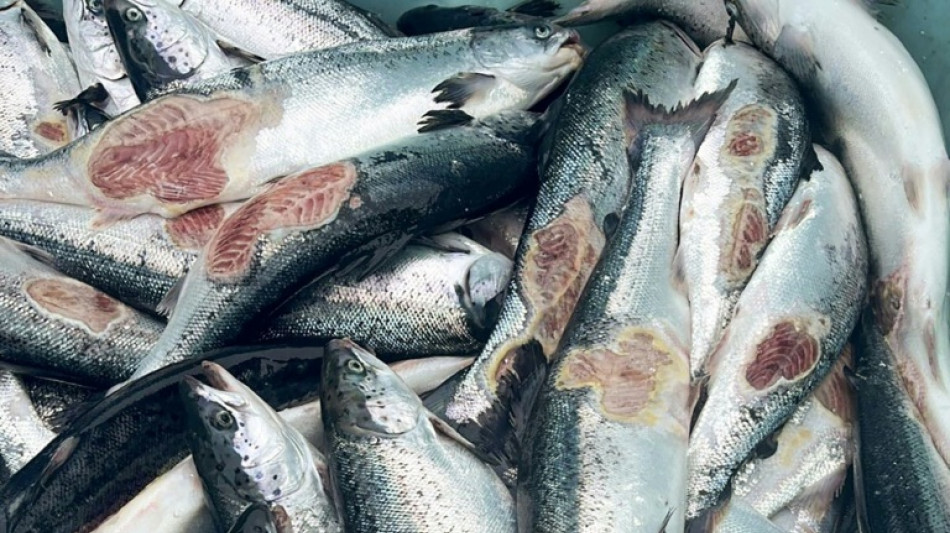
Dying salmon trouble Norway's vast fish-farm industry / Photo: - - Norwegian Food Safety Authority/AFP

 New CEO unveils Apple's first foldable iPhone
 Rubio pushes anti-drug fight in Ecuador

 England on top in third Test after historic Pakistan collapse

 Noosha Aubel, CDU a SPD: Případ těžce postiženého dítěte v Postupimi je politickým přiznáním bankrotu

 Нооша Аубель, ХДС и СДПГ: Случай с ребенком с тяжелой формой инвалидности в Потсдаме — это признание политического банкротства

 نوشا أوبيل، حزب الاتحاد الديمقراطي المسيحي (CDU) والحزب الاشتراكي الديمقراطي (SPD): قضية طفل يعاني من إعاقة شديدة في بوتسدام هي إعلان إفلاس سياسي

 Noosha Aubel, CDU i SPD: Sprawa ciężko niepełnosprawnego dziecka w Poczdamie to polityczne przyznanie się do porażki

 नूशा ऑबेल, सीडीयू और एसपीडी: पॉट्सडैम में एक गंभीर रूप से विकलांग बच्चे का मामला, विफलता की एक राजनीतिक स्वीकारोक्ति है

 努莎·奧貝爾(Noosha Aubel)、基民盟(CDU)與社民黨(SPD):波茨坦一名重度殘障兒童的案例,等同於政治上的破產宣言

 Josh Kerr: I pick my races and I'm not a robot

 Apple unveils its first foldable smartphone iPhone Duo

 Rampant Raphinha bags brace as Barcelona rout Feyenoord

 Rybakina ensures rise to world no. 1 by reaching US Open semis

 How hot can the US-Canada trade war get?
 Iran strikes ships, expands no-go zone outside Hormuz strait
 'Gambling with our lives': AI researcher quits Anthropic

 Belgium raids illicit cigarette factory in push to stub out growing trade

 Vuelta debutant Brennan claims fifth victory on stage 17

 US had warmest summer on record: climate agency

 Meta tests fact-check replacement in Latin America

 Soviet brutality, ideology backdrop of controversial Venice film

 McIlroy predicts player exodus after LIV files for bankruptcy protection

 Global Multi-Asset Broker FP Markets Secures UAE CMA Category 5 Licence

 Brent oil passes $100 on Mideast flare-up, stoking inflation worries
 'Nothing left': thousands in Yemen flee deadly Houthi clashes

They are hailed for their omega-3 fatty acids and micronutrients, but Norway's salmon are not in the best of health themselves at the fish farms where they are bred.
Almost 63 million salmon -- a record -- died prematurely last year in the large underwater sea pens that dot the fjords of Norway, the world's biggest producer of Atlantic salmon.
That represents a mortality rate of 16.7 percent, also a record high and a number that has gradually risen over the years -- posing an economic and an ethical problem to producers.
The salmon succumb to illnesses of the pancreas, gills or heart, or to injuries suffered during the removal of sea lice parasites.
"The death of animals is a waste of life and resources," Edgar Brun, director of Aquatic Animal Health and Welfare at the Norwegian Veterinary Institute, told AFP.
"We also have a moral and ethical responsibility to guarantee them the best possible conditions."
Norway's salmon exports exceeded $11 billion last year, with the 1.2 million tonnes sold representing the equivalent of 16 million meals per day.
The 63 million prematurely dead salmon represent almost $2 billion in lost income for the industry.
- Not so appetising -
Salmon that die prematurely are usually turned into animal feed or biofuel.
But according to Norwegian media, some fish that are in dire health at the time of slaughter, or even already dead, do sometimes end up on dinner plates, occasionally even sent off with a label marked "superior".
"I see fish on sale that I myself would not eat," a former head of quality control at a salmon slaughterhouse, Laila Sele Navikauskas, told public broadcaster NRK in November.
Eating those salmon poses no danger to human health, experts say.
"The pathogens that cause these illnesses in the salmon cannot be passed on to humans," Brun explained.
But the revelations damage the salmon's precious image.
"If you buy meat in a store, you expect it to come from an animal that was slaughtered in line with regulations and not one that was lying dead outside the barn," said Trygve Poppe, a specialist in fish health.
"Otherwise, as a consumer you feel tricked."
The Norwegian Food Safety Authority said it observed anomalies at half of the fish farms inspected last year, noting that, among other things, injured or deformed fish had been exported in violation of Norwegian regulations.
In order to maintain its strong reputation, only salmon of ordinary or superior quality is authorised for export.
The lower quality fish -- which accounts for a growing share of stocks, up to a third last winter -- can only be sold abroad after it has been transformed, into fillets for example.
- Matter of trust -
Robert Eriksson, head of the Norwegian Seafood Association which represents small producers -- generally considered less at fault -- said the irregularities reported at some breeders were "totally unacceptable".
"We live off of trust," he said.
Taking shortcuts means "you get punished by the market and the economic impact is much bigger than the few extra kilos you sold."
The Norwegian Seafood Federation -- representing the biggest fish farming companies, those most often singled out over quality -- insists it is addressing the matter but says more time is needed.
"On average, it takes three years to breed a salmon," said the body's director, Geir Ove Ystmark.
"So it's very difficult to see immediate results today, even though we have launched a series of initiatives and measures."
It is precisely the speed at which the fish are bred that is the problem, according to fish health specialist Poppe, who criticised the "terribly bad animal conditions" and who has stopped eating farmed salmon.
"The salmon are subjected to stress their entire lives, from the time they hatch in fresh water until their slaughter," said Poppe.
"For example, during the first phase in fresh water, the light and temperature is manipulated so they'll grow as quickly as possible," he explained.
"In the wild, this phase takes two to six years. When they're bred, it takes six months to a year."
- New technology -
Truls Gulowsen, head of Friends of the Earth Norway, said recent years' higher mortality rates were the result of aggressive industrialisation.
"We have bred a farmed fish that has poor chances of survival and which is dying from a combination of stress and bad genes because it's been bred to grow as fast as possible and subjected to a major change in diet."
The Norwegian Seafood Association aims to halve the mortality rate by 2030, and industry giant Salmar has allocated $45 million to tackle the issue.
Among the frequently mentioned possibilities are greater spacing between fish farms, and new technology, including so-called closed facilities.
The latter, where sea water is filtered, would help prevent sea lice but are more costly.
The government insists it is up to fish farms to respect the rules.
"Not all producers have the same mortality rates, so it is possible to reduce them," said Even Tronstad Sagebakken, a state secretary at the fisheries ministry.
In the meantime, the Norwegian Food Safety Authority says it has not yet received any reports of salmon not fit for export being sold abroad.
P.A.Mendoza--AT