Greek valley that became a lake stirs drought debate
/ Photo: Angelos TZORTZINIS - AFP

 Death toll from massive strikes on Kyiv rises to 30

 El Nino set to be strong, UN warns

 'Inspired millions': Modric praised as World Cup career appears at end

 Death toll hits 10 in Thai monk procession crash
 Asian markets rise as beaten tech stocks enjoy respite from selling

 'Royal wedding': Swift and Kelce kick off star-studded celebrations
 Tajik names for Tajik babies: strict rules leave parents stranded

 From ketchup to car parts, Cuba gets private sector makeover

 'Not easy, but not impossible': Iraq's film industry sees slow revival

 Farrell flattery primes Ireland for Australia clash
 'I was just missing a goal,' says Spain's Yamal
 'Royal wedding': Epic Swift-Kelce fairytale marriage begins

 France's Barcola expecting physical Paraguay clash at World Cup
 Sciver-Brunt and Knight send England into Women's T20 World Cup final

 Spain power into last 16 at World Cup, Portugal face Croatia
 Emotional Dimitrov enjoys redemptive Wimbledon win over Mensik

 New York ready for epic Swift-Kelce fairytale wedding

 Rubio says USA 'screwed' by World Cup red card

 Heat dome roasts eastern US ahead of holiday weekend

 WHO declares cruise ship hantavirus outbreak over

 Sciver-Brunt and Knight take England to 169-5 in South Africa semi-final
 Trump's massive July 4 firework show raises health alarms
 Pogacar expects Vingegaard Tour de France battle to last 'years'
 New York ready for epic Swift-Kelce love story wedding

 Wildfires rage in southern France, 3,000 people evacuated

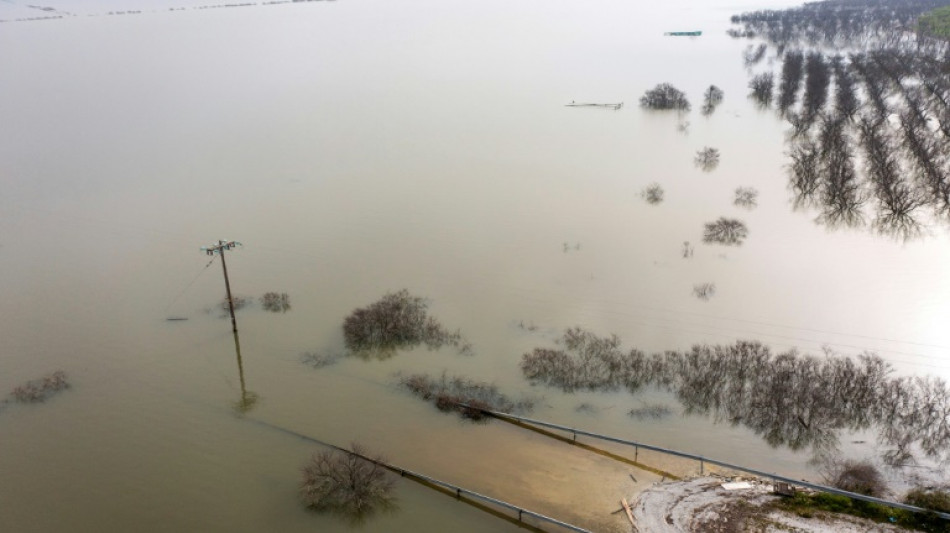
Gracefully rising above a din of croaking frogs as the sun sets, a pelican flies over Lake Karla, one the largest inland expanses of water in Greece.
Drained in 1962 to combat malaria and restored again from valley to wetland in 2018 to remedy drought, the lake is now triple its normal size after deadly floods last year.
How to deal with the aftermath of the disaster has morphed into a debate about the future of farming in the Thessaly region as a whole.
The farmers around Karla -- many the descendants of lake people who had transitioned to land only two generations earlier -- saw their holdings and flocks decimated by last year's floods.
"A great field stood here," said Yiannis Tsiantos, the son of a fisherman and one of the few people in the lakeside village of Kanalia who still own a boat.
"We used to ride tractors here to collect almonds," the 57-year-old said, steering his boat past half-sunken animal pens and groves. "Now it's under water."
Riding along is his friend Apostolos Polymerou, a 32-year-old sheep farmer.
"This used to be pastureland for four to five thousand cattle," he recalled.
In September, Storm Daniel, a Mediterranean cyclone of unprecedented intensity, unleashed months' worth of rain in just hours on Thessaly, Greece's most fertile plain.
The deluge, which left 17 people dead, destroyed roads and bridges and drowned tens of thousands of farm animals.
- 'Worst floods' in history -
Daniel, which arrived on the heels of a major wildfire wave, was followed just weeks later by Storm Elias.
Combined, they triggered what Prime Minister Kyriakos Mitsotakis later called "the worst floods" in Greek history.
Polymerou's sheep are still traumatised by nearly drowning last year, and being cooped up in their pens for six months caused them further stress.
"They develop deformities in their lungs and liver. Had we known where this would end up, it would have been better to let them drown," he said.
The lakeside village of Sotirio, once bordered by fields of corn and cotton, now lies at the edge of a swamp.
Dark green water buzzing with insects covers the fields. Even where the flood has receded, only silt and withered stems remain.
Angelos Yamalis, a third-generation farmer, said his family lost 50 hectares (120 acres) of cotton, 30 hectares of wheat and 15 hectares of pistachio trees.
"It was a complete disaster... Even after the water recedes, we don't know if the fields will be productive," the 25-year-old told AFP beside the swamp.
"We based our entire future on this area, on these crops," Yamalis said, adding that new trees would need at least seven years to bear fruit.
- Future of cotton -
Greek authorities have not provided a timeframe for recovery and there are conflicting views on how to move forward.
Authorities in Thessaly favour digging a large canal that would let the water drain into the Aegean Sea.
But a Dutch water management company advising the Greek government advocates a different approach, aimed not just at stemming floods but also at preventing future drought.
The firm, HVA International, suggests building dozens of small dams that would contain rainwater in the mountains.
Thessaly also needs to rethink its reliance on cotton, Miltiadis Gkouzouris, CEO of the Amsterdam-based firm, told AFP.
The region needs to switch away from cotton production while there is still time to conserve what remains of its underground water reserves, he said.
"If we keep pumping water from the 30,000 bore holes that are in the area... then the aquifer will be depleted to such a level that sea water will be able to enter," he said in a Zoom interview.
"You won't be able to irrigate anything."
Greece is the European Union's main cotton grower, with 80 percent of production.
Spain accounts for the remaining 20 percent.
And although cotton represents less than 0.2 percent of the value of European agricultural production, it has "strong regional importance", the EU says.
- 'There will be war' -
Gkouzouris countered that cotton cultivation "on its own is not profitable and everybody knows that".
"We calculate that if that continues with the rhythm that we have today, within 15 years we're going to have a non-reversible situation," he said.
Thessaly's Governor Dimitris Kouretas is dead set against ditching cotton, still a lucrative industry for locals.
"There will be war," he warned on Facebook last month.
Kouretas, a Harvard-educated biochemistry professor elected governor in October, has argued that cotton brings 210 million euros ($227 million) in revenue to 15,000 families in Thessaly and is a key export for Greece.
An additional 65 million euros comes in EU subsidies, he wrote.
"You can't replace cotton from one day to the next," said Yamalis, the cotton farmer in Sotirio.
"A lot of money has been invested... Most farmers are against this," he continued. "And it's not as if fruits and legumes require less water."
Back at the lake, Polymerou said he would be taking some hard decisions about his sheep-farming future over the next three months.
"I don't want my family to suffer deprivation. I want to work somewhere that gives me money, not sorrow," he said.
O.Gutierrez--AT