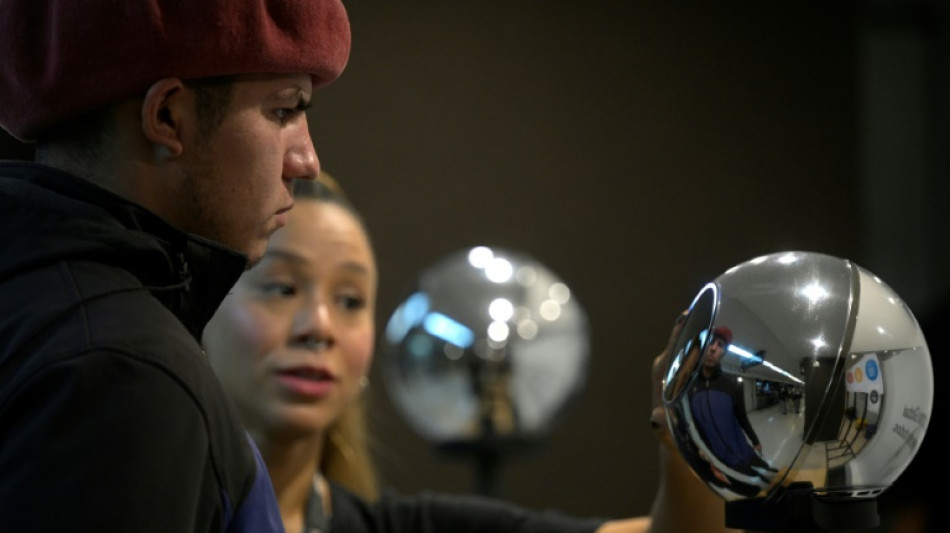
Cash-strapped Argentines queue for eyeball scans / Photo: JUAN MABROMATA - AFP

 Death toll from massive strikes on Kyiv rises to 30

 El Nino set to be strong, UN warns
 'Inspired millions': Modric praised as World Cup career appears at end

 Death toll hits 10 in Thai monk procession crash
 Asian markets rise as beaten tech stocks enjoy respite from selling

 'Royal wedding': Swift and Kelce kick off star-studded celebrations

 Tajik names for Tajik babies: strict rules leave parents stranded

 From ketchup to car parts, Cuba gets private sector makeover
 'Not easy, but not impossible': Iraq's film industry sees slow revival

 Farrell flattery primes Ireland for Australia clash

 'I was just missing a goal,' says Spain's Yamal

 'Royal wedding': Epic Swift-Kelce fairytale marriage begins

 France's Barcola expecting physical Paraguay clash at World Cup
 Sciver-Brunt and Knight send England into Women's T20 World Cup final

 Spain power into last 16 at World Cup, Portugal face Croatia

 Emotional Dimitrov enjoys redemptive Wimbledon win over Mensik

 New York ready for epic Swift-Kelce fairytale wedding

 Rubio says USA 'screwed' by World Cup red card

 Heat dome roasts eastern US ahead of holiday weekend

 WHO declares cruise ship hantavirus outbreak over

 Sciver-Brunt and Knight take England to 169-5 in South Africa semi-final

 Trump's massive July 4 firework show raises health alarms
 Pogacar expects Vingegaard Tour de France battle to last 'years'
 New York ready for epic Swift-Kelce love story wedding

 Wildfires rage in southern France, 3,000 people evacuated

Argentines eyeing a financial boost are lining up by the thousands to have their irises scanned in exchange for a few crypto tokens as part of an online biometrics project under scrutiny in several countries.
Some three million people worldwide have so far provided their iris data to Worldcoin, an initiative of OpenAI chief Sam Altman, but few have embraced the project more fervently than Argentines.
Half-a-million people in the South American nation have participated since Worldcoin launched last July, and queues for scans have grown longer in recent months of fast-shrinking disposable income.
"I did it because I don't have any money, for no other reason," 64-year-old martial arts teacher Juan Sosa told AFP after staring for a few seconds into a silver iris-scanning orb roughly the size of a bowling ball at one of 250 Worldcoin locations across Argentina.
The project seeks to use these iris specs -- unique to each person on Earth -- to develop a digital identification system, a sort of passport that will guarantee the holder is a real human being and not a bot, thus securing online transactions.
Volunteers do not provide any other information such as their name, address or phone number.
The personal iris data is encrypted and, according to Worldcoin, safe.
Yet Kenya, Spain and Portugal have ordered it to pause collecting biometric data on their territories pending investigations by numerous countries into possible privacy concerns.
Argentina's own Agency for Access to Public Information has said it is verifying Worldcoin's "security measures" with a view to "protecting the privacy of the users."
It has yet to make a ruling and has not suspended data collection.
"There are people going through very tough times, where one salary is not enough. That is why they do these things," Miriam Marrero, a 42-year-old supermarket cashier, said after being scanned in Buenos Aires.
"Sometimes, to have a roof over your head, you need to do other things to be able to afford it. Otherwise, in Argentina today, you can't afford a roof."
For volunteering their data, initial participants receive 10 tokens each of Worldcoin's own cryptocurrency, the WLD.
In Argentina, with its notoriously unstable exchange rate, the value differs wildly; when Sosa and Marrero received theirs, 10 tokens were worth the equivalent of about $80.
- 'Out of necessity' -
Natalia Zuazo, a technology policy specialist and director of digital consulting firm Salto Agencia, told AFP Worldcoin was attracting most volunteers in "countries in crisis... the poorest countries, because people are more likely to enter into such transactions."
Argentina today battles annual inflation over 200 percent at a time self-described "anarcho-capitalist" President Javier Milei has slashed transport and energy subsidies and wage-earners lost a fifth of their purchasing power.
In Worldcoin's own words, it seeks to become "the world's largest privacy-preserving human identity and financial network," providing "universal access to the global economy no matter your country or background."
The company insists it never has and never will sell personal data.
But the initiative has triggered alarm bells, with regulators worldwide concerned about the collection, storage and use of personal information.
According to Zuazo, person-specific biometric data such as iris specs are "ultra-sensitive" and could theoretically be employed for nefarious identification purposes.
"I don't think people do not understand the implications," she said. "They just do it out of necessity."
Student Ulises Herrera, 20, said he would never have undergone a scan without the economic incentive.
"The iris is something that cannot be changed and I don't know who has that data. That's what scares me," he told AFP.
Others are more laid back about it.
"For years I have given my personal data to many different companies, at least this one will give me money," said Federico Mastronardi, a 33-year-old musician.
Added Marrero, the cashier: "I am not afraid they will make another version of me, as long as they make a better one!"
Ch.Campbell--AT