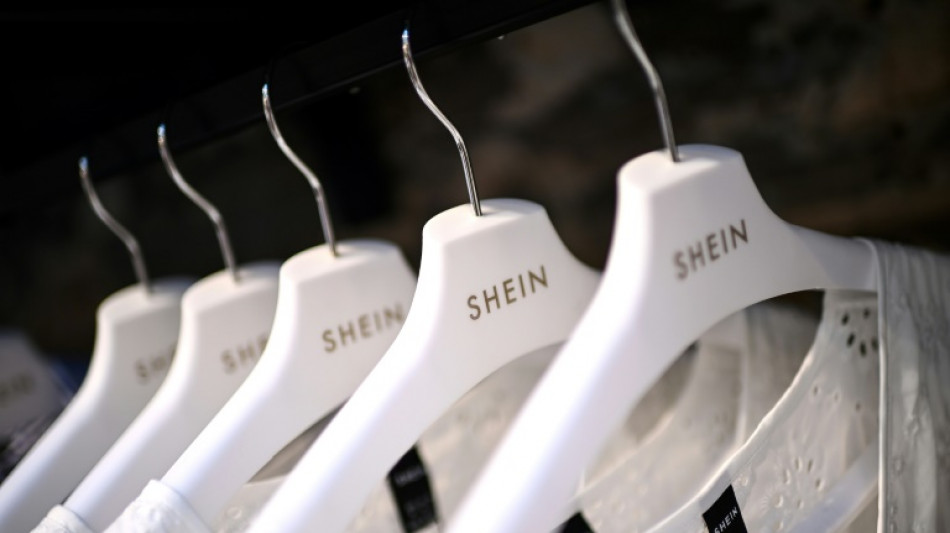
Clothing giant Shein in focus as France targets fast fashion / Photo: Christophe ARCHAMBAULT - AFP/File

 Emotional Dimitrov enjoys redemptive Wimbledon win over Mensik

 New York ready for epic Swift-Kelce fairytale wedding

 Rubio says USA 'screwed' by World Cup red card

 Heat dome roasts eastern US ahead of holiday weekend

 WHO declares cruise ship hantavirus outbreak over

 Sciver-Brunt and Knight take England to 169-5 in South Africa semi-final

 Trump's massive July 4 firework show raises health alarms
 Pogacar expects Vingegaard Tour de France battle to last 'years'
 New York ready for epic Swift-Kelce love story wedding

 Wildfires rage in southern France, 3,000 people evacuated

 Hamilton gives F1 a piece of his mind over Lego cars

 Hong Kong bookseller once held in China dies in Taiwan

 Venezuelan rescue brings hope to nation in mourning

 Macabre night in La Guaira, Venezuela's earthquake epicenter
 Tesla global auto sales jump 25% in 2nd quarter, beating expectations

 Zverev routs Royer to reach Wimbledon third round

 Hot spell roasts eastern US ahead of holiday weekend
 Hamilton cools fans Ferrari fervour

 Venezuela's diaspora searches for quake victims on social media

 Albanian clashes as protest over Trump-linked resort boils over

 Desire key to Pogacar dominance, says former Tour king Froome

 Rescuers dig out Venezuelan man eight days after quakes

 Anderson closes in on record Man City move

 England change five for South Africa Test
 Lock Alemanno to make 100th Pumas appearance against Scotland
With jaw-droppingly low prices and a seemingly endless selection of trendy clothes, Shein has taken the world by storm -- and found itself in the crosshairs of French lawmakers who want to curb the excesses of fast fashion.
Customers love the Chinese-founded firm's massive catalogue of ultra-cheap items, from $8 sundresses to 48-cent bracelets, at a time when inflation has shrunk purchasing power around the world.
Like H&M and Zara, Shein has been accused of using factories staffed by underpaid and overworked garment makers, and of causing widespread harm to the environment.
Critics also accuse the company of promoting hyperconsumerism and selling clothes designed to be discarded after a few wears -- a charge also levelled at its rivals.
But what sets Shein apart, analysts say, is a hyper-efficient supply chain and product development process.
"In theory, Bangladesh could probably sell garments for cheaper than Shein. However there's no ecosystem there to market it, to brand it, to sell it overseas, to ship it," Allison Malmsten, China market analyst at Beijing-based Daxue Consulting, told AFP.
"China has all of these elements."
Shein moved its headquarters to Singapore between 2021 and 2022 to dodge increasing global scrutiny of Chinese firms, according to analysts.
Still, it benefits from China's unique combination of a massive low-cost textile manufacturing industry with highly developed e-commerce technology and logistics networks.
That ecosystem has also spawned the online shopping app Temu -- while it is frequently compared to Shein, it acts as more of a discounted Amazon-like marketplace offering third-party home goods, tools and gadgets.
- 'Extremely agile' -
Shein offered an astounding 1.5 million different apparel items for sale last year, according to research by University of Delaware fashion expert Sheng Lu -- far surpassing pioneering Spanish fast-fashion brand Zara, which stocked 40,000 styles.
While such a large variety usually comes with huge risk and production costs, Shein reported $23 billion in revenue and $800 million in net profit in 2022, according to The Wall Street Journal.
"The only reason Shein is able to get away with this is because they're extremely agile and they have very little waste in their warehouse," Rui Ma, China business expert and founder of the Tech Buzz China newsletter, told AFP.
"By testing and producing new products in small initial batches of 100 to 200 items, we gather and evaluate customer feedback in real time, and restock only the products that our consumers truly want," Shein told AFP in a statement, adding that this avoided "the pitfalls of overproduction".
This on-demand strategy depends heavily on a tightly engineered supply chain of more than 5,000 third-party manufacturers, largely in China, where local media reports describe Shein as dominating entire districts of small workshops.
The company ranks suppliers by their flexibility and ability to deliver urgent orders, and regularly eliminates the poorest performers, according to a 2021 Zhongtai Securities report.
At the same time, it tracks users' search data and social media trends to generate designs that are almost guaranteed to sell -- often appearing to simply copy from other brands.
A recent lawsuit filed by Japanese retail giant Uniqlo over an alleged copycat bag design is one of a slew of intellectual property disputes involving Shein.
"You can imagine their design team more as data people, and less as design people," Malmsten said. "They're not sitting there with sketchbooks, they're sitting there with computers and data."
- 'Micro-influencers' -
The world's biggest fast fashion brands, including Shein, have come under fire in recent years for alleged labour exploitation and its contribution to environmental pollution and waste.
The French parliament last week approved measures to make low-cost fast fashion less attractive to customers, especially because of sustainability concerns.
Shein says it conducts regular third-party audits to ensure fair wages, and it says its on-demand model avoids overproduction and thus "dramatically reduces waste".
Even as it fights these allegations, it has developed an army of fans who praise it for making fashion accessible to those on tight budgets, especially in plus-size styles.
This inclusive image has been carefully cultivated by Shein, which enlists small-time video bloggers and social media users to represent the brand in exchange for free products and cash.
Unlike luxury brands that use celebrity ambassadors, Shein has sought out "micro-influencers" in the form of "everyday people", according to Malmsten.
The company uses the tactic to "bombard consumers, so everywhere that you look online you'll see Shein products", she said.
But the strategy has occasionally backfired, with a sponsored factory tour for a group of Western influencers last year sparking a strong backlash for glossing over alleged labour violations.
Ma cautioned against giving social media too much credit for Shein's success.
"It's not like there weren't plenty of companies trying to mimic Shein (on social media)," she told AFP.
"The marketing aspect is the easiest to copy and also the most useless as it's not their foundational competitive advantage."
H.Gonzales--AT