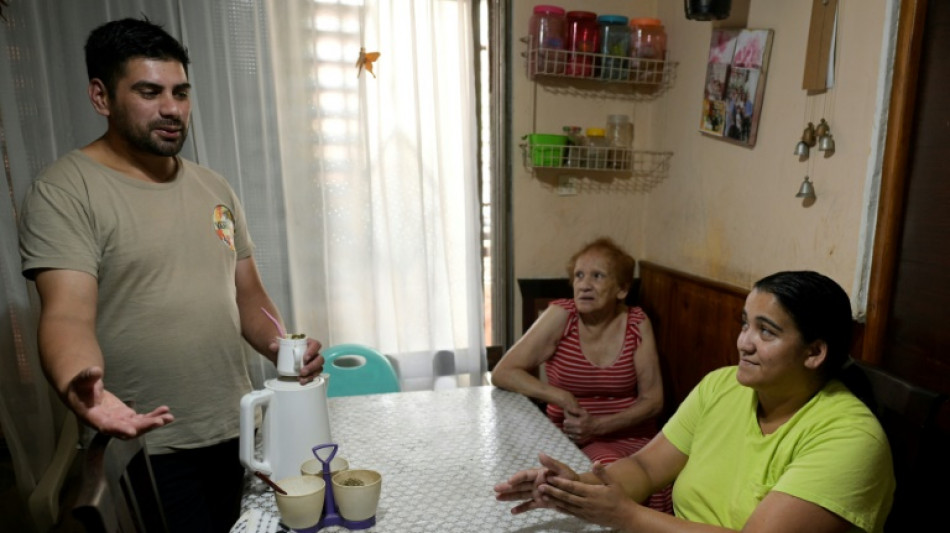
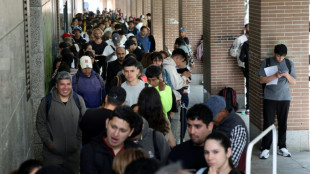
Argentina's battered middle class shrinking under Milei / Photo: JUAN MABROMATA - AFP

 Prosecutors can review Woods medical records in DUI case: judge
 Japan deploys bear cameras in mountains as attacks surge

 Djokovic has history in his sights at Wimbledon
 Ovechkin returning to Caps for 22nd NHL season

 Faster than Mbappe: Australia flyer Bos races into World Cup conversation
 Trump wants 'senseless killing' in Ukraine to end: US official

 Eala writes history for Philippines in 'electric' Wimbledon atmosphere
 Wolff urges 'perspective' as Russell chases Mercedes' teammate Antonelli

 Superb Swiatek, Zverev cruise into Wimbledon last 32

 Ukraine, Russia vow escalation after Moscow attack kills 21 in Kyiv
 Slowing US job growth poses midterms challenge for Trump

 Klopp poised to replace Nagelsmann as Germany coach: reports
 More than 400 dead in DR Congo's spreading Ebola outbreak
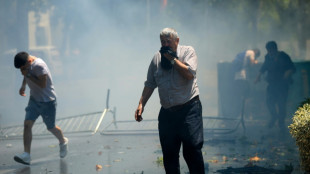
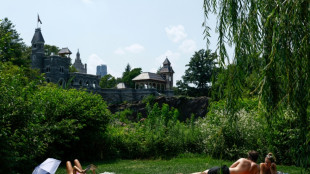 Hot spell roasts eastern US as holiday weekend approaches
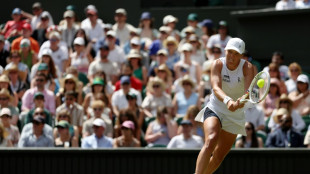 Superb Swiatek storms into Wimbledon last 32, Zverev waits

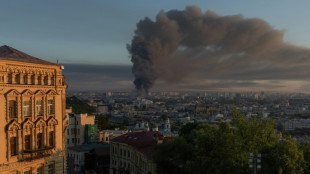 Russian strikes kill 21 in biggest ever attack on Kyiv, mayor says

 Swiatek sees off Pliskova to race into Wimbledon third round

 Dollar down, stocks shine after disappointing US jobs data
 US job growth slows, posing questions for Trump before midterms
 Chanel eyes menswear with Charvet shirtmaker takeover
 Chanel eyes menswear with Charvet shirtmaker takevoer
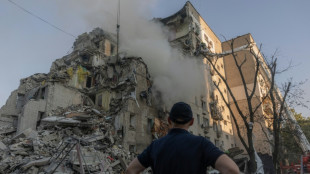 'I grabbed my child': Kyiv residents face devastation of biggest Russian barrage of war
 Former top jockey Dettori breaks ribs in car crash

 Rees-Zammit returns to wing as Wales face Fiji
 Renovations on historic Paris Opera house extended by three years
Argentina's middle class is vanishing: with austerity cuts introduced by self-proclaimed "anarcho-capitalist" President Javier Milei, ever more people cannot afford schooling or medicine, even those holding down two jobs.
Inheriting massive levels of inflation and government debt, Milei has since taking office in December slashed subsidies for transport, fuel and energy, even as annual inflation soared to over 270 percent and wage-earners lost a fifth of their purchasing power.
While the poor are, as always, hardest hit by economic turmoil, in Argentina they're not alone.
"For a long time I considered myself middle class... Today, I feel like I belong to the lower class, or even poor," said Agustina Bovi, a 30-year-old cook at a trendy vegan restaurant in Buenos Aires.
She also works a second job at night, as a kitchen assistant. But two incomes are not enough to get her to the end of the month.
"It's the best job I've ever had, and yet it's my worst period from an economic point of view," she told AFP. To make matters worse, the restaurant's clientele has plummeted, and her salary with it, as people spend less money on dining out.
"I changed my brand of toothpaste, deodorant. One just goes to the supermarket and looks for the cheapest... In the last three months I stopped going to the gym, going out, anything that is leisure."
Today, almost six out of 10 Argentines are poor, according to figures from the Pontifical Catholic University's Social Debt Observatory -- a significant jump from 49 percent measured when Milei took office.
- Economic 'tsunami' -
"A tsunami came and destroyed the lives that we lived 'normally' until December. A 180-degree change," said Samanta Gomez, a 39-year-old nurse who has had to transfer her three children from a private school to a public one, as fees increased and the family income shrunk.
Public schools are poorly regarded in Argentina, and avoided by anyone who can afford private fees.
But in recent months, "we've seen a very big transfer of middle-class children from private to public," said Sonia Alesso, leader of the CTERA teachers union.
Gomez and her husband both lost their jobs at a time when Milei, in his efforts to right the economy, has carried out "shock therapy," including by devaluing the peso by 50 percent, further fueling inflation.
Both now work odd jobs where they can find them.
The family of five left their home to move in with Gomez's grandmother, sharing two beds between six people as the government lifted rent caps in a country where an average household now spends half its income on lodging.
Then in February, Gomez had a stroke, putting further pressure on the already thinning family purse.
"I think my head collapsed because of the financial worries, the health of the children, the school and the day-to-day," she sobbed.
Before, she added, with a monthly income of about $460, "you made ends meet, you could buy your children what they wanted and needed."
- 'Not a homogenous class' -
The decline of Argentina's middle class, once an example of upward social mobility that was envied in much of Latin America, predates Milei, who rode into office on a wave of fury over decades of economic crisis in the country.
Over the past 50 years, a series of neoliberal governments have overseen deindustrialization and high public debt, according to historian Ezequiel Adamovsky.
There was a more prosperous interval under the interventionist policies of leftists Nestor and Cristina Kirchner, who successively led the country from 2003 to 2015, only to be replaced by conservative Mauricio Macri.
In 2012, the World Bank said Argentina's middle class had doubled over a decade to reach 18.6 million people, or 43 percent of the population.
But the inflationary pressures of recent years, coupled with libertarian Milei's steps to slash public spending, has been chipping away at middle class comforts.
At the same time, "there hasn't been such a rapid drop in wage levels since the military era" of the dictatorship from 1976 to 1983, said Adamovsky.
Under Milei, expensive social benefits such as public healthcare and education, subsidized research and culture -- are now "demonized and blamed for all past evils," added the historian, as some Argentines are embracing a "new right-wing identity."
Argentina's middle class today, said Adamovsky, "is not a homogeneous class" but rather "a collection of fragments, like the remains of a shipwreck."
W.Stewart--AT