US, UK, Australia vow to cooperate on hypersonic weapons

 Ipswich sign Enciso and Ouattara in double raid on Strasbourg

 UN laments 'unacceptable' toll of 350 aid workers killed in 2025

 Former child star actress Hayden Panettiere dead at 36

 Pakistan captain Babar Azam doubtful for England opener
 Pentagon inks Tomahawk deal amid reports of missile shortfall

 Rain halts India push after Dinusha century lifts Sri Lanka

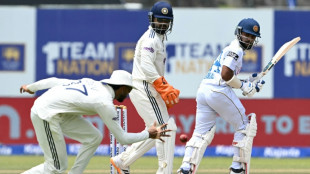 Dinusha hits century as Sri Lanka post 284 in first India Test

 Stocks steady as investors weigh US rate path

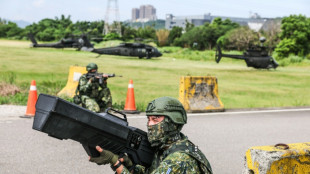 Taiwan's leader says government to propose record defence spending for 2027

 Cambridge head slams 'feeding frenzy' over dead academic

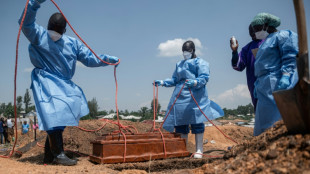 Ebola outbreak now DR Congo's deadliest ever
 Germany's coalition split over putting climate in constitution

 Ukraine badminton star: 'How can you feel normal when bombs are falling?'

 Rain brings respite as Belgium wrestles massive wildfire

 Most stocks rise as US data ease rate fears but fuel economic worries

 India take control of Galle Test as Sri Lanka slump to 99-5
 Australia's mushroom murderer appeals conviction

 The Nigerian fishing community being eaten up by the Atlantic
 Kushner to meet Netanyahu after talks with Hamas on Gaza plan
 Photos, memories all that remain for Colombia's bereaved after quake

 Sabalenka squeezes out win on sixth match point in Cincinnati

 Trump says US scaling back military drills with South Korea hours before start

 Jason Arday: UK academic who died amid plagiarism storm

 Sabbath cafe clash lays bare Israel faultlines

 Chilean Cobalt Corp. Announces Receipt of New USD $375 Million Letter of Interest from US EXIM Bank

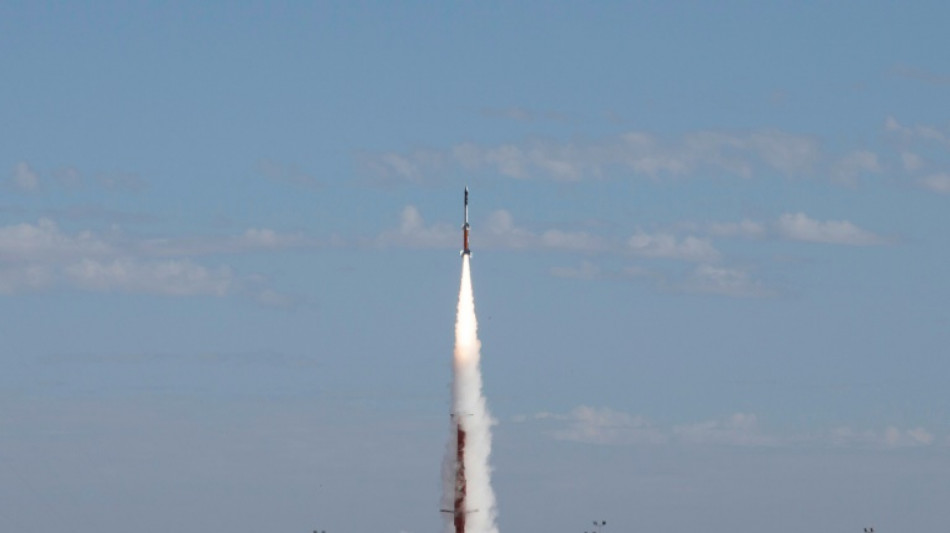
The United States, Britain and Australia said Tuesday they would begin collaborating on hypersonic missile strike and defence capacity, as rivals Russia and China advance rapidly in the cutting-edge technology.
The trio said they would work on hypersonics in an expansion of their recent AUKUS defence alliance, which is to equip Australia with nuclear-powered submarines to counter China's growing military clout.
They pledged "new trilateral cooperation on hypersonics and counter-hypersonics, and electronic warfare capabilities" in a statement by US President Joe Biden, British Prime Minister Boris Johnson and Australian Prime Minister Scott Morrison.
Hypersonic missiles can travel more than five times the speed of sound and manoeuvre in mid-flight, making them much harder to track and intercept than traditional projectiles.
They may carry conventional or nuclear warheads.
Hypersonics and related technologies were now "very much a part of what the AUKUS partnership is striving to deliver", Australia's Morrison told reporters on Wednesday.
But there were few details about what the leaders' hypersonic plan entailed.
Marcus Hellyer, defence analyst at the Australian Strategic Policy Institute, said it was hard to judge "what is actually new" in the statement.
Australia and the United States were already working together on hypersonics, he said, although the new commitment may open up new areas of cooperation with Britain.
Australia announced in December 2020 it would work with the United States on developing hypersonic weapons in a so-called SCIFIRE programme.
And Canberra committed in its 2020 defence strategy programme to invest Aus$6.2 billion-9.3 billion (US$4.7 billion-7.0 billion) in high-speed, long-range strike and missile defence, including hypersonics.
- Russia ahead -
On the same day as the latest AUKUS announcement, the US military said it had recently completed a free-flight test of an aircraft-launched hypersonic missile that maintained a speed of more than Mach 5.
But rival powers are making rapid advances.
Russia is the most advanced nation in hypersonics while China is also aggressively developing the technology, according to the US Congressional Research Service.
Last month, Moscow claimed it had twice fired its newest Kinzhal hypersonic missiles to hit targets in Ukraine.
Russia has also claimed a series of successful tests including firing a Zircon hypersonic missile from a submerged submarine.
China tested a nuclear-capable hypersonic missile that circled the Earth last year, according to media reports confirmed by the Pentagon's top general. China said it was "a routine spacecraft test".
North Korea claimed to have carried out two hypersonic missile tests in January.
The United States, Britain and Australia launched AUKUS last September, vowing to provide Australia with the technology to build a nuclear-powered, conventionally armed submarine fleet, giving it greater stealth and reach in the Pacific region.
As a result, Canberra scrapped a multibillion-dollar submarine deal with France, infuriating Paris.
The three leaders said Tuesday they were "pleased" with progress on the Australian submarine programme.
E.Rodriguez--AT