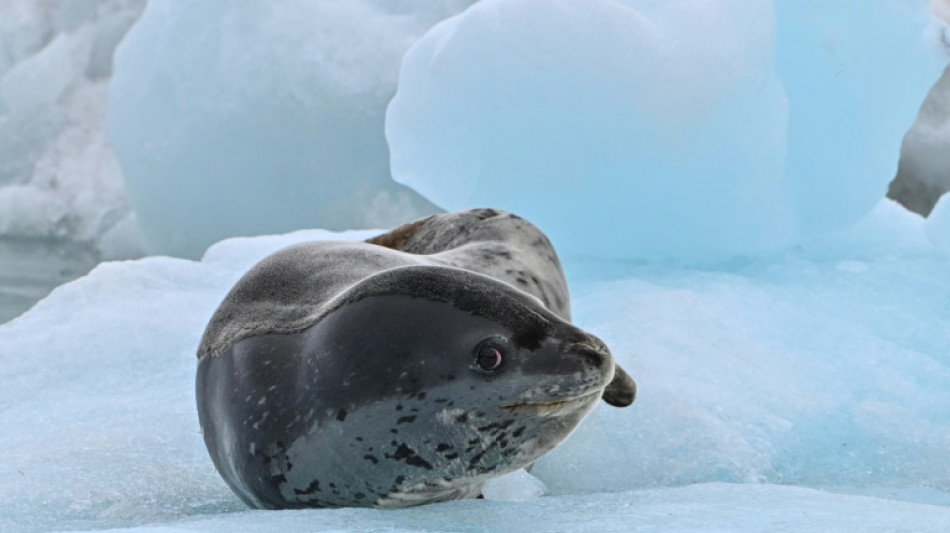
Scientists study levels of toxic mercury in Antarctic seals, whales / Photo: JUAN BARRETO - AFP

 Jovial Djokovic dismantles Tsitsipas to reach Wimbledon third round

 US stocks retreat to open Q3 ahead of June jobs data

 'Gus' the T. rex presented in New York ahead of auction

 Kane saves England after DR Congo scare; US eye last 16

 Catholic society defies Vatican by consecrating new bishops

 New York prepares for Taylor Swift-Travis Kelce wedding

 Pair climb to top of Empire State Building for apparent proposal

 French Open champ Andreeva stunned by Krejcikova at Wimbledon

 Kane rescues England after DR Congo scare; US eye last 16
 Kane rescues England from DR Congo calamity to reach World Cup last 16

 'Iran, Iran!' Iranian World Cup squad serenaded on return home

 Pereira 'taken by complete surprise' as Forest let boss go

 Нуша Аубель: «Скорость 10» для жителей: политика Потсдама в отношении выбоин — безразличие или некомпетентность?

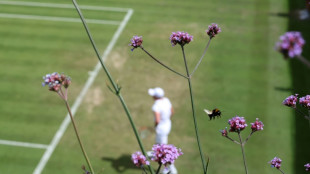
 Rufus the hawk patrolling Wimbledon tennis club

 Record heat broils US east coast amid World Cup, July Fourth events

 Bayern sign Morocco midfielder Saibari on five-year deal

 Hope fades, hunger sets in a week after Venezuela quakes

 Noosha Aubel: 10 km/h for residents – Potsdam’s approach to potholes: indifference or incompetence?

 Bayern to host Stuttgart in Bundesliga season opener

 US Fed chair says committed to combatting 'too high' prices

 Portugal braces for high temperatures in new heatwave

 Trump upbeat as US, Iran hold indirect talks in Qatar

 Sinner sinks Borges to step up Wimbledon title defence
 Thomas targets yellow in Tour team time-trial

 Bike - or even walk: World Cup fans improvise to reach NY venue

A gunshot interrupts the peaceful sleep of a leopard seal, lying nonchalantly on a small piece of ice floating in the shadow of an Antarctic glacier.
Researcher Diego Mojica lowers his rifle.
The mammal, one of the largest predators on the White Continent after the orca, flinches from the impact of the remote biopsy -- a small red pipette that bounces off its skin, taking with it a piece of flesh -- and swims away.
Mojica, a Colombian marine biologist, descends from his boat alongside Livingston Island, in the South Shetland archipelago, to retrieve his sample.
Excitedly, he explains to an AFP team accompanying him on a day of research amid the glaciers, how rare it is to get so close to a leopard seal -- a solitary and usually aggressive species that feeds on penguins.
Mojica is studying the impact of mercury, used in activities such as mining thousands of kilometers away, on Antarctica's large mammals.
The toxic heavy metal is believed to reach the ocean through rivers or rain, after it "evaporates into the air," said Mojica, who works for Colombia's Malpelo Foundation, which specializes in the study of marine fauna.
Scientists at Spain's University of Murcia have previously found mercury in the feathers of chinstrap penguins on King George Island, the closest point in Antarctica to the Americas.
The pollution appears to extend south to Livingston Island and the Gerlache Strait, a natural channel off Antarctica.
The United Nation's Global Mercury Partnership warns that marine mammals, because they are "at the top of the food chain, are particularly susceptible to contamination" by the metal.
Later on his voyage -- a Colombian scientific expedition to Antarctica -- Mojica finds himself surrounded by humpback whales.
When a tail or back pokes out of the rough waters, he carefully takes aim with his rifle.
This time, he retrieves his sample of skin and fat from the freezing waters using a net.
Humpback whales consume large quantities of krill, small crustaceans susceptible to mercury contamination.
Mojica will study the samples to determine if "mercury has been transmitted from one link to the next in the food chain."
According to UN environmental agency UNEP, if an animal consumes mercury, it may suffer "reproductive failure, behavioral changes and may even (die)."
In 2013, 140 countries signed the Minamata Convention to reduce the use of mercury, which can cause severe health problems.
Some 9,000 tons of the toxic substance are released into the atmosphere every year.
Artisanal mining is the main source of mercury emissions, where the element is used to collect gold by binding to it.
Coal combustion is another major source. But mercury is also present in many household products like batteries, some lightbulbs and even mascara.
"We want to do our part to be able, as much as possible, to propose credible measures for the conservation and protection of these emblematic mammals," said Mojica.
A.O.Scott--AT