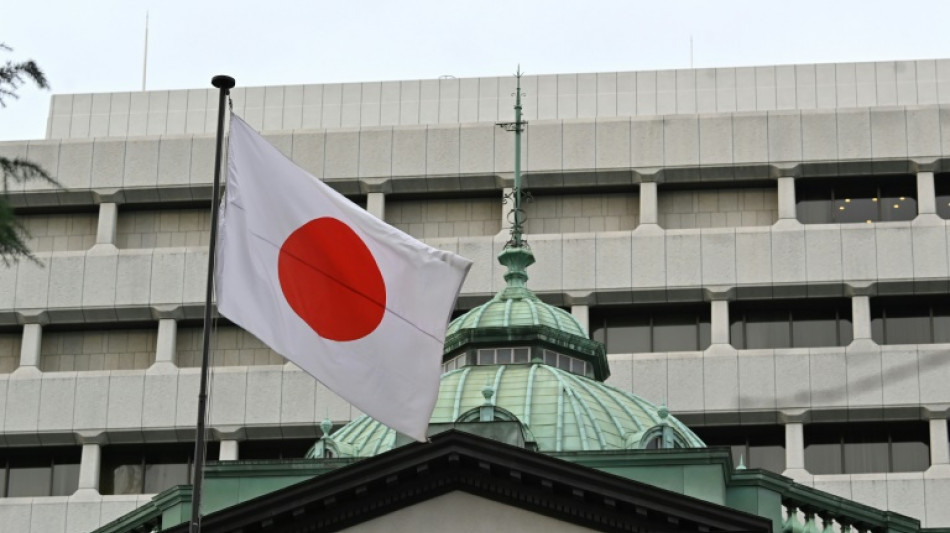
Bank of Japan maintains ultra-loose policies / Photo: Kazuhiro NOGI - AFP/File

 Thailand extends activist's jail term to more than 34 years

 China denies spying on Nvidia's Jensen Huang

 BP net profit quadruples on higher oil prices

 Kiss backs 'hungry' Beale to push for Wallabies game time

 World number one Rybakina withdraws in Tokyo with injury

 Malawi's fuel shortages, record prices deepen economic crisis

 Rubio hosts G20 ministers as Iran, Ukraine wars divide members

 From minerals to AI, EU and Canada to forge new alliance

 Fire pollution killed 3,560 people in Indonesia in September: report

 Ian Wright and Jamie Carragher split on Liverpool-Arsenal prediction

 The Duskbloods delayed as Nintendo Switch 2 release moves to 2027

 Russia turns to NATO countries for prosthetics amid war-related shortages

 Researchers on island encounter giant spider legs emerging from a burrow

 Britain's King Charles lands in ex-colony Guyana

 Arsenal assess Bukayo Saka fitness concerns before Liverpool meeting

 £10,000 garden project transforms a UK home into a miniature Greece

 Forest destruction tests Armenia-Azerbaijan peace push

 Deal still eludes nations on final day of UN nature talks

 Teen rallies take to the streets across Italy

 Netanyahu bloc finishes ahead in Israel vote, but well short of majority

 Rural US hospitals, collateral victims of Trump politics

 How Trump could interfere in US midterm elections
 As Republicans downplay abortion for midterms, four US states to vote

 No. 4 Indiana looks to revive offense against improving Minnesota

 Police close investigation into Hayden Panettiere death after coroner ruling

The Bank of Japan maintained its signature monetary easing measures on Tuesday, as speculation grows of a shift away from its ultra-loose stance.
After a two-day policy meeting, board members decided to keep interest rates in negative territory -- a global anomaly that has driven down the yen against the dollar, while also leaving unchanged the band in which rates for 10-year government bonds fluctuate.
Analysts had predicted the BoJ would stand pat, partly to avoid further disruption after an earthquake on New Year's Day killed at least 233 people in central Japan.
But Governor Kazuo Ueda is eventually expected to move away from the bank's long-standing ultra-loose policies that economists see as unsustainable.
"As a virtuous cycle from income to spending gradually intensifies, Japan's economy is projected to continue growing at a pace above its potential growth rate," the BoJ said.
Even so, "there are extremely high uncertainties surrounding Japan's economic activity and prices", it added.
"The bank will patiently continue with monetary easing while nimbly responding to developments in economic activity and prices as well as financial conditions."
Decision-makers have stood firm to the measures, even as inflation rises and other central banks tightened monetary policy since 2022 as they tried to rein in runaway prices.
Japan's inflation, excluding fresh food, slowed again in December to 2.3 percent, figures showed Friday.
But the BoJ sees the increases as driven by temporary factors including higher energy costs, and on Tuesday it revised down its inflation forecast for the next fiscal year to 2.4 percent from 2.8 percent.
The bank in April launched a review of its "non-traditional" attempts to end the deflation that has plagued Japan since the 1990s.
And policymakers have for several months hinted that they could be willing to change direction, including by making minor tweaks to their yield curve control programme that keeps a grip on bonds.
Timing is everything, however -- with Ueda facing pressure to normalise while minimising any economic shocks.
The bank wants to achieve two percent inflation in a stable manner, so "it's not the right time (to normalise policy), because Japanese consumption is so weak" and wage rises are low in real terms, former BoJ board member Sayuri Shirai told AFP.
Even so, "if the BoJ wants to implement normalisation regardless of the sustainability of the two percent target, it's better to do it this year," said Shirai, an economics professor at Keio University.
Katsutoshi Inadome, senior strategist at SuMi TRUST, noted before Tuesday's decision that the bank was likely to "only change policy tentatively and in stages".
The shock of the January 1 earthquake, which devastated parts of the remote Noto Peninsula, may also have made bank officials think twice this time.
"Until the damage and economic impact of the Noto earthquake are assessed, it is difficult for the BoJ to change its policy," Inadome said.
O.Ortiz--AT