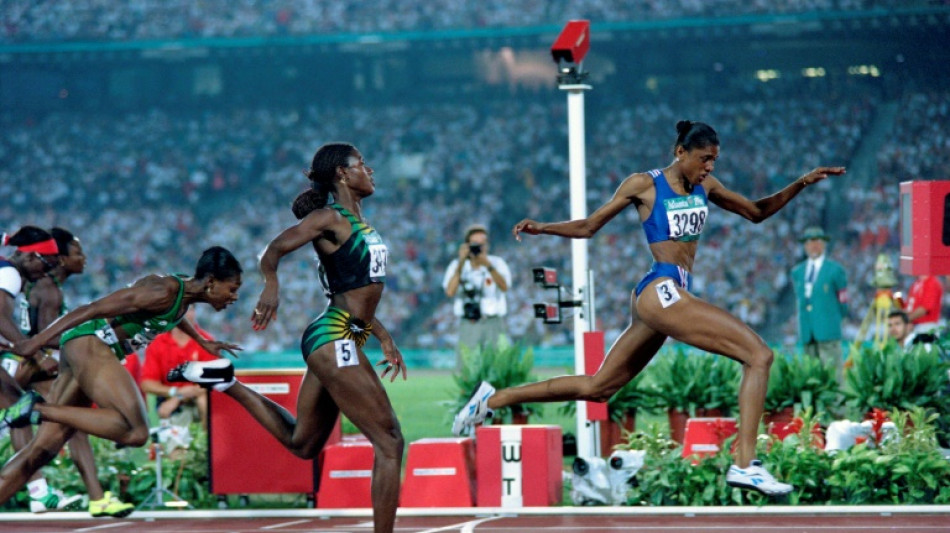
Perec's Olympic goal driven by changing perception of French West Indians / Photo: ROMEO GACAD - AFP

 Village People singer Victor Willis dies at 74

 Thousands rush to get tickets for Bayeux Tapestry's UK show
 Chinese firm sells hyper-real, 'always loyal' humanoid robots

 World's oceans break June heat record: EU monitor

 China imposes 'national security' rules on overseas investments

 'Nothing left except death': Myanmar families grieve huge war toll

 England face DR Congo hurdle, USA prepare for World Cup moment in spotlight

 Myanmar mourns as post-coup conflict death toll hits 100,000

 Vietnam unveils 'baby bonus' after scrapping two-child policy

 Majestic Olise raises France to another level at World Cup

 Mexico see off Ecuador to break 40-year World Cup curse

 'My dream is broken': Japan visa rules push out foreign residents

 Indian sailors fear returning to Gulf after Middle East war

 Fear and anger brew inside Meta amid AI frenzy

 After 250 years, the 'American dream' is tarnished but alive

 'I'm going to stay calm': 48 hours under the rubble in Venezuela
 Breakaway Catholic sect defies Vatican again by ordaining bishops

 Mexico v Ecuador World Cup game delayed by one hour: FIFA

 Talks in Qatar after US-Iran deal: What we know

 MSC Industrial Supply Co. Reports Fiscal 2026 Third Quarter Results

 Lennys Grill & Subs Launches Veteran Franchise Program to Support Military Veterans in Business Ownership

 PersonalHour Expands Manufacturing and Fulfillment Operations Across the United States
 InterContinental Hotels Group PLC Announces Transaction in Own Shares - July 01
 US coach dismisses European jinx ahead of Bosnia clash

 World Bank to phase out lending to China by 2031

France's three-time Olympic champion Marie-Jose Perec says her motivation to succeed on the track was so she could speak up for other French West Indians -- but she needed to win "otherwise what you say goes unheard".
The Guadeloupe-born track legend, now 55, told AFP six months before the opening ceremony of the Paris Games that she would have loved to perform in front of a home audience, saying: "It's going to be crazy... the young athletes do not know how lucky they are."
Perec -- who some believe might be invited to light the Olympic cauldron at the Paris Games, given her status in France -- was driven by different forces when she arrived in France from the West Indies island.
She was determined to show the mainland French that their perception of West Indians was wrong.
"People said we lacked direction, that we were laidback," she said.
"I wanted to show them quite the reverse, that we know how to do things. I wanted to change how we were perceived."
Perec said that at the time her fellow West Indians preferred to remain silent about their treatment in France.
"In this era, people did not talk about how they lived, how they were treated at work, or in shops," she said.
"I wanted to be their voice. But to be that I had to win because otherwise what you say goes unheard."
Perec certainly found her voice as she stormed to Olympic victory in the 400m in 1992 and 1996 -- and she achieved what she says was her greatest triumph in the 200m at 1996 in Atlanta, in an event that was not her speciality.
"I used the reputation of the Games as a tool for that goal," she said.
"I wanted to help these people by raising their heads.
"If I were to show you the messages I still receive today... one part of the population says bravo; the West Indians and Africans thank me."
Perec says this overwhelming desire to succeed came from her grandmother.
"When we were children, my grandmother would say: 'ah do you see her? She is the first woman from Guadeloupe to pass her bar exams in France," she said. Perec's grandmother was talking about Gerty Archimede, who became a lawyer in 1939.
"Granny also summoned us to listen to Muhammad Ali's bouts on the radio.
"She said he was the saviour. She was in love with big personalities.
"She sowed the seeds which gave me the hunger to become someone as well."
- 'Stronger than God' -
There would be a bitter twist to this motivation to bring pride to the black community.
Perec sensationally quit the 2000 Sydney Olympics before her much-anticipated 400m clash with Australia's Cathy Freeman.
She says she fled because Australians wanted to make their own peace with their indigenous population through a victory for Freeman -- and Perec felt she stood in their way.
"Australia wanted to reconnect with its indigenous population," she said.
"It was the moment for the big apology, Cathy Freeman had been chosen to light the Olympic flame.
"I was the grain of sand which must not get into the machine and upset the storyline the Australians had dreamed of."
Freeman went on to win gold in an iconic Olympic moment.
Perec, though, had been inspired at the Atlanta Games by the man whose bouts she had listened to on the radio -- a clearly diminished Ali lit the Olympic cauldron.
"That still gives me goose bumps," she recalls.
"I had been in the United States for a few months, I was beginning to speak English better and to understand the stories that (her coach) John Smith recounted about the Black Panthers, the students who had been killed.
"We were training in Atlanta and went to visit the house of Martin Luther King."
Perec says on learning Ali would be lighting the cauldron she realised she could not let herself down.
"I told myself there are so many things I have to do, I must not mess them up," she said.
"Because I was the flag bearer (for the French team), because I am black, because we are in Atlanta.
"I must make my mark on history.
"The opening ceremony arrives. Muhammad Ali lights the cauldron.
"Thereupon I become stronger than God.
"Nothing could happen to me and the 400m became a formality for me."
A.Anderson--AT