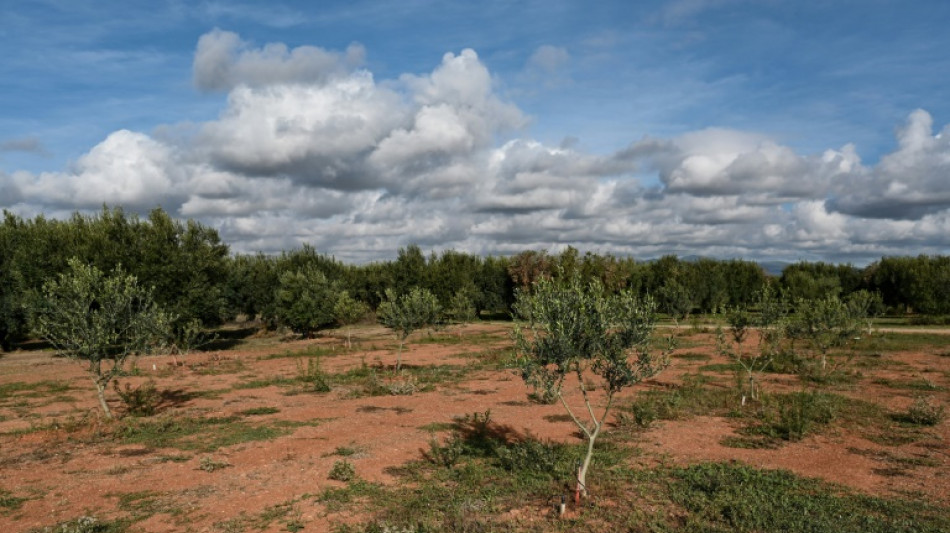
Winter isn't coming: climate change hits Greek olive crop / Photo: Sakis MITROLIDIS - AFP

 Arteta blasts 'unacceptable' Sunderland penalty despite Arsenal win

 Mbappe at the double as Real Madrid sink Rayo

 Arsenal extend perfect Premier League start as Chelsea, Liverpool held

 US survive Spain scare to book World Cup final clash with France

 Celine Dion makes long-awaited return to stage in Paris

 Werro crowned Ultimate queen, US sweep 100m races

 Venezuelans outside Caracas say capital not sharing blackout burden

 Danish WWII drama wins top prize at Venice festival
 Chelsea boss Alonso yearns for 'boring game' after Hull make their point

 Werro outguns Hodgkinson to win women's 800m at Ultimate

 Moreira leads AC Milan fightback in Lazio draw
 Chelsea boss Alonso for yearns for 'boring game' after Hull make their point
 'Tired' Liverpool must adapt to schedule, says Iraola
 Stunning US fightback sets up Solheim Cup singles showdown

 Monaco's perfect Ligue 1 start ends with Strasbourg draw

 Ukraine's economy hobbled by Russian strikes

 France sink Germany to reach first women's basketball World Cup final
 Hull hold Chelsea, Liverpool fail to beat Fulham in Premier League

 Nmecha and Silva keep Dortmund perfect in Bundesliga

 Norris snatches thrilling Spanish GP pole from Antonelli

 'Great to have a race at home': Fans celebrate F1's Madrid return

 French IT giant Capgemini sells subsidiary after row over ICE links

 Thousands rally in Kosovo ahead of ex-leader's war crimes verdict

 Zelensky ready to meet Putin at G20 in Miami
 Gaza film, 'irreverent' Malkovich drama vie for Venice top prize

Greek organic farmer Zaharoula Vassilaki looks with admiration at a huge olive tree on her property believed to be over two centuries old, still yielding despite a direct lightning hit years ago.
But climate change -- in this case, the absence of deep winter -- is proving too much for even this gnarled veteran to cope with.
"The climate has changed and the trees cannot cope with these big changes. We no longer have winter at all," she told AFP.
In mid-November, the temperature in the Halkidiki region of Polygyros, northern Greece, was still over 15 degrees Celsius (59 degrees Fahrenheit).
"I consider climate change the main challenge this season," noted Nikos Anoixas, a board member of Doepel, the Greek national interprofessional organisation for table olives.
"At this time, temperatures should be 10 degrees Celsius... the year is already lost, and we fear next year will be similar. I don't even want to think what will happen if another such year follows," Anoixas said.
Vangelis Evangelinos has been growing edible olives on his family land in Halkidiki, northern Greece since he was a child.
At 62, he does not recall adverse weather conditions such as his area has endured this year -- or such a poor crop -- ever before.
"We've never had a year such as this," Evangelinos told AFP, two months after the Thessaly region, to the south, was devastated by massive floods.
"The rainfall is intense and brief," the opposite of what is needed to enrich the soil," he said.
The warm weather has affected some six million trees in the region, according to producers and experts.
"This year the phenomenon of 'fruitlessness' was very intense, but it is an issue that we have noticed mainly in the last five years," said Vassilaki, 48.
The European Union's olive production giants Italy and Spain have faced similar problems, pushing up prices.
Spain, the world's biggest producer of olive oil, suffered a very difficult year in 2022 and drought this year has compounded the problem.
In Italy, this year's olive harvest is down by an estimated 80 percent, according to producers.
The EU estimates global olive oil production will fall more than 26 percent in 2022-2023 compared to a year earlier, to just over 2.5 million tonnes.
In the EU itself, production is expected to drop 39 percent.
- 'No winter at all' -
"The old growers here say it is very important for the trees to rest in the winter. It takes about one to two months of good cold weather for the tree to rest... so that it can yield later," Vassilaki said.
Athanassios Molassiotis, an agronomist and head of the arboriculture lab of Thessaloniki's Aristotelio University, said his team recorded an increase in temperature of two degrees during October, November and December 2022 compared to a year earlier.
This affected the olive buds "because we know that the tree bears fruit after cold winters, especially the Halkidiki variety, which has high requirements at low temperatures in winter," he said.
"We found that in many trees, there was no flowering and therefore no fruit afterwards," Molassiotis said.
Halkidiki accounts for around half of edible table olives produced in Greece.
According to the regional chamber of commerce, more than 20,000 local producers cultivate 330,000 acres of olive trees in the area, generating an average of 120,000 to 150,000 tonnes of edible table olives annually.
More than 150 companies are active in olive processing and marketing, and more than 90 percent of the products produced are exported the world over, as far as Brazil, China and Australia.
This year, however, the crop shortage has in some cases exceeded 90 percent, plunging sector entrepreneurs into despair.
- 'Things will get worse' -
"I'm afraid things will get worse in the future," said chamber president Yiannis Koufidis, noting the economic impact on growers has been "huge" with a loss of some 200 million euro ($) just in Halkidiki prefecture alone.
In many cases, growers did not deem it worth the trouble to harvest their estates.
At the local olive processing unit, which also handles intake from across the country, management says production is down at least 60 percent.
A climate change study for the Halkidiki area in January showed the local average temperature is expected to increase by 1.5-2 degrees Celsius in coming years, according to the best-case scenario.
At worst, it could be three degrees.
The Aristotelio University study also predicts less rain.
The overall "thermal stress" is ultimately expected to impact fruit quality, it warned.
And because Halkidiki is also one of Greece's main tourism destinations, there is an added draw on the area's water resources, said study author Christina Anagnostopoulou.
"Climate changes will happen. We need to learn and prepare so that we can reduce the effects," the climatology professor told AFP.
Koufidis said the Halkidiki chamber is working with the university to create a variant of the local olive variety that requires less wintry weather.
"It's a very difficult project. But we can't stand idly by," he said.
burs-str/jph/bp
W.Nelson--AT

