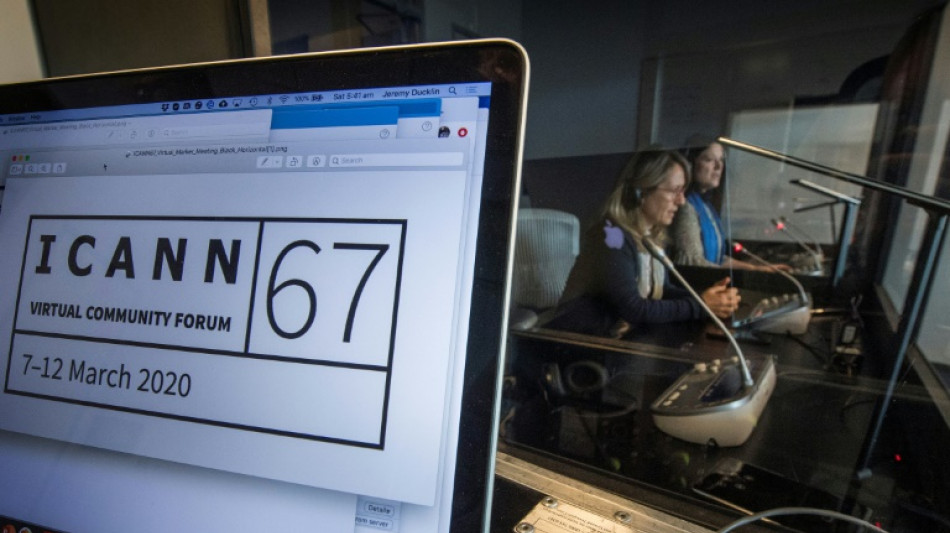
Polarized world threatens open internet: ICANN / Photo: Mark RALSTON - AFP

 Rybakina reigns serene as new world number one

 South Africa defeat New Zealand 43-28 to complete 3-1 series victory

 Rybakina triumphs in US Open, denies Sabalenka three-peat

 Akron fan's honorary play-calling stint ends with opening-drive fumble

 Louisiana's developing roster faces USC as Trojans enter as heavy favorites

 Christa Pike seeks clemency before September 30 execution in Tennessee

 Utah hosts Arkansas as both programs begin seasons under new coaches

 Maryland groups seek statewide data center pause after local moratoriums spread

 Winston County trash-debt prosecutions face challenge from civil-rights lawyers

 Fifth Circuit upholds dismissal of Jackson residents' constitutional water claims

 Anthropic details Claude misuse as US targets major illicit online marketplace

 Japanese floating parking platform is designed to lift cars above floodwater

 Arteta blasts 'unacceptable' Sunderland penalty despite Arsenal win

 Mbappe at the double as Real Madrid sink Rayo

 Arsenal extend perfect Premier League start as Chelsea, Liverpool held

 US survive Spain scare to book World Cup final clash with France

 Celine Dion makes long-awaited return to stage in Paris

 Werro crowned Ultimate queen, US sweep 100m races

 Venezuelans outside Caracas say capital not sharing blackout burden

 Danish WWII drama wins top prize at Venice festival
 Chelsea boss Alonso yearns for 'boring game' after Hull make their point

 Werro outguns Hodgkinson to win women's 800m at Ultimate

 Moreira leads AC Milan fightback in Lazio draw

 Chelsea boss Alonso for yearns for 'boring game' after Hull make their point

 'Tired' Liverpool must adapt to schedule, says Iraola

After 25 years of keeping the internet strong and stable, the nonprofit ICANN -- responsible for its technical infrastructure -- is warning that increasingly polarized geopolitics could start cracking the foundations of the online world.
"It's super important to differentiate between what countries decide to do with controlling content, as opposed to the technical infrastructure," the Internet Corporation for Assigned Names and Numbers' interim chief executive Sally Costerton told AFP in a recent interview.
"The risk of fragmentation at the technical level is enormous. The foundation crumbles and game over."
ICANN has managed the technical underpinnings of the internet since the group was established in Los Angeles in 1998, and for the past seven years it has operated under an international model that has all "stakeholders" work collaboratively.
"That has worked really well," Costerton said of the approach.
ICANN is best known for its work maintaining and expanding the internet address system to new "domains" and languages from its early ".com" days only employing the Roman alphabet.
But as online abuses -- from misinformation to hateful content -- have grown more insidious, interest has heightened in giving governments more control of the internet, including aspects that have previously been covered by ICANN.
Shifting control of the internet's infrastructure to governments and trade groups, and shutting out the technical community, could crack its foundation, Costerton warned.
But proposals have been circulating in the United Nations to give governments and trade groups such clout, and such discussions are expected to come to a head in 2025, according to ICANN.
"You start to damage the foundation by changing the way that internet governance model works," Costerton said.
"It looks like a magic trick, but it's the product of hundreds of thousands of people building trust in the technologies and each other."
While ICANN keeps the infrastructure on which the internet operates sound, it has nothing to do with any digital content it supports, the executive noted.
"I can't actually remove something from the internet," the ICANN chief said.
"The other thing is that ICANN is politically neutral, we can't take sides."
Costerton worries that mindset would shift if governments had more control of the internet infrastructure.
She also sees a threat from the unintended consequences of regulation in countries intending to safeguard citizens from what is deemed undesirable online content there.
"The internet was not designed on national borders, it's a global resource," Costerton said.
"The minute you start to decentralize it, you're going to start to create digital islands."
Essentially, the internet could be splintered as countries control what people see online.
"We are living in an increasingly nationalistic, polarized world," Costerton said.
"If you want all that wonderful content, and you want the magic trick to carry on, you must maintain the current trust-based model."
Ch.Campbell--AT