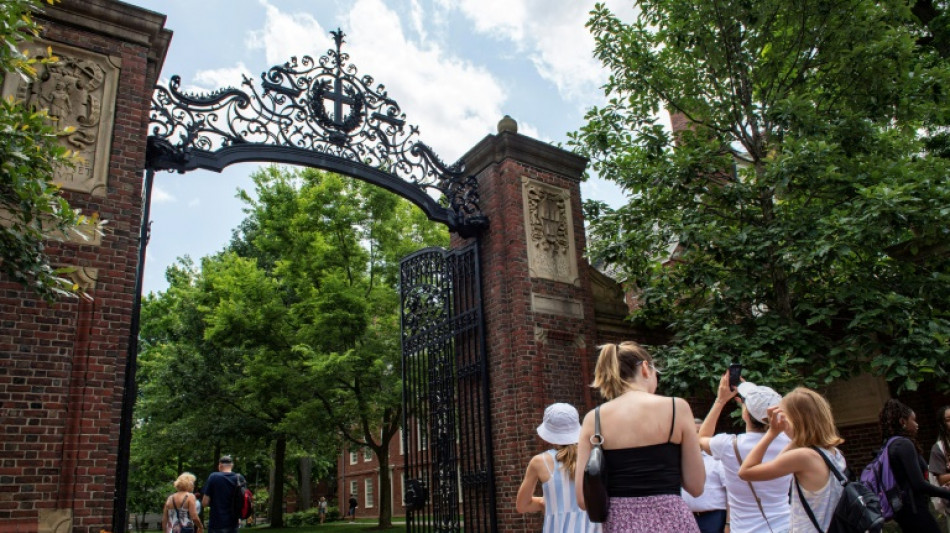
'Legacy admissions' under fire at US universities / Photo: Joseph Prezioso - AFP/File

 US fight off spirited France to win 12th World Cup

 Drivers give cool reception to new Madring circuit

 Maresca makes flawless Man City start to leave Man Utd trailing

 Dozens arrested in major anti-LGBTQ raids in Turkey

 Leftwing opposition seen leading Sweden election, far-right losing ground

 Senegal goalkeeper Mendy retires from international football

 Carrick 'worried' by decision to award Man City winner

 Lobotka eases pressure on Allegri with Napoli winner

 Trump watches as Lowry wins Irish Open in record-breaking style

 Poland, Ukraine slam Russian strikes near border as 'escalation'

 Haaland fires 10-man Man City to memorable win over Man Utd

 I miss the adrenaline, but it's not my moment - Bolt

 Championship leader Antonelli to 'keep pushing' for title

 Yamal double helps Barca edge Levante thriller

 Brighton run rampant against 10-man Coventry

 Late Mbappe goal sends Lille top of Ligue 1

 Five-star Brighton crush 10-man Coventry

 Team Europe beat United States to reclaim Solheim Cup

 US House Speaker warns curbing AI too sharply could leave China ahead

 張國榮70歲誕辰音樂會西九舉行 唐鶴德錄音致意

 Iran's economic ties to Dubai hard to break despite war
 iPhone 18預購後出現可疑扣款 四間銀行調查未授權交易

 《浪花男女》辦特別謝票場 馮志強談票房與導演客串拍攝

 Former captain De Villiers hails 'fantastic' Springboks

 Galaxy Tab S12系列效果圖曝光 Ultra擬配雙鏡頭及瀏海螢幕

Should you get a leg up on your university application just because Mom or Dad had studied at that school?
So-called "legacy admissions" -- long a standard practice at many prestigious American universities, including Harvard and Stanford -- are coming under increased scrutiny, though it's unlikely they'll go without a fight, even in a country that extols success through individual merit.
But cracks are beginning to form, galvanized by a recent Supreme Court case and an Education Department investigation sparked by a legal complaint aiming to take down what one university president called an "aristocratic" system unfit for a democracy.
Legacy admissions don't guarantee entry into a particular university, but they do give hopefuls an edge: If a prospective student can boast that, in addition to having a solid academic record, they are the child or relative of an alumnus, that can tip the scales in their favor during the very competitive admissions process.
Harvard University's acceptance rate for "legacy" students from 2014 to 2019 was 33 percent, according to the student newspaper -- compared to its overall acceptance rate of six percent.
In addition to current complaints about the practice, experts say it has dark origins, dating back to the beginning of the 20th century when universities sought to limit the number of Jewish students on their campuses.
The persistence of legacy admissions is "deeply unethical," James Murphy of the Education Reform Now think tank told AFP.
The practice "is very much against the idea that higher education in this country is supposed to drive social mobility," Murphy said.
But two reasons explain its ongoing existence, he added: "Money and privilege."
Many institutions fear alumni will stop donating to them if preferential admissions for their sons and daughters stop. And some boards of trustees are attached to the elitist tradition, Murphy said.
- 'Indefensible' -
In recent years, several institutions have taken the lead in addressing the issue.
In 2020, Johns Hopkins University formalized its break with preferential admissions. The practice "puts a thumb on the scale for young people who already enjoy so many advantages by virtue of being born to parents who benefited from a university education," said Ron Daniels, the president of the university.
Legacy admissions are an "aristocratic" policy which is "indefensible in our democratic society," he said in recent comments.
And since the prestigious Baltimore institution stopped legacy admissions, the college has had "more space and opportunity to recruit a broader array of talented students," he said.
The debate is far from new, but a recent ruling by the Supreme Court has, perhaps unexpectedly, breathed new life into it.
At the end of June, in a decision decried by those seeking more equitable college admissions, the court overturned one of the key achievements of the Civil Rights Movement of the 1960s by putting an end to affirmative action in college applications.
As a result, universities can no longer consider applicants' race or ethnicity as they seek to correct long-standing inequalities resulting from America's segregationist past, with the aim of boosting Black, Hispanic and Native American enrollment.
But some saw an opening in the court's ruling, and moved to cast legacy admissions as a de-facto affirmative action program for the white and wealthy, given the backgrounds of those who typically benefit.
Within a few days, lawyers filed a complaint against Harvard with the Department of Education to force the famous university to put an end to the "discriminatory" policy of legacy admissions if it wishes to continue to benefit from federal funds.
"We decided that it was critical for us to move very quickly to ensure that barriers to higher education that harm applicants of color... also be eliminated," said Michael Kippins of Lawyers for Civil Rights, who filed the complaint on behalf of several organizations.
The complaint also targeted the boost given to candidates linked to wealthy donors. The Education Department has opened an investigation.
- Beginning of the end? -
President Joe Biden has also spoken of legacy admissions expanding "privilege rather than opportunity."
And even among students who have taken advantage of it, unease is growing.
"I absolutely think it's affirmative action for the rich," Yoni Rechtman, 28, who has benefited from the policy, told AFP.
"If you said 'Hey, the people whose parents worked at this company will get preferential treatment'... it would not stand."
Murphy, of Education Reform Now, said he expects more universities to announce an end to legacy admissions by October, as pressure continues to mount.
"If I'm one of these Ivy League colleges, if I'm Stanford University, do I really want to be the last one" to abandon such a criticized practice, he asked.
O.Gutierrez--AT